
Pete Hegseth’s Broker Looked to Buy Defence Fund Before Iran Attack
Paul Murphy, Harriet Agnew, Joshua Franklin and James Politi Financial Times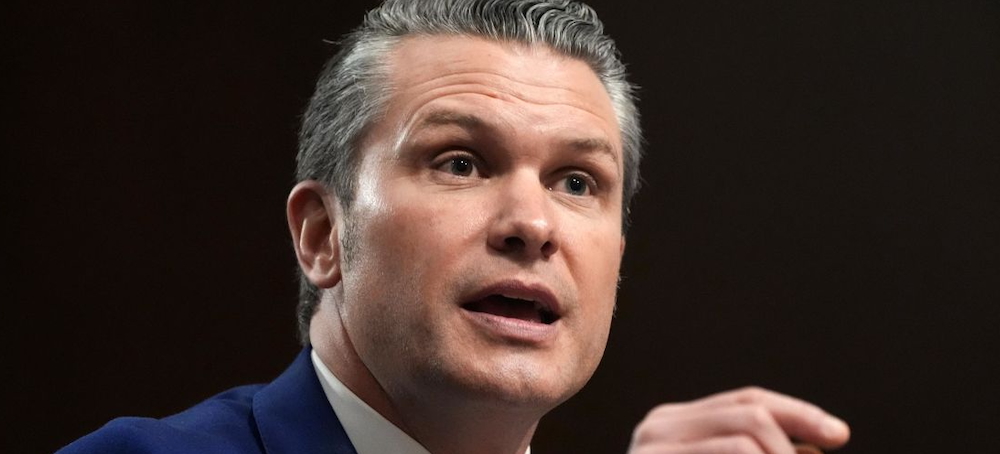 Defense Secretary Pete Hegseth. (photo: Jacquelyn Martin/AP)
 Pete Hegseth’s Broker Looked to Buy Defence Fund Before Iran Attack
Paul Murphy, Harriet Agnew, Joshua Franklin and James Politi Financial Times
Morgan Stanley wealth manager approached BlackRock about multimillion-dollar investment for US defence secretary
Hegseth’s broker at Morgan Stanley contacted BlackRock in February about making a multimillion-dollar investment in the asset manager’s Defense Industrials Active ETF, the people said, shortly before the US launched military action against Tehran.
The inquiry on behalf of the high-profile potential client was flagged internally at BlackRock, according to the people familiar with the matter.
According to BlackRock, the $3.2bn equity fund, which carries the ticker IDEF, pursues “growth opportunities by investing in companies that may benefit from increased government spending on defense and security amid geopolitical fragmentation and economic competition”.
Its largest holdings include defence conglomerates RTX, Lockheed Martin and Northrop Grumman, which count the US Department of Defense as their biggest customers, as well as data integration specialist Palantir.
Following publication of the FT’s report, Sean Parnell, chief Pentagon spokesperson, wrote on social media site X: “This allegation is entirely false and fabricated. Neither Secretary Hegseth nor any of his representatives approached BlackRock about any such investment.”
BlackRock and Morgan Stanley declined to comment.
Hegseth is among the chief architects of the war in Iran, and also served as one of the Trump administration’s most vocal advocates for the attack on the Islamic republic, often flaunting the US’s military might.
The investment discussed by Hegseth’s broker did not ultimately go ahead as the fund, which launched in May last year, was not yet available for Morgan Stanley clients to buy. Although ETFs are designed to be bought and sold as easily as a stock, their proliferation has meant that most big brokerage and trading platforms only carry a subset of the over 14,000 ETFs in existence.
It is not known whether Hegseth’s broker subsequently found an alternative defence-focused fund to make the investment. ETFs are popular with individual investors because they tend to offer lower fees and more favourable tax treatment than mutual funds as well as being able to buy and sell in and out of them more quickly.
The Nasdaq-listed IDEF fund has risen 28 per cent over the past year, but has not risen on the Middle East war, falling almost 13 per cent in the past month.
While the aborted nature of the approach to BlackRock may have avoided short-term losses, the fact that Hegseth’s broker was prepared to make such an investment when the defence secretary’s own department was preparing to launch a large-scale military campaign is likely to stir controversy.
The discussions about the defence investment come at a time when Wall Street analysts have been scrutinising trades made in financial and prediction markets ahead of decisions the Trump administration takes.
Hegseth has been a champion of the US campaign against Iran, with President Donald Trump identifying the former Fox News television personality as the first in his national security circle to push for war.
While at Fox News, Hegseth earned $4.6mn in salary from 2022 to 2024, according to a disclosure form submitted for his Senate confirmation. He also made nearly $500,000 from two book advances in those years, and $100,001 to $1mn in royalties for each. He also earned almost $900,000 in speaking fees.
His most recent financial disclosure, released in June 2025, showed the defence secretary sold stock in 29 different companies, with values ranging from $1,001 to $50,000 each.