
Pentagon Prepares for Weeks of Ground Operations in Iran
Dan Lamothe Washington Post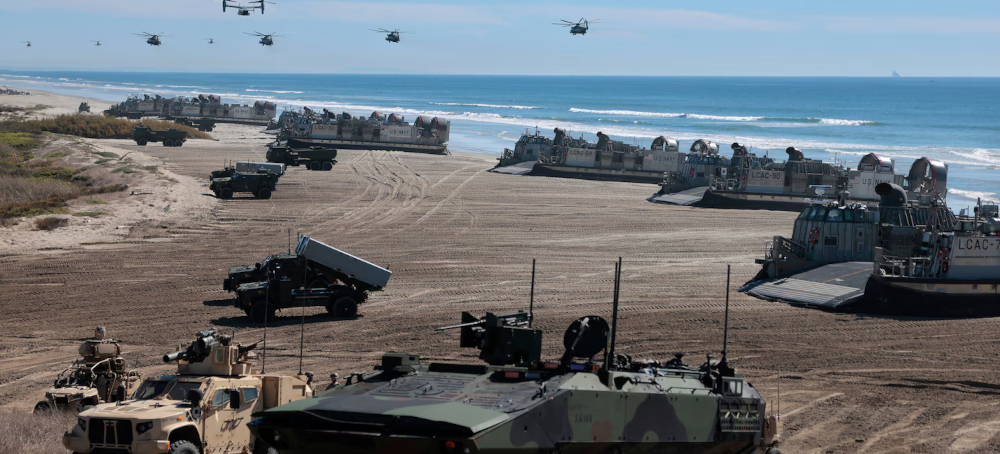 Navy Landing Craft Air Cushions unload equipment onto the beach at Camp Pendleton in Oceanside, California, last year as U.S. Marine Corps V-22 Ospreys and CH-53 Super Stallions fly overhead during an event commemorating the 250th birthday of the U.S. Marine Corps. (photo: Mario Tama/Getty)
 Pentagon Prepares for Weeks of Ground Operations in Iran
Dan Lamothe Washington Post
If President Donald Trump approves the plans, such an effort would mark a new phase of the war that could be significantly more dangerous to U.S. troops than the first four weeks.
Any potential ground operation would fall short of a full-scale invasion and could instead involve raids by a mixture of Special Operations forces and conventional infantry troops, said the officials. All spoke on the condition of anonymity to discuss highly sensitive military plans that have been in development for weeks.
Such a mission could expose U.S. personnel to an array of threats, including Iranian drones and missiles, ground fire and improvised explosives. It was unclear Saturday whether Trump would approve all, some or none of the Pentagon’s plans.
The Trump administration in recent days has vacillated between declaring that the war is winding down and threatening to amplify it. While the president has signaled a desire to negotiate an end to the conflict, White House press secretary Karoline Leavitt warned Tuesday that if the regime in Tehran does not end its nuclear ambitions and cease its threats against the United States and its allies, Trump is “prepared to unleash hell” against them.
In a statement responding to questions for this report, Leavitt said: “It’s the job of the Pentagon to make preparations in order to give the Commander in Chief maximum optionality. It does not mean the President has made a decision.”
Discussions within the administration over the past month have touched upon the possible seizure of Kharg Island, a key Iranian oil export hub in the Persian Gulf, and raids into other coastal areas near the Strait of Hormuz to find and destroy weapons that can target commercial and military shipping, officials said. One person said that the objectives under consideration would probably take “weeks, not months” to complete. Another put the potential timeline at “a couple of months.”
The Pentagon did not respond Saturday to requests for comment.
Trump, speaking March 20 in the Oval Office, told reporters: “I’m not putting troops anywhere. If I were, I certainly wouldn’t tell you, but I’m not putting troops.”
Secretary of State Marco Rubio, speaking in France on Friday after a gathering of U.S. allies anxious about the war’s mounting economic toll, told reporters that it is “not going to be a prolonged conflict.” He repeated a frequent, if vague, administration assessment that the operation is ahead of schedule, and said the United States “can achieve all of our objectives without ground troops.”
Rubio’s comments followed a report from Axios indicating that the Pentagon is preparing a “final blow” against Iran that could include both ground forces and a massive bombing campaign. Axios and the Wall Street Journal also reported in recent days that the administration is considering deploying another 10,000 ground troops to the Middle East, supplementing those already in the region. The Washington Post was unable to verify those reports.
In the past month, 13 U.S. troops have been killed in action, including six in a plane crash in Iraq, six in a drone attack on Port Shuaiba in Kuwait, and one in an attack on Prince Sultan Air Base in Saudi Arabia. More than 300 service members have been wounded by Iranian drone and missiles in retaliatory attacks targeting U.S. facilities in at least seven countries across the Middle East, including at least 10 who suffered serious injuries, officials said.
The prospect of deploying U.S. combat troops on Iranian soil faces significant opposition among Americans, according to recent polls. One, conducted jointly by the Associated Press and the National Opinion Research Center at the University of Chicago, found that 62 percent of respondents strongly oppose the use of ground troops in Iran, with just 12 percent in favor.
Those polled were split more evenly about whether the U.S. should launch airstrikes against military targets in Iran, with 39 percent opposed and 33 percent in favor.
While there has been significant public speculation about U.S. troops potentially seizing Kharg Island, such a mission comes with significant peril, said Michael Eisenstadt, director of the Military and Security Studies Program at the Washington Institute for Near East Policy. It may be safer, he said, for U.S. forces to lay mines around the island and use it as a pressure point to compel Iran to remove any mines it has laid in the Strait of Hormuz.
“I just wouldn’t want to be in that small place with Iran’s ability to rain down drones and maybe artillery,” said Eisenstadt, a retired Army officer who served in Iraq, Israel and Jordan.
A smarter ground mission, he said, may be for U.S. troops to “clear out” some of Iran’s coastal military sites that pose a threat to commercial and military shipping. Some are near the Strait of Hormuz, a vital oil-shipping route now under threat, and others are likely farther up the coast, he said.
“I think it’s better to not have the troops located in any given place for a prolonged period of time,” Eisenstadt said. “Agility is part of your force protection, if they are moving and doing raids, in and out.”
The 31st Marine Expeditionary Unit, made up of about 2,200 U.S. sailors and Marines, was ordered to the region in recent weeks. It has significant capability to conduct such missions but faces logistical limitations in how long it can fight without additional supplies, said a retired senior military officer familiar with the unit’s operations.
Kharg Island is Iran’s most significant territory in the Persian Gulf, the retired officer said, but U.S. military officials have studied other Iranian islands closer to the Strait of Hormuz as potential sites for U.S. operations.
Iran’s Islamic Revolutionary Guard Corps, an elite paramilitary force, is likely to dig in and fight, the retired officer said, and those fighters could use Kharg Island’s valuable oil infrastructure there as part of their defense against U.S. forces.
Another former senior defense official familiar with the U.S. military’s plans for a ground campaign in Iran said they are extensive. “We’ve looked at this. It’s been war-gamed,” the official said. “This is not last-minute planning.”
Seizing Iranian territory will embarrass the Iranian regime and create valuable bargaining chips in future negotiations, this official said. The biggest challenge, the official added, will be protecting any U.S. forces holding territory.
“You’ve got to provide cover for the people on Kharg Island,” the official said. “That’s the difficult task. Seizing it is not difficult. Protecting your guys once they are there is.”
While Democrats are almost universally against the war in Iran, Trump’s Republican backers in Congress are split on the possibility of ground operations.
Pressed Sunday on NBC News’s “Meet the Press” as to whether he would support Trump putting boots on the ground in Iran, Sen. James Lankford (R-Oklahoma) did not answer conclusively but appeared to favor the use of Special Operations forces.
“That depends on what boots we’re putting on the ground, in that sense,” Lankford said. “If this is special forces to be able to carry out a specific operation — get in, get out — that’s very different than a long-standing occupation.”
Rep. Derrick Van Orden (R-Wisconsin), a staunch supporter of the president and a retired Navy SEAL, told reporters Thursday that he has been “100 percent crystal clear from the beginning” that he is against putting troops on Iranian soil.
“The answer is no,” Van Orden said. “We can achieve the strategic goals that Donald Trump wants to achieve without doing that.”
Rep. Nancy Mace (R-South Carolina) said on social media that after attending a House Armed Services Committee briefing about the war, “I will not support troops on the ground in Iran.”
Other lawmakers have urged the president to press forward. Sen. Lindsey Graham (R-South Carolina) has called for U.S. forces to seize Kharg Island, drawing condemnation from lawmakers on both sides of the aisle after making a comparison to how U.S. troops seized the Pacific island of Iwo Jima during World War II — while suffering about 6,800 fatalities.
“We did Iwo Jima, we can do this,” Graham said in an interview on Fox News last weekend. “My money’s always on the Marines.”