
Pardon Me
Ruth Marcus The New Yorker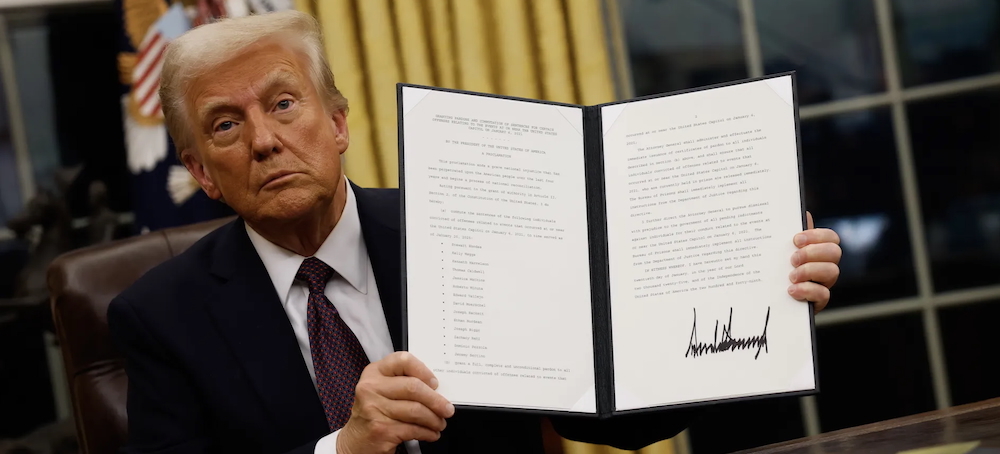 President Trump signs executive orders in the Oval Office. (photo: Anna Moneymaker/Getty Images)
 Pardon Me
Ruth Marcus The New Yorker
For some wealthy offenders, clemency is just a golf game—or a million-dollar plate at Mar-a-Lago—away.
Now, in an only-in-Trump’s-America turn, Blagojevich has become a pardon lobbyist. His client is Anne Pramaggiore, who was once one of the most prominent women in Chicago: the C.E.O. of Commonwealth Edison, the state’s largest utility; the chair of the board of the Federal Reserve Bank of Chicago; and a benefactor of the Art Institute of Chicago, the Lincoln Park Zoo, and the Chicago Urban League. In January, Pramaggiore reported to a federal prison in Marianna, Florida, to serve a two-year sentence for her role in a scheme to provide no-show jobs to associates of Michael Madigan, the long-serving speaker of the Illinois House of Representatives and, before his own conviction on corruption charges, perhaps the most influential politician in the state. At the time, Pramaggiore was appealing her conviction, and she stood a reasonable chance of winning. (A Supreme Court ruling had wiped out the basis for part of the conviction, and the foundation for the remaining charges was shaky.) But, in Trump 2.0, the courts are just one route to freedom, and not necessarily the swiftest. So Pramaggiore had also turned to lobbyists in the hope of a Presidential intervention, eventually paying them a total of nearly five hundred thousand dollars. Two hundred and thirty thousand went to Blagojevich, according to federal lobbying reports.
In several months of reporting on pardons during the second Trump Administration, I reached out to dozens of lawyers, lobbyists, pardon recipients, and Administration officials, most of whom declined to be named, if they responded at all. Not Blagojevich, who returned my phone call with alacrity. “Put me on the record, because Anne Pramaggiore is one thousand per cent innocent,” Blagojevich insisted when we first spoke, in late February. “She’s a victim of a terrible injustice, inflicted on her by a system in Illinois that’s dirty, rotten, and corrupt.” (Pramaggiore was indicted in November, 2020, during Trump’s first Administration, and his second Administration has defended the conviction on appeal.)
In pursuit of clemency for Pramaggiore, Blagojevich said, he met with multiple players in the world of pardons under Trump: Ed Martin, the Stop the Steal activist who was installed in the position of pardon attorney after his nomination to be the U.S. Attorney for the District of Columbia tanked; Alice Johnson, who was named to the newly created role of White House pardon czar a half-dozen years after Trump, during his first term, commuted her life sentence, for cocaine trafficking, at the behest of Kim Kardashian; and Sean Hayes, a former Republican congressional staffer, who oversees pardons as deputy White House counsel. The ultimate decider, of course, is Trump himself. “We’re trying to build a coalition of support to bring this to President Trump’s attention,” Blagojevich told me. “It’s not so easy. He’s the busiest person in the world.” To make the case for Pramaggiore, Blagojevich brought in Dershowitz, a Trump confidant. “The two of us, maybe, potentially, can at one point go see President Trump and talk to him about this, when the timing’s right,” Blagojevich said.
Before Blagojevich could get in to see Trump, Pramaggiore’s case took an extraordinary turn. On April 14th, it was argued before the federal appeals court in Chicago; that day the panel of judges granted Pramaggiore a new trial and ordered her released right away. For Blagojevich, though, the pardon effort isn’t over. He is hopeful that Trump will still intercede. “I would ask that he does for her what he did for me,” Blagojevich said on a phone call after Pramaggiore’s release.
Unlike his predecessors, who tended to delay dispensing pardons until their final months in the White House, Trump plunged into the process in the first hours of his second term. “Most Presidents sit there and allow injustices to linger while innocent people are stuck in prison, or people who may have done wrong, who’ve been over-sentenced, are treated mercilessly and have to sit and wait,” Blagojevich said. “President Trump is very different. He sees something wrong, and he works to get it done and undo the wrong.”
Under previous Presidents, pardon seekers were expected to wait at least five years after serving their sentences and to demonstrate remorse for their actions. With Trump, no wait—and no remorse—is required. Nor is conducting a previously standard F.B.I. background investigation. On January 20, 2025, his first day back in office, Trump made good on a campaign pledge to pardon the January 6th defendants. Calling them “our great hostages,” Trump pardoned around fifteen hundred of them, effectively erasing the largest investigation in the history of the Justice Department. One of those pardoned was serving a twenty-year sentence for blasting bear spray into the mask of a police officer and using a crutch to bash another officer in the head. Another pardoned rioter, sentenced to twelve and a half years, stole a Taser and shocked an officer with it twice, giving him a heart attack. The next day, Trump fulfilled another campaign promise: to pardon Ross Ulbricht, the founder of the online black market Silk Road, who was convicted of distributing narcotics and conspiring to launder money, and was given two life sentences and forty years. “The scum that worked to convict him were some of the same lunatics who were involved in the modern day weaponization of government against me,” Trump posted on Truth Social.
Trump’s first-term pardons were focussed, in part, on undoing the work of the special counsel Robert Mueller, whose investigation into the Trump campaign’s dealings with Russia plagued his Presidency. Trump pardoned his former national-security adviser Michael Flynn after Flynn pleaded guilty—twice—to lying to the F.B.I. about a conversation with the Russian Ambassador during Trump’s first Presidential transition. He pardoned his former campaign chairman Paul Manafort after Manafort’s conviction for, among other things, hiding millions of dollars in offshore accounts and failing to register as a foreign agent for Ukraine. Trump pardoned his longtime ally Roger Stone, who was convicted of witness tampering and lying to Congress, and he pardoned the former White House strategist Steve Bannon before Bannon stood trial for siphoning funds from a campaign to build a border wall.
As with much else involving Trump’s two Presidencies, his first-term performance appears restrained in retrospect. During the first year of his first term, Trump granted a single pardon and commuted a single sentence. Similarly, Joe Biden, Barack Obama, George W. Bush, and Bill Clinton issued no pardons or commutations during their first year in office. Trump, in his first full year back in power, dispensed eighty-eight pardons and twenty-three commutations—not including the January 6th rioters or seventy-seven individuals preëmptively pardoned for any crimes they may have committed during the 2020 election. The theme of the second-term pardons has been rectifying the purported weaponization of the Justice Department under Biden’s Attorney General, Merrick Garland. Trump “was very clear when he came into office that he was most interested in looking at pardoning individuals who were abused and used by the Biden Department of Justice and were over-prosecuted by a weaponized D.O.J.,” Karoline Leavitt, the White House press secretary, has explained.
Rachel Barkow, a law professor at New York University who specializes in Presidential clemency, told me, of Trump’s use of the pardon power, “It’s part of his carrot-and-stick approach—you’re his enemy, he’s going to prosecute you. You’re Jim Comey, you’re Tish James, he’s going to investigate your mortgage application. He’s going to do everything he can to bring you down. Whereas, if you’re a January 6th person, you support his family’s crypto business, you do anything to support him, he will give you a pardon. We’ve never seen anything like this before in history.”
The pardon power was intended, the Supreme Court has said, to promote “the benign prerogative of mercy.” Some of Trump’s pardon recipients appear worthy—the White House pointed me to, among others, a sex-trafficking victim who’d been convicted in an extortion scheme run by her abusers—but, in one instance after another, this President has directed clemency toward political allies, celebrities, and fraudsters. Trump commuted the sentence of the former congressman George Santos (“Good luck George, have a great life!” the President wrote on Truth Social) and pardoned the reality-TV stars Todd and Julie Chrisley, who’d been convicted of bank fraud and tax evasion. Matt Gaetz, the disgraced former congressman and a failed nominee for Attorney General, used his show on One America News Network to press Trump to pardon the former Honduran President Juan Orlando Hernández, who was convicted of drug trafficking in what Trump labelled a “Biden setup.” The Trump confidante Laura Loomer weighed in on behalf of Rabbi Joseph Schwartz, a New Jersey nursing-home owner convicted of defrauding the government of thirty-eight million dollars by failing to pay employment taxes. Trump pardoned both men last year. (In one astonishing twist, a lobbyist named Joshua Nass, who received a hundred thousand dollars as part of the effort to secure the Schwartz pardon, was arrested in March and charged with having “plotted the violent extortion of one of his own clients,” apparently Schwartz, who Nass claimed had failed to pay him an additional five hundred thousand dollars.)
Trump has pardoned people charged by his own Justice Department. One such instance, as reported by the Wall Street Journal, followed a golf outing with the former congressman Trey Gowdy, who asked Trump to help him move up a meeting with Justice Department prosecutors and ended up with a full pardon for his client. In a first for any President, Trump has granted clemency to corporations, pardoning one company and commuting the sentence of another. He has even purported to have pardoned an individual convicted of a state crime: Tina Peters, a former county clerk in Colorado who was convicted of tampering with voting machines in 2020. Martin, the pardon attorney, had promised in a post on X, “Tina, we are coming for you, M’am.”
Trump’s chief of staff, Susie Wiles, was reportedly blindsided by the pardon of Hernández and attempted to put a pause on pardons late last year. She was said to be concerned about the haphazard nature of the process and the huge sums being paid to lobbyists and attorneys. “Susie does not like this,” one person familiar with the pardon process told me. “Pardons are rarely a good news story.” The flow has slowed recently: this year, there have been eight commutations and twenty pardons but none, as of late April, since February.
For pardon supplicants, the surest way to the President’s signature is to tap into his sense of victimhood. As one lawyer who works on pardon cases explained to me, “Is this a prosecutor that the President hates? Is this a judge the President hates? Everything about him seems to be personal, and so you need to take that approach and view this as personal grievances. He doesn’t really care about your case, but he’s happy to exercise his personal grievances through your case.”
Trump’s pardon spree may have happened in any event, but it was facilitated, as a political matter, by Biden’s decision to pardon his son Hunter. During Biden’s truncated reëlection campaign, he repeatedly promised that he would not pardon Hunter, who, in June, 2024, was convicted of illegally possessing a gun and went on to plead guilty to failing to pay income taxes. Not long after Trump was elected, Biden abandoned his pledge, asserting that his son had been “selectively and unfairly prosecuted” by Biden’s own Justice Department. The pardon was remarkably broad: it covered any offenses that Hunter “may have committed” during an eleven-year period. Biden followed up with preëmptive pardons for his siblings and their spouses, who were not under investigation. He also took the unusual step of issuing preëmptive pardons to current and former officials who were potential targets of the incoming Administration, including the former chief medical adviser Anthony Fauci, the former chairman of the Joint Chiefs of Staff General Mark Milley, and members and staff of the House January 6th committee, including the former representative Liz Cheney. Liz Oyer, who served as pardon attorney under Biden, told me that, in her view, Biden’s actions “laid the groundwork for this narrative that Trump has tried to spin—that this is just what all Presidents do.” (According to the Journal, Trump recently promised pardons to “everyone who has come within two hundred feet of the Oval.” Leavitt suggested this was a joke.)
The role of the pardon attorney is to review requests for pardons and commutations and transmit recommendations to the President. During the Biden years, Oyer told me, the work had been “very frustrating.” Thousands of people were serving lengthy prison sentences under mandatory-minimum laws that Biden had championed during his Senate days, but Oyer found his Administration reluctant to intervene. “There was a lack of political courage in the White House,” she said.
The frustrations of working with the Trump Administration were of a different magnitude. Oyer says that she was never told, despite repeated requests, whom she should deal with in the White House counsel’s office. She recalled that she learned about the January 6th pardons from a news alert. “I started getting frantic calls from people in the Bureau of Prisons saying, ‘We’re being told we need to release four hundred people tonight, and facilities are reporting that families are coming in their cars and knocking on doors.’ ”
The Trump Justice Department assigned Oyer a task outside the office’s normal scope. It wanted her to look into restoring gun rights to individuals whose previous convictions made them ineligible to possess firearms. Oyer duly assembled a roster, which was eventually whittled down to nine people who had already been vetted and had committed nonviolent crimes. Then she was asked to add a tenth: Mel Gibson. The actor had pleaded no contest, in 2011, to a domestic-violence misdemeanor for assaulting his ex-girlfriend; she said she’d been left with two broken teeth and a black eye. According to Oyer, an aide to Todd Blanche—then the Deputy Attorney General, now the acting Attorney General—told her, “We have to grant relief to Mel.” In fact, Oyer’s assent wasn’t needed; the Attorney General has the authority to take this action. “I believe that my recommendation was sought because it would give a veneer of legitimacy to what was really a political favor for a friend of the President,” Oyer told me. In early March, she submitted a memo that included Gibson as a possible candidate but declined to recommend restoring his gun rights. That very day, she was pulled out of a meeting by her deputy and told that security officers were waiting in her office to present her with termination papers. The following month, the Justice Department announced that Gibson’s gun rights would be reinstated. (A senior Justice Department official denied that Oyer was pressured to recommend Gibson or that she was fired because of the incident.)
“Trump has totally upended the clemency system as we know it,” Oyer said. “There is no path forward for regular people who have merit-based claims to clemency. And, at the same time, there’s a booming pardon economy where—if you’ve got inside access or if you have the money to spend to get the right lawyer or lobbyist in place—you can essentially buy a pardon. If you can pay to attend one of these million-dollar-a-plate dinners at Mar-a-Lago, or if you can make a gigantic donation to Trump’s political interests, or if you can fund his crypto business, then you can get a pardon.”
Oyer notes that Trump’s pardons take a financial toll, in addition to a moral one. On her Substack, “Lawyer Oyer,” she maintains a running total of the pardons’ cost to the federal government, in fines and forfeitures, and to victims, in restitution. Trump’s pardons, Oyer estimates, have erased at least one and a half billion dollars owed by those convicted of crimes.
The White House insists that money plays no role in Trump’s pardons. The evidence suggests otherwise. “If you’re a wildly rich guy who’s looking for a pardon, giving a contribution is probably the single best way to elevate your brand,” one Republican lobbyist told me. In 2023, Trevor Milton, the founder of an electric-and-hydrogen-vehicle startup called Nikola, was sentenced to four years in prison for defrauding investors; his supposedly “fully functioning” prototype had been towed to the top of a hill and filmed rolling down the slope. Trump’s “pardon of innocence,” as Milton called it, not only excused him from serving time (he had been free on bail while appealing the conviction) but relieved him of having to pay restitution to those he defrauded, a sum that federal prosecutors claimed amounted to more than six hundred and sixty million dollars. “There was real loss to real people who listened to Mr. Milton and invested in Nikola because of what they heard from him,” the U.S. district judge overseeing Milton’s case said.
Before the 2024 election, Milton had contributed relatively small sums to political candidates. He gave fifteen hundred dollars to Trump during the 2016 campaign cycle, a thousand in the 2020 cycle, and ten thousand in 2022. In the fall of 2024, while Milton was appealing the conviction, he and his wife, Chelsey, contributed more than $3.6 million to Trump and other Republican candidates and committees, according to Federal Election Commission records. The Miltons also gave nearly a million dollars to Robert F. Kennedy, Jr., after he endorsed Trump. Milton—who had been represented for years by Brad Bondi, the brother of the former Attorney General Pam Bondi—received a pardon from Trump in March, 2025. (A spokesman for Milton said that Brad Bondi was “not involved in any form or fashion in the pardon process.”) “They say the thing that he did wrong was he was one of the first people that supported a gentleman named Donald Trump for President,” Trump said then. When the President called Milton to inform him of the pardon, Milton recalled, Trump told him, “You’re clean, you’re cleaner than a baby’s bottom, and you’re cleaner than I am, Trevor.”
Today, Milton is the C.E.O. of SyberJet Aircraft, an Arizona-based company, which claims that a new nine-seat jet will be the fastest of its kind. (“SyberJet is pushing the limits of light jet aviation in ways no other manufacturer is,” the company’s website says.) I wrote to Milton to ask about his pardon and his ramped-up political giving. “I was never offered a pardon until I received it,” he wrote in response. “Never bought a pardon. I never offered to donate for a pardon. I was never asked to donate.” Shortly afterward, the Journal reported on a multimillion-dollar lobbying campaign that SyberJet was conducting, which included sponsoring the lavish SyberJet Lounge at the Kennedy Center. “I walk into meetings now, and I’ll get high fives from the most wealthy people in the world,” Milton said. “They’re, like, ‘Welcome to the club. You can withstand the fire. We can trust you now.’ ”
Another recent Trump pardon beneficiary is Paul Walczak, from Palm Beach Gardens, Florida, whose family owned nursing homes. On November 15, 2024, ten days after Trump’s reëlection, Walczak pleaded guilty to failing to pay withholding taxes for his employees. Prosecutors argued that he should face a sentence of between five and six years. According to their sentencing memorandum to the judge, Walczak “used the funds to enrich himself,” purchasing a two-million-dollar yacht and spending corporate funds at Bergdorf Goodman, Cartier, and Saks. In addition, the memorandum continued, “when the IRS persisted—refusing to allow him to simply walk away with the millions of dollars he took from his employees under the guise of complying with the tax code—the Defendant tried to hide his personal wealth by starting a new business under the name of his then twenty-year-old daughter.”
After pleading guilty, Walczak agreed to pay the taxes and asked for leniency. But, prosecutors said, “awarding a lesser sentence to a defendant simply because he is wealthy enough to pay back millions of dollars after being caught is not justice.” Rather, they wrote, “to maintain confidence in the justice system, it must be the case that nobody can pay his or her way out of jail.”
Unbeknownst to prosecutors, Walczak was maneuvering to do just that. Even before Trump returned to office, Walczak’s lawyers had prepared a clemency petition that cited, among other things, the millions of dollars that Walczak’s mother, a conservative activist named Elizabeth Fago, had raised for Trump and for Republican causes. During the 2020 campaign, the petition noted, she’d hosted a Trump fund-raiser, attended by Donald Trump, Jr., where a diary stolen from Biden’s daughter Ashley was circulated. The petition highlighted support for Walczak from Trump, Jr., and his then girlfriend, Kimberly Guilfoyle. It made the argument, sure to appeal to Trump but unsupported by the evidence in the case, that prosecutors had singled out Walczak because of his mother’s Republican ties. And, to bolster Fago’s claim that her son was being punished for her political activity, it noted Biden’s assertion that he’d been compelled to pardon Hunter because of selective prosecution by his Justice Department.
As Walczak’s sentencing date approached, Fago received an invitation to a million-dollar-per-person fund-raiser for maga Inc., Trump’s super pac. The “candlelight dinner,” to be held on April 4, 2025, at Mar-a-Lago, would feature President Trump. Fago’s largest previous single donation had been a hundred thousand dollars to the Republican National Committee, in 2002, and her political giving for the 2024 election cycle totalled a little more than six hundred dollars. maga Inc. reported receiving a million-dollar check from Fago on April 3rd. The next evening, she seized the moment to make her case to Trump, according to a person familiar with the event. Afterward, the President spoke to Wiles and his top fund-raiser, Meredith O’Rourke, issuing instructions: “Get it done.” The following week, Walczak was sentenced to eighteen months in prison and ordered to pay more than four million dollars in restitution. But before he had to report to prison the White House announced the pardon. The White House did not respond to a detailed request for comment about the pardoning of Walczak and others. Fago, through an attorney, declined to comment, and Walczak didn’t respond to an e-mail. An Instagram post by Walczak’s half brother showed Walczak celebrating with family members. In one photo, Fago has wrapped her arms around her beaming son. He is wearing a red baseball cap emblazoned with the words “Make Paul Great Again.”
To avoid concentrating too much power in any single branch of government, the architects of the Constitution crafted an intricate system of checks and balances. Pardons, derived from the British monarch’s ancient “prerogative of mercy,” represent a deliberate exception. Article II, Section 2, Clause 1 provides that the President “shall have Power to grant Reprieves and Pardons for Offences against the United States, except in Cases of Impeachment.” As the Supreme Court described it in an 1866 case, the pardon power “extends to every offence known to the law, and may be exercised at any time after its commission, either before legal proceedings are taken or during their pendency or after conviction and judgment.”
For a power so sweeping, the President’s pardon authority received little attention during the debates over the Constitution. The first two draft proposals did not include a pardon power; that came later, as part of a plan proposed by Alexander Hamilton. “Humanity and good policy conspire to dictate, that the benign prerogative of pardoning should be as little as possible fettered or embarrassed,” Hamilton argued in Federalist No. 74. “The criminal code of every country partakes so much of necessary severity, that without an easy access to exceptions in favor of unfortunate guilt, justice would wear a countenance too sanguinary and cruel.” He and others posited that a single individual, the President, would wield the pardon power more responsibly than if authority—and therefore blame for bad decisions—were spread more widely.
The delegates at the Constitutional Convention, well aware of abuses of pardons under the English monarchy, worried about the potential for corruption. One of them, Roger Sherman, suggested that the Senate be required to concur in grants of clemency; he received support from only his home state of Connecticut. Toward the end of debate, Edmund Randolph, Virginia’s governor, moved unsuccessfully to bar pardons in cases of treason, expressing concern that the President “may himself be guilty” and that the “Traytors may be his own instruments.” (A counter-argument was that impeachment would protect against such abuses.) In hindsight, the critics of untrammelled pardon authority had a point. The President “ought not to have the power of pardoning, because he may frequently pardon crimes which were advised by himself,” George Mason argued at the Virginia ratifying convention, in 1788. “It may happen, at some future day, that he will establish a monarchy, and destroy the republic. If he has the power of granting pardons before indictment, or conviction, may he not stop inquiry and prevent detection?”
On May 29, 1865, Andrew Johnson granted pardons to most former Confederates, an act that helped restore them to political power and frustrated the goals of Reconstruction. But thousands, including high-ranking officers, were at first excluded from the mass amnesty, so Johnson’s tenure also featured the emergence of “pardon brokers,” who promised to help desperate Confederates seeking to recover property seized by Union forces. The typical fee was a hundred and fifty dollars. The Johnson White House insisted that such services had no effect. “The President declares that any intimation that money can assist a petition is a gross insult of his whole office,” Johnson’s pardon clerk wrote.
More recent Presidents have issued their own share of questionable pardons. On Christmas Eve, 1992, the departing President, George H. W. Bush, pardoned the former Secretary of Defense Caspar Weinberger and five other former officials connected to the Iran-Contra scandal. The pardons led the independent counsel Lawrence Walsh to suggest that the President, who was mentioned in Weinberger’s notes, was trying to shield himself from being drawn into any court proceedings. “In light of President Bush’s own misconduct, we are gravely concerned about his decision to pardon others who lied to Congress and obstructed official investigations,” Walsh said.
Bill Clinton’s pardons—he issued a hundred and forty on his final day in office—were even more squalid. A House investigation found that Clinton’s half brother, Roger, “engaged in a systematic effort to trade on his brother’s name,” receiving hundreds of thousands of dollars in payments from individuals seeking pardons. Hillary Clinton’s brother Hugh Rodham, a Florida lawyer, also received nearly four hundred thousand dollars from two clients for whom he obtained last-minute pardons. Most infamously, Clinton pardoned Marc Rich, a financier who’d fled the country rather than stand trial on charges of tax evasion. Rich’s ex-wife Denise, who’d lobbied Clinton to grant the pardon, had contributed a million dollars to Democrats and four hundred and fifty thousand dollars to Clinton’s Presidential library. “It’s clear that none of these grants of clemency would have been issued on the merits,” the House committee conducting the investigation concluded. “Only by capitalizing on relationships between President Clinton and individuals close to him were these petitioners able to obtain grants of clemency.”
Frank Bowman, an emeritus law professor at the University of Missouri, has recently completed a book on the history of pardons. He faults Johnson for undermining Reconstruction, Clinton for his questionable eleventh-hour actions, and Biden for shielding family members. But for all the distasteful pardons of past Presidents, Bowman told me, Trump is in a sordid class by himself. “On the Trump side, you can keep going for literally dozens, maybe hundreds, of what-abouts. And, on the other side, you’re going to keep coming back and saying, ‘What about Marc Rich?’ ‘What about Hunter Biden?’ ” Bowman said. “The first answer to whataboutism is one of scale. Nothing on Trump’s scale has ever happened at any point in American history, period.”
Trump’s brazen use of the pardon power has generated a Washington growth industry—pardon lobbyists and lawyers, who tout their connections with Trump Administration officials. Some of the biggest reported payments have occurred in cases where the clemency bid has not succeeded. Keith Schiller, Trump’s former bodyguard and later his director of Oval Office operations, disclosed that his lobbying firm, Javelin Advisors, was paid a million dollars to secure a pardon for Fred Daibes, a New Jersey businessman convicted in a bribery scheme in which he gave gold bars to the former senator Bob Menendez. No pardon has been granted. Robert Travers, a lawyer for Daibes, issued a statement last fall that indicated some frustration with the outcome: “Fred Daibes has not worked with Keith Schiller or Javelin since June of this year and he is no longer engaged with them.” (In response to a lengthy list of questions about Trump’s pardons, Leavitt, the press secretary, sent the following statement: “President Trump exercises his constitutional authority to issue pardons and commutations at his discretion. Anyone spending money to lobby for pardons is foolishly wasting their money.”)
Some lawyers and lobbyists have reached out, unsolicited, to people who have been indicted or convicted, dangling the prospect of making their problems disappear. “Every one of my clients is being approached by these scumbags,” one prominent criminal-defense lawyer told me. “They identify people who are under the gun, who’ve been convicted, who have money, and they say, ‘I can make this happen.’ ” Another prominent criminal-defense lawyer said, “There’s a category of people who just sell the connection. It’s really so bald-faced—they are just so clear that they can get it done. They say who they’re friends with. It’s often White House counsel. And they ask for a million dollars, and another million dollars if it’s successful.”
Ches McDowell, a bearded, baby-faced man with a penchant for bespoke suits, chewing tobacco, and ostrich-skin boots, isn’t one of those cold callers—business at his firm, Checkmate Government Relations (so named “because we win,” he told me), is too good for that. McDowell, a North Carolina lobbyist who set up shop in Washington in May, 2025, reported an astonishing twenty-two million dollars in lobbying revenue last year. His clients have spanned the corporate landscape, from Fortune 500 firms such as Eli Lilly, General Dynamics, and Philip Morris to newer entrants on the Washington scene, such as the GEO Group (which operates detention centers), the Sports Betting Alliance, and Trevor Milton’s SyberJet.
Most Washington lobbying shops are decorated in the style of an upscale airport lounge. McDowell’s features taxidermy—a seven-hundred-pound stuffed bear that he shot himself, a snarling mountain lion—plus a plaque with the Wi-Fi password, which refers, cheekily, to Trump’s claim of having won the Presidency three times. McDowell, the son of two staunchly Democratic pastors, met Trump, Jr., shortly before the 2016 election and now counts him as a close friend. But McDowell said that they do not mix business and friendship. “I’ve never, never once, discussed a lobbying issue that I’m hired to work on with Don,” he told me.
McDowell squeezed me in for an interview while being driven, in his Cadillac Escalade, to his Georgetown tailor for a fitting. “We’re burning K Street to the ground and rebuilding,” he said, referring to the traditional address of Washington lobbying shops. “The model that we brought to D.C. was ‘We’re going to get it done whatever it takes, no matter how much political capital we have to burn.’ ” McDowell’s team includes a nephew of Robert F. Kennedy, Jr., and the son of Trump’s campaign manager Chris LaCivita.
Among McDowell’s achievements is obtaining a pardon for Changpeng Zhao, the billionaire founder of Binance, a cryptocurrency exchange. In 2023, during the Biden Administration, Zhao pleaded guilty to failing to implement an effective anti-money-laundering program. The company agreed to pay $4.3 billion, one of the largest corporate penalties in U.S. history, and to subject its operations to strict monitoring; Zhao was fined fifty million dollars and served a four-month sentence. The technical-sounding nature of these offenses belies the seriousness of the misconduct, which allegedly helped Hamas terrorists, Russian drug traffickers, and other criminals move billions of dollars. “Binance turned a blind eye to its legal obligations in the pursuit of profit,” then Treasury Secretary Janet Yellen said when the guilty pleas were reached. Binance began its formal lobbying campaign soon after Trump’s second Inauguration, hiring the law firm Baker & Hostetler. It reported being paid three hundred and thirty thousand dollars last year for lobbying on “financial services policy issues” and “executive relief”—in other words, pardons.
In the meantime, the Trump family had ventured into the cryptocurrency industry, with a company called World Liberty Financial, which launched in September, 2024. An entity owned by the Trump family controls around forty per cent of the business. “It’s one of the more successful things we’ve ever done,” Eric Trump told the Times last year. Binance played a key role in insuring that success. According to the Journal, Binance arranged for an investment firm owned by the United Arab Emirates to buy a two-billion-dollar stake in Binance—with the purchase made using World Liberty Financial’s stablecoin, USD1. This transaction gave World Liberty Financial access to an enormous new pile of cash, one that could generate an annual income of eighty million dollars. (World Liberty Financial has denied that Binance played a role in having the deal financed with USD1.)
Then, last September, Binance brought on McDowell’s Checkmate to lobby the Trump Administration for a pardon and on cyber-policy issues. Checkmate has been paid more than $1.3 million for its services. For McDowell, neither Ed Martin, the pardon attorney, nor Alice Johnson, the pardon czar, was necessary to make his case. Instead, he went to Bo Hines, a fellow North Carolinian, who had recently served as the executive director of Trump’s crypto council. McDowell’s pitch to him was simple: the President’s crypto policy required undoing the excesses of the Biden Administration. “I felt like that was an easy sell,” McDowell said.
A few weeks later, McDowell, en route to a hunting trip with Trump, Jr., joined the President’s son at the White House for a ceremony awarding the Presidential Medal of Freedom to Charlie Kirk. At some point, as the Journal first reported, McDowell, finding himself one on one with the President, took the opportunity to advocate for Zhao. Trump signed Zhao’s pardon seven days later. Leavitt explained that the President “has officially ended the Biden Administration’s war on the cryptocurrency industry, and I think that’s the message he sent with this pardon.” Trump, for his part, said of Zhao, “I have no idea who he is. I was told that he was a victim, just like I was and just like many other people, of a vicious, horrible group of people in the Biden Administration.”
McDowell’s colorful approach is not the only strategy for pardon lobbying. Adam Katz, an unassuming-looking man who grew up on Long Island, has a law practice that consists mostly of run-of-the-mill commercial litigation and white-collar defense work—a pharmaceutical-company employee facing an overseas bribery investigation, a chemical manufacturer accused of racial discrimination. But during Trump’s first term Katz became a pardon attorney, owing to connections that have served him well in the age of Trump. After graduating from Duke, he met a fellow-alumnus, Andrew Giuliani, the son of the former New York City mayor and Trump ally. Katz went on to represent Rudy Giuliani when he was sued for defamation by two Georgia poll workers, whom he’d accused of election fraud. (A jury awarded them a hundred and forty-eight million dollars.) In law school, at Georgetown, Katz befriended Boris Epshteyn, Trump’s personal senior counsel and longtime close adviser. Katz went on to play a small role advising Trump when the President was sued for defamation and sexual assault by the advice columnist E. Jean Carroll. (In two separate cases, juries awarded Carroll a total of eighty-eight million dollars.)
Katz was on a business trip to Las Vegas, in 2019, when he happened to meet a man named Andres Camberos, a California marijuana entrepreneur. Camberos shared the story of his sister, Adriana, who was about to serve a two-year prison sentence for selling counterfeit 5-hour Energy drinks, portraying her as the dupe of her husband, who had also been convicted in the scheme. Katz offered to try to help and, in January, 2020, he filed a clemency petition on Adriana’s behalf. A month later, Andres made his first significant political contributions, consisting of a hundred thousand dollars spread among Trump-campaign committees and the Republican Party. (Seven months earlier, he had donated twenty-eight hundred dollars to Biden.) Katz brought in Stefan Passantino, a former deputy White House counsel who retained strong ties to Trump world. Marjorie Taylor Greene, a client of Passantino’s, also expressed support for Adriana. The day before Trump left office in 2021, he commuted Adriana’s sentence; she was about halfway through her prison term.
Then, in November, 2024, both Camberos siblings were convicted in a separate fraud scheme, this one involving reselling grocery items and other household supplies. “With the money they made from the scheme, Adriana and Andres Camberos made extensive luxury purchases and investments,” the Justice Department said in a news release. “They bought or financed a Ferrari F12 Berlinetta, a Lamborghini Huracan, and multiple Range Rovers; purchased multiple homes in the San Diego area; purchased a condominium at the beach in Coronado; and put the money in multiple investment accounts.” Adriana said that she hadn’t realized the diversion scheme broke the law; District Judge Cynthia Bashant disagreed. “Ms. Camberos knew exactly what she was doing was illegal,” Bashant said at Adriana’s sentencing. “She developed an elaborate scheme to hide what she was doing. To the extent she testified to the contrary, I find she testified untruthfully.” Adriana was sentenced to a year in prison, Andres to home confinement.
With Trump back in office, Katz and Passantino went to work, this time with an argument tailor-made to appeal to Trump: that vengeful prosecutors had targeted the Camberos siblings for political reasons. The case against them, the pardon petition said, represented “a grave miscarriage of justice against two established business owners who were only prosecuted because President Trump commuted Ms. Camberos’s sentence from a prior conviction in 2021 and Mr. Camberos made a donation to the Trump campaign.” The petition compared the Camberoses’ prosecution to the case brought by New York’s attorney general, Letitia James, against the Trump Organization, arguing that in both cases the supposed victims of the fraud did not suffer any financial harm. In mid-January, Trump granted clemency—and this time went beyond mere commutation. Adriana and Andres Camberos each received a full pardon.
George W. Bush wrote in his memoir, “Decision Points,” about his revulsion at the pardon process. “One of the biggest surprises of my presidency was the flood of pardon requests at the end,” Bush recalled. “I could not believe the number of people who pulled me aside to suggest that a friend or former colleague deserved a pardon. At first I was frustrated. Then I was disgusted. I came to see the massive injustice in the system. If you had connections to the president, you could insert your case into the last-minute frenzy. Otherwise, you had to wait for the Justice Department to conduct a review and make a recommendation. In my final weeks in office, I resolved that I would not pardon anyone who went outside the formal channels.”
Vice-President Dick Cheney pressed Bush to grant clemency to Cheney’s former chief of staff I. Lewis (Scooter) Libby, who had been convicted of perjury and obstructing an investigation into the leak of the identity of a covert C.I.A. officer. “We don’t want to leave anyone on the battlefield,” Cheney argued. Bush commuted Libby’s sentence shortly before Libby was to report to prison, saying that the thirty-month term was “excessive.” But, to Cheney’s great displeasure, Bush balked at granting a full pardon. (That move was left to Trump, in 2018. “I don’t know Mr. Libby,” he said, “but for years I have heard that he has been treated unfairly.”) Bush took the extraordinary step of cancelling a pardon, which he’d given the day before to a New York real-estate developer. He said he had not known that the recipient’s father had contributed more than thirty thousand dollars to Republicans. “It raises the appearance of impropriety, so the President prudently decided not to go through with the pardon,” the White House press secretary Dana Perino said at the time.
For all that, recent Presidents can be faulted as much for their stingy exercise of the pardon power as for its deployment. Oyer, the former pardon attorney, described arriving at her office at seven on the morning of Trump’s second Inauguration, prepared to process Biden’s final pardons and commutations, only to find a disappointingly short list of cases. “I had expected to see more names in there, people who were really deserving,” she said. “It was really absolutely gutting to see how many people were left behind.” Although Biden issued a record number of commutations—more than four thousand—his total of eighty pardons was the second lowest on record, according to an analysis by the Pew Research Center. Only George H. W. Bush granted fewer, seventy-four in all.
Mark Osler, a law professor at the University of St. Thomas, in Minneapolis, oversees a clemency clinic there, supervising a half-dozen law students as they pursue commutations and pardons. Osler developed an interest in clemency after serving as a federal prosecutor in Detroit during the late nineties. His caseload was heavy with crack-cocaine prosecutions that carried long mandatory minimum sentences and fell disproportionately on African American defendants. The punitive approach, he came to believe, conflicted with his Christian faith, in particular the admonition in John 8:7: “Let he who is without sin cast the first stone.” He told me, “I felt the weight of the stone in my hand. I put it down and walked away and did mercy.”
Osler’s clinic is currently seeking a commutation for an eighty-three-year-old Texas man who was sentenced to life in prison without parole, in 1985, for helping run a drug ring. He’s confined to a wheelchair and recently suffered a stroke, but his crimes occurred so long ago that he is not eligible for compassionate release. Another client, this one seeking a pardon, is a Kentucky woman who was sentenced to fifty-seven months, in 1996, for nonviolent drug crimes. She was released in 2001 and has been unable to receive licenses for several professions, including as a physical therapist and a real-estate agent, because of rules that exclude convicted felons.
Osler has watched with increasing frustration as his clients’ petitions go unanswered. He described the pardon attorney as “a zombie office, in the sense that they’re assigning numbers to cases that come in, but it’s not clear that anything’s happening beyond that.” Rather than receiving good or bad news for clients, Osler said, “you simply don’t hear. There’s no up, and there’s no down. And so, when they call from prison or they write, I have to tell them it’s pending. But, really, that means it’s being ignored.”
When I asked Osler which pardons bothered him most, he said, “It’s those that have gone to the people who are fabulously wealthy—these are the people who have been advantaged by so much. With my students, we’ve told the stories of people who are fabulously poor and are being ignored.” Clemency, Osler continued, “has begun to take the form that the worst parts of government have already had, which is to be dominated by lobbying. It’s been O.K., if you are a polluter, to hire people who are connected to the President to inveigh on your behalf and pay them tons of money. That wasn’t how clemency worked. But now that kind of ugly fog has floated over to what’s supposed to be about mercy.”