
Pakistan Can Play the Messenger, Not the Mediator
Bobby Ghosh Substack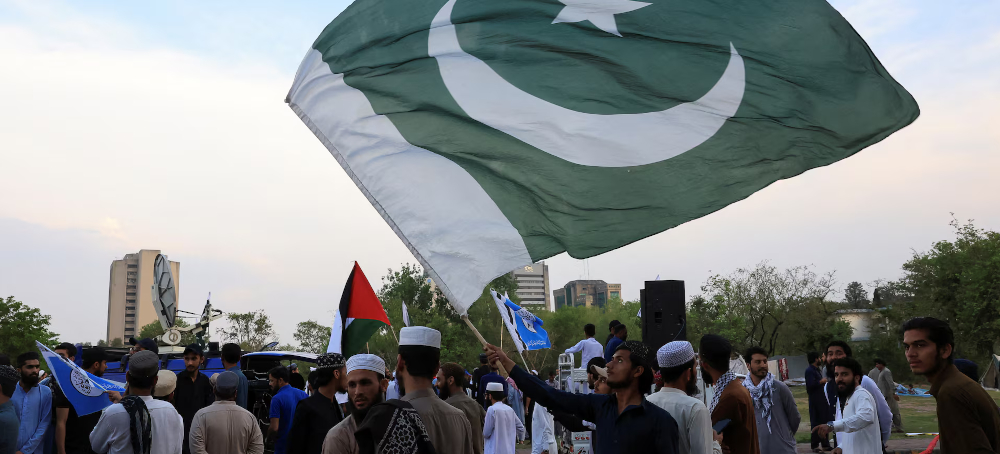 A man waves Pakistan's flag as he along with others gather in support of Pakistan Army. (photo: Reuters)
 Pakistan Can Play the Messenger, Not the Mediator
Bobby Ghosh SubstackALSO SEE: Ghoshworld, Bobby Ghosh on Substack
Islamabad lacks the relationships, the credibility, and the trust that it will take to broker negotiations between the US and Iran.
That is what genuine conflict mediation looks like. What Pakistan is offering in the context of the current war against Iran is something else entirely.
Islamabad is currently presenting itself as the go-between in the war between the US-Israel combine and Iran, now in its fourth week. Prime Minister Shehbaz Sharif has spoken repeatedly with Iranian President Masoud Pezeshkian. Army chief Asim Munir — Field Marshal Munir, to use the title that Trump, who calls him “my favorite field marshal,” seems to enjoy — spoke with the American president directly as Washington announced a five-day pause in strikes on Iranian infrastructure. Pakistan has reportedly ferried Trump’s 15-point ceasefire terms to Tehran. It has offered Islamabad as a venue for direct talks.
Some of this activity has produced results. The five-day pause is not nothing, in a conflict that has already killed Iran’s Supreme Leader, sent missiles raining on six Gulf states, and choked off a fifth of the world’s oil supply through the Strait of Hormuz. Shuttling messages between two parties who will not speak directly to each other is a legitimate and valuable function. Let us give Pakistan its due: in a moment when the architecture of Middle Eastern diplomacy lies in rubble, Islamabad has kept some lines of communication open. That matters.
But there is a significant difference between carrying the mail and negotiating the peace. And Pakistan — for all its eagerness, and all of Trump’s apparent fondness for its army chief — does not have what genuine mediation requires.
Return to Algeria in 1981. What made Algiers the right venue, and Algerians the right mediators, was not geography or goodwill. It was specific people with specific relationships. Algeria’s ambassador in Tehran, Abdelkrim Ghrïeb, had spent years cultivating trust with the new revolutionary government. Algeria’s ambassador in Washington, Redha Malek, had equivalent standing with the Americans. These were not diplomats parachuted in for a photo opportunity; they were men who had been in the room, again and again, long before the crisis erupted. When negotiations hit a wall — as they inevitably did, over the financial terms of releasing frozen Iranian assets — it was the Algerians who invented a solution: rather than forcing the US and Iran to sign a joint bilateral agreement (which neither could stomach politically), they drafted two separate declarations of independent obligations. A legal architecture conjured from nothing, by people trusted enough by both sides to make it stick.
That is what mediators do. They do not merely deliver messages. They diagnose deadlocks, propose solutions neither party has thought of, or dared to suggest. They draw on reservoirs of personal trust, built over years, to push protagonists past the point where pride or paranoia would otherwise stop them.
Pakistan has none of these reservoirs with any of the principals.
Start with the most basic disqualification: Pakistan has no diplomatic relations with Israel. None. A mediator in this conflict needs to speak with all three parties. Pakistan literally cannot pick up an official telephone and call Jerusalem. It is being asked to referee a match in which it cannot acknowledge one of the players.
Its relations with the US, while currently warm — the Munir-Trump bromance is real, if unusual — are historically volatile and institutionally shallow. They run on personal chemistry, not decades of accumulated trust. Chemistry evaporates in a crisis; institutions endure.
Most revealing, however, are Pakistan’s relations with Iran. The two countries share nearly a thousand kilometres of border and a history of calling each other “brotherly” nations while doing decidedly unbrotherly things to each other. As recently as January 2024, Iran launched missile and drone strikes on Pakistani territory in Balochistan, killing civilians. Pakistan expelled the Iranian ambassador, recalled its own, and within days launched retaliatory strikes inside Iran. Ambassadors were eventually returned, the word “brotherly” restored to circulation, but the wound did not disappear. It simply scabbed over.
Iran’s more paranoid factions — and paranoia is the Islamic Republic’s default operating mode, doubly so in wartime — see Pakistan not as a neutral friend but as a Sunni-maximalist power aligned with Riyadh. Last September, Islamabad signed a mutual defense pact with Saudi Arabia, under which an attack on either country is considered an attack on both. From Tehran’s perspective, Pakistan is not offering to mediate between two sides. It is one of the sides.
The more sectarian-minded figures in the Iranian regime go further. They regard the Pakistani military-dominated establishment, which has long marginalised the country’s substantial Shia population, as ideologically hostile. These are not men who will whisper their real red lines to a Pakistani interlocutor at midnight, the way Ghrïeb’s Iranian counterparts once did in Tehran.
And then there is the small — and richly ironic — matter that Pakistan is currently fighting a war of its own. Since February, Islamabad has declared “open war” against neighbouring Afghanistan, launching airstrikes on Kabul and Kandahar in a widening conflict with the Taliban. A country bombing one neighbour is an unusual candidate to broker peace for another. The optics alone should give pause. The logic is worse.
The Iranians will not have forgotten that, The more pointed measure of Pakistan’s limitations is what it did just last summer. First,it formally nominated Donald Trump for the Nobel Peace Prize, praising his “decisive diplomatic intervention and pivotal leadership.” Then, when the Trump administration supported Israel’s 12-day war with Iran, Islamabad reversed course and condemned the attack on Iran as a violation of international law and backed Tehran’s right to self-defence.
This is not the behavior of a principled neutral. It is the behavior of a country desperately managing multiple, contradictory relationships — and not managing them particularly well. Genuine mediators are trusted precisely because they are predictable, steady, and seen by all sides to have no axe of their own to grind. The Nobel nomination stunt, and the whiplash that followed, is exhibit A of why Iran’s hardliners will never see Pakistan as an honest broker.
Alas, the traditional honest brokers of this conflict are no longer available. Oman spent decades building the kind of Algeria-style credibility that allowed it to host US-Iran nuclear talks as recently as February this year, with its foreign minister shuttling between separate rooms in Muscat. The Omanis were trusted by Tehran precisely because the sultanate had a longstanding policy of being friend to all and enemy to none — and because its career diplomats had cultivated Iranian relationships patiently, without fanfare, across multiple administrations. Iran repaid this by bombing Oman anyway. Kuwait and UAE, which once served as back-channels, have similarly had missiles land on their airports and residential towers. Qatar and Saudi Arabia are too implicated on the American side for Tehran to trust. Egypt is practically a satellite of Riyadh.
The landscape of potential mediators has been scorched, almost literally, by Iran’s strategy of horizontal escalation.
That leaves Turkey — imperfect, complicated, prickly, but the most qualified candidate still standing.
Ankara has done something in this conflict that no other non-belligerent has managed: it has maintained genuine credibility with all three principals simultaneously. Erdoğan condemned the US-Israeli strikes as a violation of international law — and in the same breath, his foreign minister Hakan Fidan blamed Iran for the failure of pre-war negotiations and criticized Tehran’s retaliatory strikes on Gulf states. The message was deliberate and carefully calibrated: Turkey is against this war, but it is nobody’s ally in it.
From the first days of the conflict, Erdoğan spoke directly to both Trump and Pezeshkian. Fidan worked the phones relentlessly, speaking to fifteen foreign ministers in the opening 48 hours, maintaining backchannel contact with Iranian Foreign Minister Araghchi throughout. Analysts in Washington note that the Trump administration is “listening to Erdoğan” and that Secretary of State Rubio takes Fidan’s calls seriously — not as a favor, but out of genuine respect.
This is something close to the Algerian model: a state with real, longstanding relationships on all sides, officials who know the interlocutors personally, and enough institutional depth to propose solutions rather than merely transmit grievances.
Turkey has its own interests and anxieties in this conflict — Kurdish actors along its borders, inflation driven by oil prices, Iranian missiles that have grazed its airspace. But these are the interests of a genuine regional power with skin in the game, not the interests of a country trying to curry favor with Washington by flattering its president.
Pakistan’s moment in the spotlight will pass. The envelopes it has carried may have helped buy time — and time, in a conflict this dangerous, is genuinely precious. But time is not peace. When the moment comes for the harder work — for a mediator to sit with an Iranian official at midnight and say, with credibility, I know what they will accept, and I know you can live with it — that call should go to Ankara.
Trump, who has shown he can be swayed by flattery from smaller powers, should resist the temptation. Algeria did not free those 52 Americans by being liked. It freed them by being trusted. There is a difference, and it is everything.