
Oil Prices Could Easily Go Much Higher
Paul Krugman Substack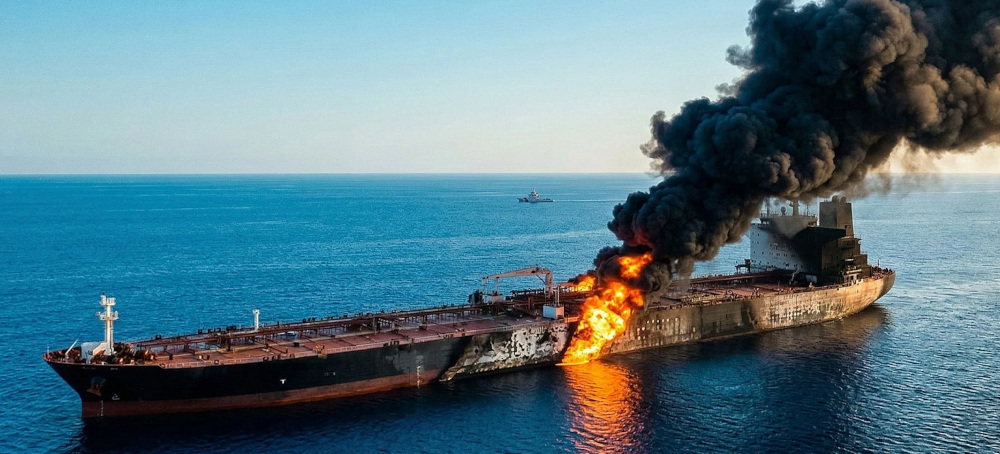 An oil tanker on fire in the Persian Gulf. (photo: AFP)
 Oil Prices Could Easily Go Much Higher
Paul Krugman SubstackOr to put it differently: even after the spike in oil prices we’ve seen, those prices aren’t high enough to cause a global economic crisis. And that’s a reason prices may have to go much, much higher.
The rise in prices since the bombs began falling has evidently come as a huge shock to Trump and company, and they are flailing furiously (and epically.) But as I and many others have pointed out, the U.S. and other major economies are a lot less oil-dependent than they were in the 1970s, and even at $100 a barrel oil prices are not high enough to provoke a major crisis.
In fact, as the chart at the top of this post shows, the real price of oil — the price of oil relative to the prices of everything else, as measured by the Consumer Price Index — isn’t much higher than it was during much of Trump’s first term, when nobody was talking about an energy crisis.
Yet if one looks at the state of global oil supply, it’s extremely dire. Around 20 percent of the world’s normal flow of oil is bottled up inside the Strait of Hormuz — and as we’ve seen in the past day, even tankers and oil facilities inside the Strait are vulnerable to attack. If this blockade persists, it will be a much worse shock to world oil supplies than the 1973 embargo, the 1979 Iranian revolution, or the 2022 Russian invasion of Ukraine.
So what happens if the Strait remains closed for months? It’s a matter of supply and demand. If the quantity of oil supplied to world markets can’t rise — which, as far as we can tell, it won’t until the mullahs decide to let tankers through again — the price of oil will have to rise high enough to reduce the quantity demanded.
And how high would that price have to be? It would have to be high enough to persuade drivers to stop driving, trucks to stop trucking, airlines to stop flying.
In other words, the price of oil would have to rise enough to cause a global economic crisis even though the world is much less oil-dependent than it used to be.
Given time to adjust, the world can conserve oil in many different ways. For example, gas mileage roughly doubled in the decades that followed the 70s oil shocks — and that was before hybrid and electric vehicles. In the long run, the world economy could make do without Persian Gulf oil, at minimal cost in terms of global GDP.
But in the long run we are all dead. In the short run, the economic impact of a sustained loss of Gulf oil could be very ugly. In fact, it would have to get ugly to persuade the world to buy a lot less oil.
I’ve seen some alarmists warn that a long war in the Gulf could lead to oil at $150 a barrel. That looks low to me.