
Netanyahu Could Have Learned His Lesson Last Time He Took Trump to War With Iran
Joshua Leifer Haaretz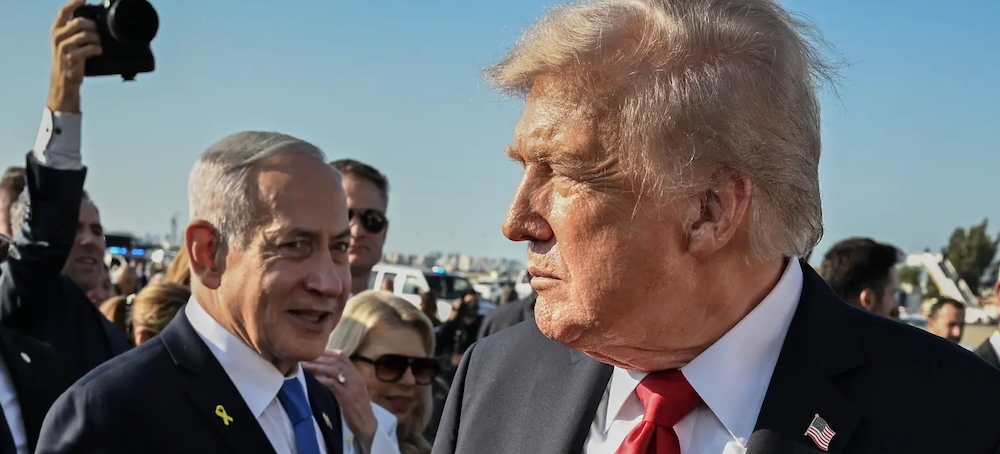 Mr. Trump and Mr. Netanyahu jointly launched war on Iran six weeks ago. (photo: Kenny Holston/NYT)
 Netanyahu Could Have Learned His Lesson Last Time He Took Trump to War With Iran
Joshua Leifer Haaretz
'America is a thing you can move very easily,' the Israeli leader once quipped. But Trump started looking for a way out almost as soon as the fighting began, and Israel's strategic objectives are of little concern to him
But Trump wanted calm. "ISRAEL is not going to attack Iran," he posted on social media. "All planes will turn home, while doing a friendly 'Plane Wave' to Iran."
For Prime Minister Benjamin Netanyahu, this should have been a lesson: The price of military dependence on the United States is obeisance to the dictates of its president, however erratic they may be, and even when those dictates conflict with what are perceived as Israeli interests.
In June, only the matter of retaliation was at stake. Now, as Trump seeks to end the U.S.-Israeli war, the cost of Israel's utter reliance on American firepower is its failure to achieve the objectives Israel's leader set out at the start of the fighting.
The long-term cease-fire being negotiated is poised to leave Israel without the grandiose victory, the historic remaking of the Middle East, that Netanyahu and his right-wing allies had promised. The Islamic Republic not only remains standing; its power in the region has increased.
Its control of the Strait of Hormuz means it holds the fate of the entire global economy in its hands. Its ballistic missile capacities have not been destroyed, nor has its drone arsenal been seriously diminished. While its nuclear program has arguably been set back – no one seems to be able to say definitively by how much – Iran's 440 kilograms (970 pounds) of highly enriched uranium, enough for a small number of bombs, remains unaccounted for.
In Lebanon, Israel is also likely to fall short of its war aims. Contrary to the claims that Hezbollah was decimated in Israel's offensive in the fall of 2024, Hezbollah retains the ability to pound Israel's north with rocket fire and anti-tank missiles. Even as Israeli forces have pressed far into Lebanon, the Iranian-backed Shi'ite militia group has demonstrated the ability to keep hundreds of thousands of Israelis running to bomb shelters. Trump is pressuring Netanyahu to wrap up the fighting and enter negotiations with the Lebanese government, all while Hezbollah appears unbowed and unlikely to be disarmed.
Israel's strategic objectives are of little concern to Trump, and if Netanyahu believed otherwise, he had not learned the lesson of the previous war or understood Trump as well as he claimed.
Almost as soon as the war began, Trump started looking for a way out. The war was immediately unpopular, provoking a small but vocal segment of his MAGA base to decry what it saw as a betrayal of Trump's promise to end wars, not start them. As gasoline prices rose, with midterm elections looming in November, it quickly became clear that the assassination of Iran's leadership would not bring down the regime.
It is no surprise, then, that Trump jumped at the opportunity presented by the talks mediated by Pakistan in Islamabad. After threatening that "a whole civilization will die tonight," Trump will frame whatever deal gets signed as a victory, the result of overwhelming military pressure and the power of brute force.
No matter what that deal means for Israel, Netanyahu will have no choice but to comply with it. Netanyahu pitched Trump hard on the war; according to The New York Times, it was Netanyahu and his intelligence chief who persuaded Trump to strike Iran, against the advice of some of Trump's closest advisers. But in doing so, Netanyahu also relinquished control over how the war will end.
"America is a thing you can move very easily," Netanyahu infamously quipped in 2001. The course of the current war illuminates both Netanyahu's ability to persuade American leaders and, with Trump, the limits of Netanyahu's charm. Trump has given a great deal to Netanyahu, perhaps more than anyone ever in the White House. But Trump is also the only American president, perhaps since Ronald Reagan, able to force Israel to back down and silence the guns, and the only president who has said no repeatedly to Netanyahu.
What will the end of the war mean for Israel? What will it mean for Netanyahu?
In American public opinion, the war has reduced support for Israel to its lowest level ever; a bipartisan anti-Israel consensus is emerging, and continued U.S. military aid will almost certainly be challenged from both the right and the left. European leaders are increasingly frustrated by Netanyahu. While the Gulf states have, even if behind the scenes, moved closer to Israel, Saudi Arabia, for instance, is unlikely to pursue normalization when Israel is widely viewed as the region's greatest source of instability after Iran.
Netanyahu, for his part, will have to face an Israeli public exhausted and demoralized by 40 days of war. Thousands of people have lost their homes to Iranian rocket and missile strikes. While casualties during the war fell far below what Israeli defense officials had planned for, more than 7,000 Israelis have been wounded in the fighting. At least 100 remain hospitalized.
The prime minister's popularity long rested on his ability to claim that life for Israelis had improved consistently under his watch. No longer. For almost three years, since Hamas' attacks on October 7, Israel has been in a state of constant war and mobilization. The economy has begun to wobble after such protracted on-and-off disruption. What was once exceptional – rocket sirens in Tel Aviv – has become routine.
If Netanyahu had hoped a quick victory would boost his chances in an election year, the opposite appears to be happening: His Likud party and its coalition allies are slipping further in the polls. Ironically, the war that Netanyahu begged Trump to unleash is what, in the end, may do the greatest damage to his popularity.