
Neither Venezuela Nor Gaza: Iran Is Iran
Bobby Ghosh Substack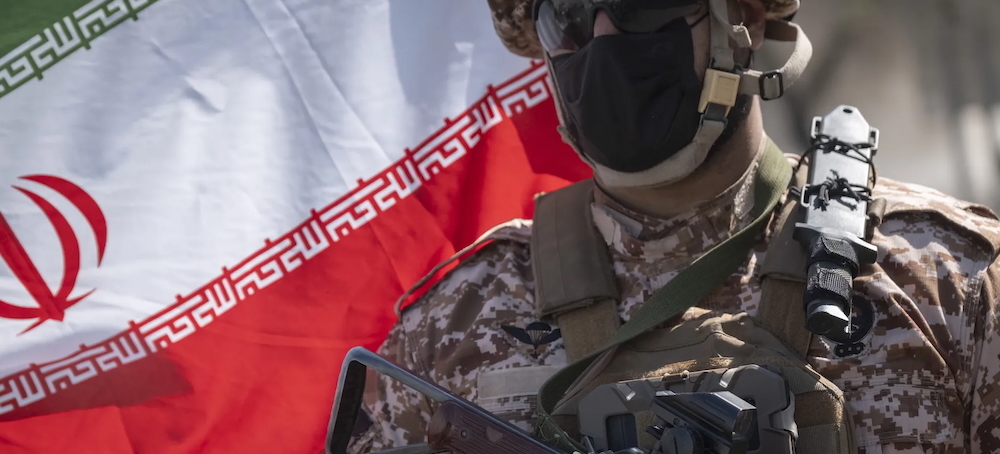 An armed military member of the Islamic Revolutionary Guard Corps (IRGC) holds a rifle in Tehran, Iran, on March 4. (photo: Morteza Nikoubazl/NurPhoto/Getty Images)
 Neither Venezuela Nor Gaza: Iran Is Iran
Bobby Ghosh SubstackALSO SEE: Ghoshworld, Bobby Ghosh on Substack
Trump’s conduct of the war has been informed by bad analogies. To get out of it, he must recognize his adversaries for who they are.
In other words, let’s agree on a piece of paper now, the difficult conversation later. Sound familiar? The Bloomberg piece names the precedent the administration is implicitly invoking: Gaza.
Before we proceed, let’s remind ourselves of what the Gaza ceasefire achieved. It ended most of the fighting, allowing the civilian population as well as combatants some breathing room. But it punted the most contentious issue of the negotiations, the disarmament of Hamas, to a phase two that, seven months on, is nowhere in sight.
That, essentially, is what the Trump administration is now proposing to do with Iran — agree to end the fighting now and open the Stair of Hormuz, and leave the trickier topics, such as Iran’s nuclear and ballistic-missile programs, to be hashed out at some future date.
Trump went into this war believing Iran would be Venezuela. I have written before about why that analogy was always going to fail — there was never going to be an Iranian Delcy Rodríguez gliding from regime loyalist to reliable American interlocutor — and the events of the past ten weeks have made the point more thoroughly than I could.
Now, with the Venezuela template in pieces on the floor, the administration is trying another one for size. It is just as wrong as the first, and just as certain to fail.
It’s not hard to see why Trump and his advisors are seduced by the Gaza precedent. It is recent, it ended a hot war and it allowed a president who likes to be photographed with signed documents to be photographed with a signed document. The envoys who made it happen, Steve Witkoff and Jared Kushner, have since been redeployed to Iran. Same men, same template: secure the immediate deliverable, defer the difficult one, declare a victory.
But the analogy crumbles under the slightest pressure — for three reasons, each more disqualifying than the last.
The first is the nature of the deferred problem. Hamas’s disarmament involves rockets, tunnels, and small arms inside a 140-square-mile strip that Israel can reenter at will. Iran’s deferred problem is a stockpile of more than 440 kilograms of uranium enriched to 60 percent — enough, if further refined, for roughly ten nuclear bombs. This material belongs to a regional power that has terminated all IAEA monitoring since the end of February. The breakout window is now estimated in weeks, not years. These are not the same kind of deferred problem.
The second is the nature of the leverage available to the US after the fighting stops. Israel emerged from the Gaza ceasefire with everything it needed to enforce a phase two: territorial control of more than half the strip, total freedom of military action, an American backstop. The threat of resumption belonged to Israel.
A Hormuz-first deal reverses this geometry. Iran exits the war with the leverage that brought Trump to the negotiating table — its capacity to choke 20 percent of the world’s seaborne oil through a chokepoint lapping at its own coastline. Tehran has already laid out new shipping protocols, and is collecting tolls. Suzanne Maloney, who runs the foreign policy program at Brookings, told NPR last month that Iranian negotiators have grasped what their American counterparts have not: the strait is “their most important leverage in this negotiation.” They will not surrender it for nothing.
The third is technical. The 2015 nuclear agreement between Iran and the world powers, for all its flaws, ran to 159 dense pages and took the better part of two years to negotiate. The teams included physicists, former IAEA inspectors, career arms-control diplomats. Even with all that machinery, the verification provisions on weaponization activities — computer modeling of explosive devices, multi-point detonators, neutron sources — were chronically contested, because the Iranians never granted adequate access to military sites. A one-page understanding written by Witkoff and Kushner, deferring “all the key topics” to some future round, is not an adequate placeholder for that work.
And we already know what this team produces under deferral pressure. We are watching it in Gaza in real time.
If neither Venezuela nor Gaza offers a working template, where does that leave Trump? It leaves him where he should have started: a clear picture of who he’s dealing with.
The Islamic Republic is not an inscrutable enigma. It is one of the most thoroughly studied regimes on the planet. Three things about it must be internalized before any serious American negotiator sits down at a table — and none of them is esoteric or new.
The first is ideological. The Iranian regime is built, institutionally and ideologically, to outlast precisely this kind of pressure. The IRGC’s pre-delegated retaliation authorities, the dispersed and hardened nuclear infrastructure, the proxy network, the ferocious internal security apparatus — these are the products of four decades of design, not wartime improvisations. Iran scholars have long argued that anti-Americanism is the regime’s organizing principle, the load-bearing wall of its legitimacy.
A theocracy whose claim to power rests on resistance to the “Great Satan” cannot, by its own internal logic, agree to anything that can be interpreted as a surrender to Washington. At best, it can sign a narrow, face-saving document on shipping. It will then run out the clock.
The second is a combination of geography and economics. The Persian Gulf is not Maduro’s Caribbean coast, the Strait of Hormuz is not Hamas’s tunnel network. It is a vital node of international trade that Tehran has spent decades preparing to exploit. And the regime has demonstrated the leverage it can bring to bear. The International Energy Agency has called the closure of Hormuz the largest supply disruption in the history of the global oil market. American gasoline at the pump has crossed $4.50 a gallon.
The third connects the two failed analogies. The same logic that prevented an Iranian Rodríguez from emerging now governs the kind of nuclear deal Tehran is willing to sign. The new supreme leader, Mojtaba Khamenei, is lacking in both theological prestige and revolutionary credentials, and will therefore need to demonstrate ideological purity to the IRGC and the clerical establishment. He cannot afford to look like the man who traded away the nuclear program.
This is the Islamic Republic that Trump confronts, a product of its ideology, geography and politics. It is neither Venezuela nor Gaza. The war will not end on Trump’s preferred terms — will not, in any meaningful sense, end at all — until the president and his advisors stop looking for the country in their analogies, and begin looking at the country in front of them.