
My Role as a ‘Complicit’ Journalist
Michael Scherer The Atlantic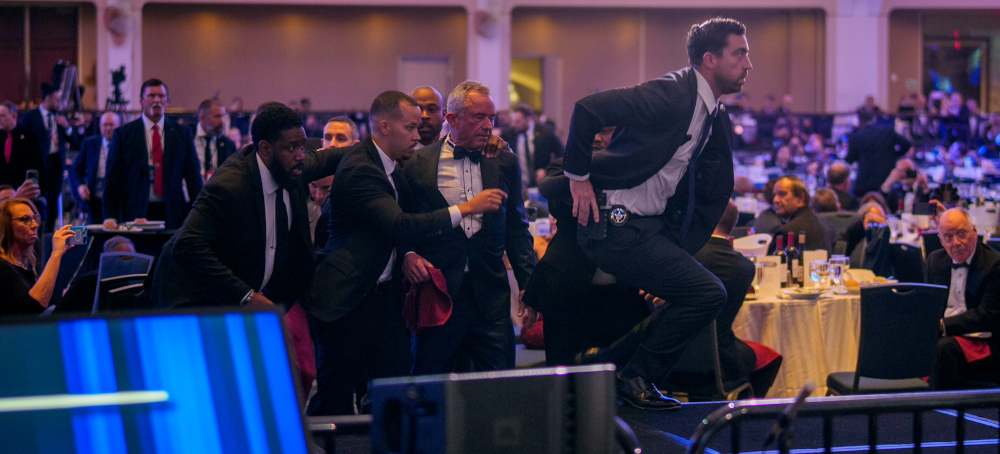 Health and Human Services Secretary Robert F. Kennedy Jr. (C) is taken out of the ballroom by security agents during a shooting incident at the annual White House Correspondents Association Dinner at the Washington Hilton on April 25, 2026 in Washington, DC. (photo: Getty)
 My Role as a ‘Complicit’ Journalist
Michael Scherer The Atlantic
Algorithms turn nuanced articles into rage bait that helps fuel political violence.
In response to a clip of Vice President Vance expressing pride in ending aid to Ukraine, a Bluesky account reportedly used by Allen read, “What a piece of shit.” When another account argued that members of the administration were “damned” for serving a president who posted an AI image of himself as Jesus, the assumed Allen account quoted from the Book of Revelation about God’s fury at worshippers of “the beast.” When Trump proposed charging tolls in the Strait of Hormuz, Allen apparently responded, “It’s public knowledge that he likely IS basically a sociopathic mob boss.”
These were not calls for violence. But they were building blocks for the crime he would soon allegedly commit. In the manifesto he is said to have emailed to his family, Allen deployed the buzzwords of social media, casting his political disagreements as questions of character that diminished the humanity of his targets. He said that he aimed to kill Trump-administration officials, but that everyone in the ballroom was fair game because “most people *chose* to attend a speech by a pedophile, rapist, and traitor, and are thus complicit.” He argued that the constitutional order had been upended and the social contract broken: “The United States of America are ruled by the law, not by any one or several people. In so far as representatives and judges do not follow the law, no one is required to yield them anything so unlawfully ordered.”
I was among the hundreds of “complicit” journalists who attended the White House Correspondents’ Dinner. My job is to interview figures from across the political spectrum, including the president and his advisers. I attend their events; I try to earn their trust; I inform the public about what is happening. Sometimes my work requires me to attend functions with administration officials; occasionally I am required to wear a tuxedo in the performance of this duty. It is no great revelation to say that Allen’s purported manifesto is wrong on the facts: The United States of America is still ruled by law, not by one man, or several people. Independent judges continue to interpret that law, and the president has not successfully defied a decision of the U.S. Supreme Court or the voting public. Trump has expanded executive power, dismantled federal ethics practices, and adopted authoritarian tactics, but he does not rule as a tyrant. The free press, despite new legal threats and cowering ownership, continues to check his power. The midterm elections will take place on November 3, and, if current sentiment holds, Trump will see his power diminished. Allen, not Trump, is the villain in this particular story, if he is guilty as charged. There is no justification for the violence he attempted.
But I cannot stop thinking about the role that journalists like me play in the drama that ended with Allen face down in a Washington Hilton hallway. I worry that we are at the beginning of a cycle of political violence that is going to get much worse, that will threaten more journalists, more corporate leaders, more candidates, and more elected and appointed officials. Public access to leaders will diminish as a result, and the gulf between the powerful and the aggrieved will grow. The list of recent attacks by suspects who seem to have been influenced not only by unfolding news events but also by the sludge of online political discourse is long and terrifying: Luigi Mangione, the accused murderer of UnitedHealthcare CEO Brian Thompson; Tyler Robinson, the alleged assassin of the conservative activist Charlie Kirk; Daniel Moreno-Gama, the accused Molotov-cocktail-wielding attacker at the home of the OpenAI leader Sam Altman, who has faced other threats; Vance Boelter, the alleged killer of a Minnesota lawmaker and her husband; Elias Rodriguez, the alleged killer of two Israeli-embassy employees outside the Capital Jewish Museum; Robert Bowers, the convicted anti-Semitic mass shooter at a Pittsburgh synagogue; Payton Gendron, the convicted neo-Nazi shooter at a Buffalo supermarket in a predominantly Black neighborhood; Patrick Crusius, the convicted racist shooter at an El Paso Walmart. (The first five await trials.)
No act has a single cause, and all of those suspects appear to have been mentally unstable to varying degrees. But their ideologies also appear to have been nurtured by the technologies we use to distribute and process political information, which isolate us from one another and push us to more extreme conclusions. Modern democracies function on the relatively recent idea that the violence that historically accompanied power transfer should be replaced with individual rights and open elections. These alleged assailants concluded that this idea no longer held, a conclusion that I observe as a growing feature of the online discourse, which routinely casts real policy difference and character judgment in apocalyptic terms stripped of critical nuance. After September 11, the national-security apparatus focused on finding homegrown terrorists who had been radicalized virtually by distant Muslim radicals. Now radicalization—including for many of the pro-Trump rioters who tried to paralyze the democratic process on January 6, 2021—comes from the algorithmic information systems themselves, which reward outrage, conspiracism, and emotional responses. They also diminish understanding, empathy, and verifiable facts.
My work unintentionally provides raw material for this ecosystem. Four days after the security breach at the Correspondents’ Dinner, I co-wrote an article about Trump’s tendency to compare himself to great figures from history—Napoleon Bonaparte, Alexander the Great, and Julius Caesar, in particular. The article contained no hint of a justification for political violence. But as it churned through social media, that’s where it ended up, sparking one outraged post after another by enraged readers who called Trump “batshit crazy,” “f*cking insane,” and much more. “Was the guy who bum rushed the correspondents dinner with a shotgun the bad guy (?)” asked one user on X, responding to a link to the story. “We supposed to just let him conquer the planet and crown himself Emperor Of Earth ??”
This happens all the time. And so I do feel implicated, just not in the way Allen’s manifesto would have it.
Perhaps the most famous scene in The Boys on the Bus, the Timothy Crouse account of reporters covering the 1972 presidential campaign, takes place after the second debate between Hubert Humphrey and George McGovern. Newspaper reporters swarm the typewriter of the lead Associated Press writer, Walter Mears, to find out how he will start his story. They each worked for regional monopolies, with captive audiences, and wanted to please their editors. If they filed something different from Mears, they would have to explain themselves.
By the time I started covering presidential campaigns, in 2008, the incentives had reversed. On the internet, we all wrote for the same captive audience, sitting in front of computers at home, so there was no upside in writing the same lede as The New York Times or The Washington Post. To win internet traffic, you had to distinguish yourself. Small things became more important, and appealing to specific groups suddenly had advantages. A blogosphere of liberal and conservative writers—the precursors of social media—emerged to filter what happened through ideological lenses.
Around the same time, the founders of Politico began to adapt traditional media to the new technology. For decades, major newspapers had assigned reporters to watch the Sunday political talk shows and write about the news that was made. Politico’s editors realized that the digital world rewarded bite-size slices and multiple headlines that could ride on Google Search. In one instance in 2009, Politico produced nine separate headlines from a single CNN interview with Vice President Dick Cheney. Some could appeal to liberal emotional cues, perhaps earning a link from The Huffington Post. Some could resonate with the right, earning a link from the Drudge Report. Every reader would get only part of the story.
This echoed the shift in broadcast news that began with cable television. Fox News’s Roger Ailes had discovered in the ’90s that people watched not for information but for emotional gratification—to get mad, to feel the thrill of the underdog, the excitement of a car chase. (Ailes also obsessively demanded that female anchors display their bare legs.) Online, liberals clicked on stories about conservative rot. Conservatives clicked on stories about liberal excess. Independents clicked on stories about the corruption of the whole system. The news became an us-versus-them training ground.
Social media, the current architecture for mass distribution, gave algorithms the ability to supercharge the emotional resonance of information by prioritizing delivery based on engagement, a measure that largely tracks the tingling appeal. But algorithms, unlike regional newspapers, Politico, and blogs, do not screen for falsehoods and have no reputations to protect. So the fidelity to facts soon fell away. (What AI will do to us next is unclear: Some people have argued that the voice of AI is, for the moment, less polarizing than the algorithmic maw. Others predict that AI slop will accelerate the same algorithmic incentives and sever us from the physical world.)
It’s hard to imagine a story more fully covered than one about shots fired at a dinner attended by hundreds of journalists. CNN’s Wolf Blitzer watched a man sprint through the magnetometers and get tackled, and was on his network within minutes detailing what he saw. But if you consumed news of the attack on social media, you were at least as likely to be offered a conspiracist version of the event—the version that gave you the greatest emotional charge—suggesting that Trump could have staged the attempt on his life. The former MSNBC host Joy Reid raised the possibility on her podcast, just as the former Fox News host Tucker Carlson did. “If it was political theater, that would be one of the biggest manipulations in modern history,” Carlson said in a widely viewed video clip, adopting the just-asking-questions mode that has made him one of the most cynical rage-farmers of his generation.
Once you understand these incentives, the other major distortions of political news fall into place. I’ve been in this business for a while, and I can more or less predict the likely readership of a story before it is published. The more a story taps an emotional vein—usually outrage or grievance—the more traffic it will tend to attract from social media. I am in the business of writing long and complicated stories full of nuance. Yet I am at the mercy of platforms that want to turn my words into cortisol and endorphins, often for people who will never click the link to read what I wrote. Regardless of my intentions, my work can fuel the false division I despise. Each derivative of my work, processed through the algorithm, becomes more cartoonish and less descriptive of what is real.
Every part of the political ecosystem now plays the game. Grievance, like a virus that can pass a cell wall, is often the best delivery vehicle. This explains much of the rise of Trump, the original insult-tweeting candidate, who designed his norm-breaking routine to provoke anger and deepen resentment on social media. It also explains the behavior of some Democrats. House Minority Leader Hakeem Jeffries assessed a ruling this week on the Voting Rights Act by calling the Supreme Court’s majority “illegitimate,” a moment that immediately became viral. Trump rode the wave, announcing in his own social-media post that Jeffries “should not be allowed to talk that way.”
The Supreme Court is not, in fact, illegitimate under any reasonable legal argument. Each of its members was appointed and confirmed according to constitutional procedures, and they act in accordance with their view of the law, as they should. But Jeffries and Trump are not really engaged in a debate about legitimacy. (A couple of months earlier, Trump called a different majority on the high court “a Disgrace to our Nation,” “fools,” and “very unpatriotic, and disloyal to the Constitution.”) They are sophisticated politicians seeking partisan advantage. Trump has no path to restrict Jeffries’s right to speak, and when the court next rules against Trump, Jeffries will not question its legitimacy. This is a staged performance whose terms are set by the technological medium by which they are distributed. The problem is that many people who consume the debate will take it literally and embrace the outrage. As a typical commenter put it on Bluesky, in response to Jeffries’s comments, “The corrupt six should go to prison and never see daylight again for their treason.”
I am not suggesting that censorship offers any solutions, and I am not contending that everyone is equally to blame. I want to pause to acknowledge the strange new physics that is distorting how many people understand the world. The information delivered in feeds and podcasts has been torqued away from reality to seize our attention. Just as many children’s brains have been hijacked by TikTok feeds of cute cats or pimple popping, political debate is now captive to a kind of alarmism that dehumanizes by default and announces any deviation from the norm as proof of systemic collapse. Allen and his cohort would likely echo what my social-media commenters tell me each day: That there is a war happening in the United States, and that the system is irreparably broken. For a nation founded in a revolution that met tyranny with force, violence can seem far too logical in the face of such flawed conclusions.
The truth is more complicated, and more challenging: The nation’s political machinery, upset by technological change, is strained but functioning. We must commit again to the basic national project—to disagree, even viciously, while maintaining respect for one another’s humanity and a desire for truth. We must discount much of the venom we see online, and from pandering leaders, as a distortion of reality, not a mirror. If we do not, more people will die.