
Minnesotans Showed Us What It Looks Like to Protect the Constitution
Dahlia Lithwick Slate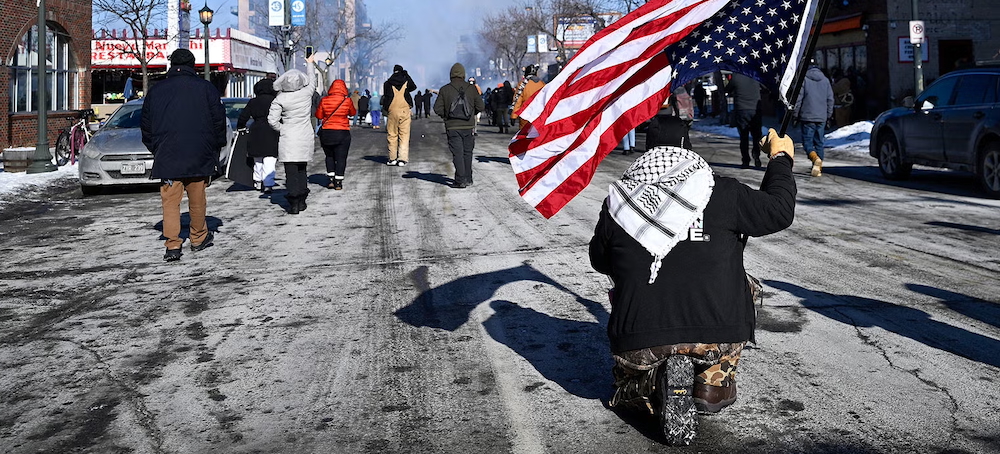 "What it takes to defend democracy from autocracy is suddenly crystal clear." (photo: Stephen Maturen/Getty Images)
 Minnesotans Showed Us What It Looks Like to Protect the Constitution
Dahlia Lithwick Slate
What it takes to defend democracy from autocracy is suddenly crystal clear.
All credit—all of it—goes to the people on the ground in Minnesota; protesters, monitors, neighborhood patrols, independent journalists. As Robert F. Worth noted in the Atlantic, for all the MAGA talk of “domestic terrorists” and woke “assassins,” what’s emerged on the streets of Minneapolis is an organic, homegrown “meticulous urban choreography of civic protest,” a movement that is “leaderless” and “hyperlocal.” It has proven indomitable in the face of cosplay and photo ops and cartoon characters like Bovino and Kristi Noem. As Sherrilyn Ifill points out: “We all owe a debt of gratitude to the resilient and principled stance of the people of Minneapolis and the state of Minnesota who have remained undeterred. They have fought for their neighbors and for themselves. They have stood in proud defense of their city, and their right to peacefully protest. The organizers on the ground have been extraordinary.” Adam Serwer calls it simply “neighborism.”
It’s going to be tempting to say that this week in Minnesota is the beginning of the end of something, but more likely it’s the beginning of something worse. Bovino and Noem in retreat is not the same as Trump and Stephen Miller in retreat, and there is genuine reason to fear that this moment of so-called symbolic compliance—a fleeting, symbolic retreat to stymy growing public resistance—will slow the roll of congressional inquiries, impeachment efforts directed at Noem, general strikes, and calls to defund ICE. Moreover, as Attorney General Pam Bondi’s not-so-subtle effort to extort voter information from Minnesota’s governor reveals, this cruel deportation dragnet is only half of the story; as ever, effort to undermine future elections is the goal. For every strategic Trump flinch and retreat, you can expect an equal and opposite effort to remain in power forever. With every threat of impeachment and accountability, the incentive to ensure a permanent MAGA majority forever ticks up, invisibly, but assuredly.
Which is why it is a mistake to think of these twin tragedies in Minneapolis as the horrific government actions that finally prompted shifts in politics, or law. Too much attention is always directed at opinion polling, craven political actors, and the levers of political change, and doubly so during this second Trump administration. This tendency to witness everything through the lens of “when will this be over for good” distracts from the real meaning of Renee Good and Alex Pretti, which is not how they died, but what they were doing when they were killed. This is what changed on the ground in Minnesota, and what needs to happen in Philadelphia and in Maine and in whatever blue city or state becomes the next target and the target after that. This transcends even the conversations about flipping the House in November. This is about what we are now learning, under immense pressure, and in real time, about authoritarian takeovers and how to resist.
For years we were told that voters didn’t care about protecting the Constitution or democracy, and they certainly didn’t vote on it. And certainly that appeared to be true in 2016 and again in 2024. But what we have seen spring up on the streets of Los Angeles and Portland and Minneapolis, and what we saw in the earliest No Kings marches, is that Americans actually care deeply about the law and the Constitution and democracy, and also—to borrow from testimony from Jack Smith last week—that those things have functioned so well in the United States and for so very long that many of us had come to take it for granted. For the last 15 years at least, after Citizens United, and Shelby County, and Dobbs, when audiences at speeches would ask me “What should I be doing?,” my responses tended to be carefully lawyerly and bloodless: court reform, gerrymandering reform, campaign finance reform. Repair and protect democracy and we could perhaps claw back its original sins as well as its distortions and degradations.
Well, it turns out it’s actually much more basic than that. What we are seeing amid the street protests, and the meal deliveries, and the marches and the legal observers and the calls for a general strike and for defunding DHS and impeachment for criminals, is actually all democracy work, and constitutional work, transmogrified and embodied into American streets and schools and small businesses. I was struck and moved by Robert Worth’s observation about what he witnessed in Minnesota: “Again and again, I heard people say they were not protesters but protectors—of their communities, of their values, of the Constitution.” And if this is, in fact, the call, then what it might look like to answer it is no longer inchoate or mysterious. People are fighting and being assaulted and even murdered on their streets for the First Amendment, the Second Amendment, the 14th Amendment … This is a clawing back of the Constitution, amendment by amendment, on the streets, and by the people.
Those of us who believed ourselves to be part of the Trump Resistance in 2016 made the mistake of naming it without quite knowing what it was. Pink hats and marches that felt like street fairs and witty signs were for social media. This version of the resistance swallows that whole—law enforcement officials want to shoot you, and you will be pepper-sprayed while you are restrained on the ground. As DHS efforts to occupy and terrorize cities morph and expand, this won’t be “protest” as we once understood it; it will be something far more frightening, something familiar to historians of racialized policing. Yes, it requires, even demands, new rules of engagement. Legal and civil disobedience training are now essential, and there will be ample work to do in protecting vulnerable neighbors and neighborhoods. It turns out that it was only hard to articulate what needed to be done to protect democracy and the Constitution until it needed doing. And now that we know what democracy emphatically does not look like—tyrannical cruelty as part of an all-out demand for mass submission to authority and the subordination of the “other”—it has, overnight, become simpler to name and understand the mission.
This is why the most dangerous days are almost certainly ahead, but it helps to know that the courts, and most of the lawyers, and the blue-city mayors and the blue-state attorneys general and the neighbors and the teachers and the religious leaders, already know in their bones which side they are on. Democracy will not defend itself, in much the same way that authoritarianism will not just pick up its nasty toys of wars and go home. There is a massive shift taking place that has to do with resisting state executions of lawful protesters but also has as much to do with fighting for the core values laid out by the same imperfect streetfighters who founded the country. It is indeed the stuff of nightmares, but this is what democracy must look like.
Now we can name the mission, which is no small thing. Focus on the mission and ignore spectacle and spin. Of the many, many things that Trump and MAGA have misunderstood, almost foremost among them was the belief that Americans would forever be more interested in consuming white-supremacist online content than in creating actual democratic freedom. From Chicago to Portland to Minneapolis to your town, when someone asks you what they should be doing, the answer must be: Protecting the Constitution.