
Marijuana, Abortion, Climate: How the US Voted Down the Ballot in Midterms
Victoria Bekiempis, Kari Paul and Miranda Bryant Guardian UK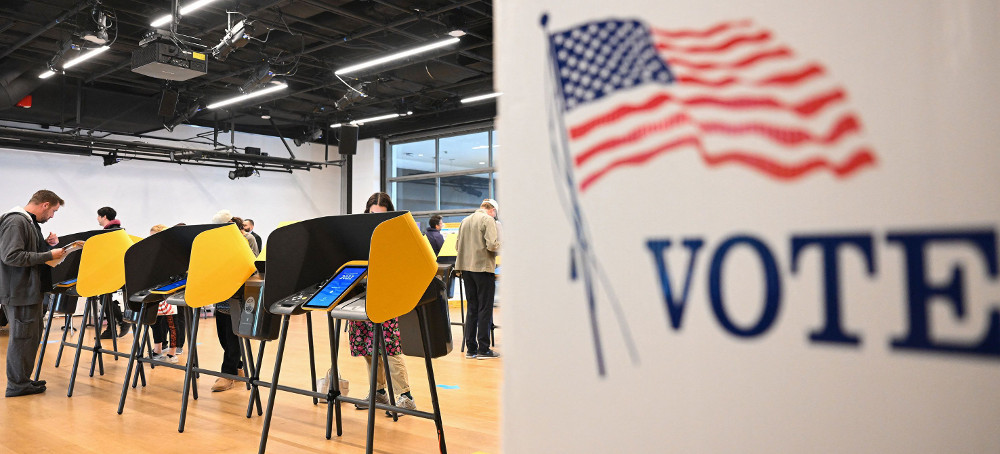 Voters cast their ballots for the US midterm elections inside a voting center in Los Angeles, California, on November 7, 2022. (photo: Patrick T Fallon/AFP)
Marijuana, Abortion, Climate: How the US Voted Down the Ballot in Midterms
Victoria Bekiempis, Kari Paul and Miranda Bryant Guardian UK
‘Green wave’ expands to Maryland with voters opting for recreational cannabis while California votes to enshrine abortion rights
Multiple states voted on whether or not to legalize recreational marijuana, part of a growing “green wave” that has already led to many relaxing their laws on cannabis use.
In Maryland, voters green-lighted a constitutional amendment to legalize recreational marijuana for adults over 21, making it the 20th state to take that step. The constitutional amendment in Maryland does not mean that adults can simply go into a shop and lawfully buy marijuana; rather it opens the door for Maryland’s state legislators to establish a legal industry.
That industry could start “as soon as” 1 July, according to the Baltimore Sun. The vote also means that adults 21 and over can legally raise up to two marijuana plants at their homes starting 1 July.
Voters in four other states – including Arkansas, Missouri, North Dakota and South Dakota – were considering similar marijuana measures in elections seen as a test of legalization’s support in more conservative parts of the country. As of late Tuesday night, the results were mixed, with recreation marijuana measures rejected in Arkansas and North Dakota.
Another ballot measure on legal drug use was in Colorado, where voters weighed a ballot measure that, if passed, would decriminalize psychedelic mushrooms. The result of that proposition was still too close to call late on Tuesday.
Elsewhere, voters weighed up measures on abortion access in the wake of the supreme court’s overturning of Roe v Wade. Reliably, Democratic California and Vermont voted to protect abortion rights in their state constitutions, while in Michigan – a closely watched presidential battleground – voters approved a ballot measure affirming the right to make personal reproductive decisions without interference.
California also rejected a ballot measure developed by a coalition of environmental and labor groups that would have raised taxes on the richest residents to address global heating by helping put more electric vehicles on the roads. The proposal, which was supported by Lyft, became highly contentious after governor Gavin Newsom and other opponents characterized it as a corporate carve-out for the ride-hailing platform.
A pair of competing measures that would have legalized sports betting in the state – and became the most expensive ballot initiative campaign in US history – failed by a landslide. Sports betting has been legalized in 30 states in the US but not in California, making it a large untapped market for gambling interests.
The two propositions would have expanded gambling access in the state in different ways, with one allowing sports betting online and the other limiting it to Native American casinos and the state’s four horse tracks. Californians overwhelmingly rejected both propositions, with 84% voting against sports betting online and 70% voting no on allowing it at Native American casinos.
Separately, California voted to ban flavored tobacco sales in the state, marking the fifth state in the US to do so.
In three states, Alabama, Tennessee and Vermont, voters approved measures to ban slavery and involuntary servitude as a punishment for crime, while Oregon remained too close to call. But Louisiana rejected a ballot question asking voters whether they supported a constitutional amendment to ban involuntary servitude in the criminal justice system.
While such changes will not force state prisons to immediately change, it could encourage legal challenges.