
Major Oil Firms Skip Trump’s Auction of Arctic Wildlife Refuge Drilling Leases
Jake Spring The Washington Post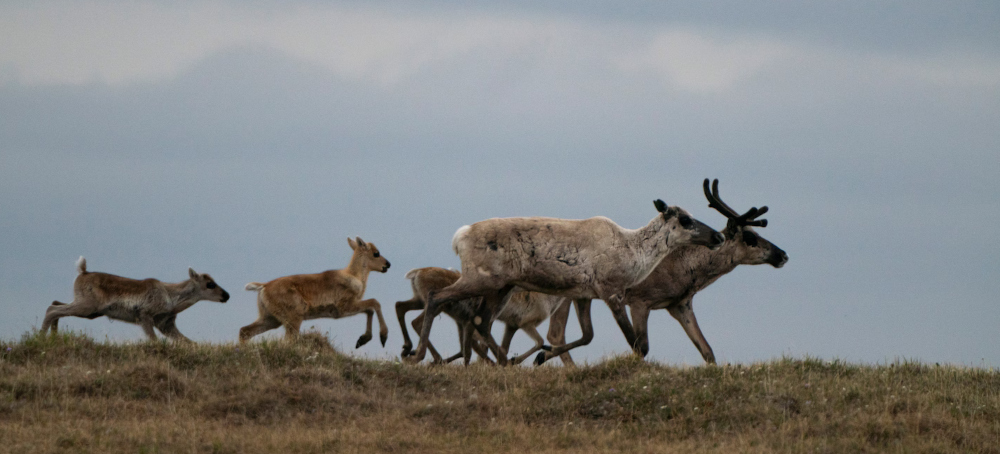 Caribou migrate in the Arctic National Wildlife Refuge in June 2024. (photo: Carolyn Van Houten/The Washington Post)
 Major Oil Firms Skip Trump’s Auction of Arctic Wildlife Refuge Drilling Leases
Jake Spring The Washington Post
The sale of 72,000 acres in leases is nonetheless a step toward extraction in the wilderness home to caribou and polar bears.
On Friday, just over one year later, that pledge was put to the test in the Trump administration’s auction of oil leases in the Arctic National Wildlife Refuge (ANWR), a pristine expanse the size of South Carolina that is home to caribou, polar bears and millions of migrating birds.
The auction drew limited interest, with no major companies bidding and only two participants, who agreed to pay $3.7 million for five tracts. The leases total 72,000 acres, out of the 689,000 acres on offer within the refuge’s 19.3 million-acre expanse.
The Bureau of Land Management’s Alaska state director, Kevin Pendergast, whose agency conducted the auction, said at an event announcing the results, “The interest was solid.”
“We look forward to learning more about the subsurface of the area as leaseholders pursue exploration,” he said.
But the Gwich’in Steering Committee, an Alaska Native group whose members are long connected to the Porcupine caribou herd that migrate across the refuge, said in a statement that the auction had “failed.”
“Yet again, no major oil and gas companies showed up to bid, because they know that drilling in the Arctic Refuge is a losing proposition,” said Kristen Moreland, the group’s executive director. “We will continue to fight the Trump administration’s leasing program, and work with our friends and allies to protect this sacred and irreplaceable landscape from development of any kind.”
The bidders were Alaska-owned natural gas company Hex Energy and Alaska Industrial Development and Export Authority (AIDEA), a corporation owned by the state government. AIDEA is not an oil company and would probably need to contract out any drilling. The two companies did not respond to requests for comment.
Holly Hopkins, a vice president at the American Petroleum Institute, which represents major oil companies, said in a statement that the Interior Department has made “efforts to restore certainty to federal leasing policy” that allow companies “the flexibility to invest strategically in parcels that pose the greatest potential for development.”
Hopkins did not directly address the results of the sale, adding “we expect to see continued investment throughout the state.”
The sale is part of the administration’s broad push to open Alaska to development by expanding drilling on public land and in federal waters, green-lighting a 211-mile mining road north of the Arctic Circle and advancing a new natural gas pipeline across the state.
These efforts, some of which jump-start energy and infrastructure projects that have stalled for decades, have horrified environmental advocates and divided Alaska Native communities. Administration officials say drilling and mining in Alaska will help meet energy and resource needs, bolster national security, and strengthen the Alaskan and U.S. economies.
But the fact that only a few bids were made in Friday’s auction was similar to the auction that President Donald Trump’s first administration held in January 2021 that drew limited interest, with AIDEA the main buyer. Those leases became tied up in litigation, and President Joe Biden’s administration later canceled them. A separate auction just before Biden left office drew no bidders.
“This lease sale certainly fits the broader pattern of putting drilling and development and extraction interests ahead of conservation and public access and long-term stewardship,” said Gregg DeBie, a senior staff attorney at the Wilderness Society, an advocacy group that is suing to block development of the refuge.
“This administration is treating these lands as something that should be given away as assets, when we think they should be protected for future generations,” DeBie added.
Voice of the Arctic Iñupiat, an advocacy coalition that represents 22 Indigenous groups on the North Slope, supports drilling in the ANWR if it is done correctly and brings economic benefits to the community, said its president and chief executive, Nagruk Harcharek. Part of the proceeds from oil development on the refuge would be distributed among these communities.
“From the North Slope perspective, we want it because it makes economic sense for us,” Harcharek said. “We benefit from that economic development. We reinvest that money in our communities.”
Harcharek, born in 1985, said he remembers not having a flush toilet as a kid until the early 1990s, when tax revenue from oil development helped to fund modern sewage systems where he lived in Utqiagvik.
Sovereign Iñupiat for a Living Arctic opposes the drilling and denounced the Interior Department’s decision to rescind Biden-era protections for the ANWR in October, as well as an earlier decision to reinstate the leases that AIDEA bought in the refuge in 2021.
But with oil prices spiking amid the war in Iran and with a favorable administration, this auction could have been different, according to an oil industry official, who spoke on the condition of anonymity because the official was not authorized to speak to the media ahead of the auction.
The refuge is not far from the start of the Trans-Alaska Pipeline at Prudhoe Bay, which has the extra capacity to easily bring the oil to market, this person said.
The economics of drilling in the refuge are similar to exploration further the east on the other side of Prudhoe Bay in the National Petroleum Reserve in Alaska (NPR-A), with development costing probably only a few more dollars per barrel in the refuge.
A March auction of NPR-A areas drew significant interest, resulting in 187 lease areas sold worth $163 million and covering 1.3 million acres in the 23-million-acre reserve.
The person said that drilling in the ANWR is riskier than in the NPR-A, where oil has already been successfully developed, also in part because environmental groups will fight harder to stop it in the refuge. Before leasing in the refuge was written into a tax-and-spending bill during Trump’s first term, development there had been off-limits for roughly half-a-century.
Oil from ANWR could not be brought to market before the end of the Trump administration, also raising the risk that a future Democratic administration could halt development once more.
Environmental groups including the Wilderness Society are challenging the administration’s steps to opening the refuge to drilling, which they argue violates the Endangered Species Act and laws governing refuges.
Building roads and oil infrastructure in the refuge will fragment wildlife habitat and interrupt the migration of Porcupine caribou, which travel thousands of miles to the coastal plane to give birth, DeBie said. It also presents risks to polar bears — which are listed as threatened under the Endangered Species Act — which dig dens in the area while raising their young.
Oil companies “bring these giant thumper trucks in and start pounding the ground during the winter, right on top of where the polar bears are denning,” DeBie said. “It crushes the cubs. The mothers abandon the dens.”
“As far as whether development can occur responsibly, obviously we don’t think so,” DeBie added. “This landscape is pristine and too fragile to support major industrial activities.”