
Judge Reopens Trump’s IRS Suit and Questions His ‘Weaponization’ Fund
Alan Feuer and Andrew Duehren The New York Times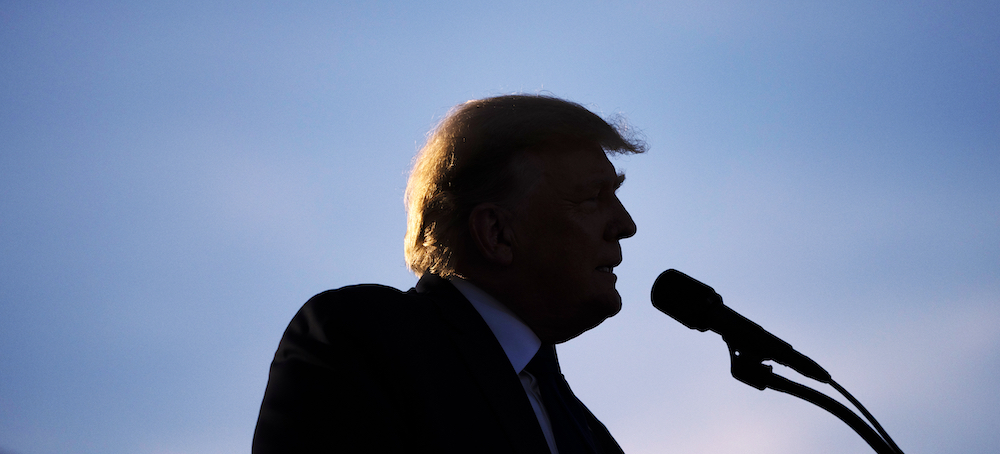 President Donald Trump. (photo: MSNBC)
 Judge Reopens Trump’s IRS Suit and Questions His ‘Weaponization’ Fund
Alan Feuer and Andrew Duehren The New York TimesALSO SEE: US Judge Temporarily Blocks Trump’s $1.8 Billion ‘Weaponization/Slush’ Fund
The ruling was a blow to both President Trump, who had voluntarily dismissed the suit last week, and to the Justice Department, which used the suit to establish a fund likely intended for Trump allies.
The ruling by the judge, Kathleen M. Williams, on Friday to revive the case shortly after closing it was a significant blow both to Mr. Trump, who had voluntarily dismissed the suit last week, and to the Justice Department. After the president withdrew the suit, senior department officials released a pair of extraordinary agreements that settled the case by establishing a $1.8 billion fund to compensate people who claimed they were victims of government “weaponization” by Democrats.
The deal also conferred lucrative tax benefits on Mr. Trump, his family and his businesses.
Judge Williams’s decision came in response to court papers filed on Wednesday by a bipartisan group of 35 former federal judges who urged her to bring the case back to life and dig into the details of the agreement to settle it.
The former judges said that Mr. Trump’s settlement agreement raised serious questions about his “candor toward the court and manipulation of the judicial system.”
Before she closed the case, Judge Williams, an Obama appointee, had in fact questioned whether the lawsuit presented an actual conflict that she could adjudicate, given that Mr. Trump was on both sides of the suit, bringing claims against a federal agency that he controlled. When she closed it, she noted there was no “settlement of record,” but shortly after, the Justice Department released its agreement foreclosing the action.
In her brief but stern order on Friday, Judge Williams said that she wanted to investigate the circumstances surrounding Mr. Trump’s efforts to settle the lawsuit in a way that benefited him and his allies. If she succeeds in moving forward with her inquiry, it could ultimately result in questions being asked of the Justice Department leaders who signed the agreements to settle the suit — chief among them, Todd Blanche, the acting attorney general, and Stanley Woodward Jr., the No. 3 official in the department.
In her order, Judge Williams asserted that she was “empowered to investigate serious misconduct” in any case before her, and ordered Mr. Trump’s lawyers to tell her by June 12 whether the lawsuit should be formally reopened because “the court was the victim of a fraud.”
She also wanted Mr. Trump’s lawyers to respond to the question of whether he had colluded with his own government to settle the case “to avoid judicial scrutiny.”
The White House did not immediately respond to a message seeking comment.
Judge Williams pointed to reporting by The New York Times that described how the I.R.S. had prepared a 25-page memorandum outlining defenses against the suit that the Justice Department did not take up in court.
Lawyers for the former judges hailed Judge Williams’s decision.
“The judges and their counsel greatly appreciate the seriousness with which the court is addressing these grievous allegations,” said Norman Eisen, who represented the former judges for the nonprofit group, Democracy Defenders Fund. “We stand ready to work with the court as it investigates this matter.”
Mr. Eisen was joined by the law firms Platkin and Susman Godfrey.
In their filing this week, the former judges claimed that Mr. Trump had improperly used his suit against the I.R.S. as a way to obtain “unlawful private benefits” for himself and his family, and to create a fund that would dole out taxpayer money “without constitutional or congressional authority.”
They also argued that the president had tried to shield the deal from judicial oversight by rushing a settlement and “short-circuiting” Judge Williams’s ability to examine its terms.
The $1.8 billion fund has faced separate legal headwinds. A federal judge in the Eastern District of Virginia temporarily blocked the Trump administration from taking any further steps to set it up or disburse money from it. Lawmakers on Capitol Hill, including many Republicans, have also been critical of the fund, which upended G.O.P. plans to pass a party-line bill funding immigration enforcement efforts last week.
Mr. Trump, along with two of his sons and the Trump family business, first sued the I.R.S. in January, claiming they were owed at least $10 billion because a former contractor at the agency had leaked their tax returns (and hundreds of others) during the president’s first term in the White House. The Trumps claimed that the I.R.S. should have done more to prevent the contractor, Charles Littlejohn, from disclosing tax information to The New York Times and ProPublica.
Mr. Trump’s suit, as I.R.S. officials laid out in their memo and other lawyers have noted, had clear legal flaws. Potential defenses against it include that it was filed after the statute of limitations, and that it incorrectly faulted the I.R.S. for the actions of Mr. Littlejohn, previously a contractor employed by Booz Allen Hamilton. But the Justice Department never made an attempt to contest Mr. Trump’s suit. No government lawyer entered an appearance in the case.
That has fueled criticism that the deal the Justice Department struck with Mr. Trump was not a genuine attempt to avoid a loss on the merits to the president in court, but instead a scheme to provide him and his political allies with public benefits.
In a footnote, Judge Williams questioned the provision granting Mr. Trump, his family and their businesses immunity from I.R.S. scrutiny of tax returns they had already filed. She wrote that the audit protection may run afoul of Justice Department rules requiring legal settlements to directly relate to the issues in the suit.
She also noted that only Mr. Blanche signed the audit provision. The separate, nine-page agreement laying out the $1.8 billion fund was signed by Mr. Woodward and Frank Bisignano, who is serving as the chief executive officer of the I.R.S., a newly created role that is not subject to Senate confirmation.