
John Roberts’ Theory of Democracy Is Laughably False
Dahlia Lithwick and Mark Joseph Stern Slate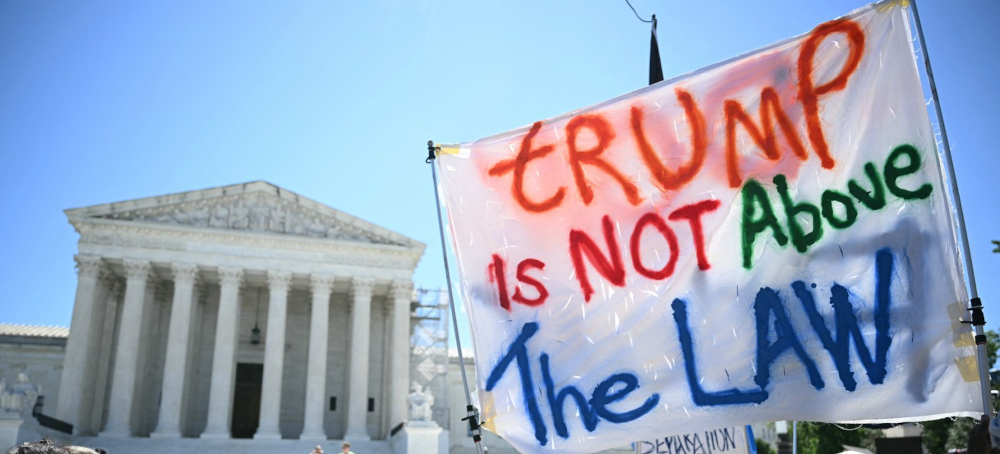 In Trump v. Slaughter, the end-of-term blockbuster allowing the president to fire members of independent federal agencies, Chief Justice John Roberts embraced a vision of executive power so sweeping that it would make King George III blush. (photo: AFP)
 John Roberts’ Theory of Democracy Is Laughably False
Dahlia Lithwick and Mark Joseph Stern Slate
John Roberts’ theory of democracy is laughably false.
On this week’s episode of Amicus, co-hosts Dahlia Lithwick and Mark Joseph Stern discuss the historical inaccuracies, logical fallacies, and political fictions underlying this radical consolidation of power in the president. They are joined by two experts on executive power: Jed Shugerman, a professor at Boston University School of Law, and Sam Bagenstos, a professor at University of Michigan Law School. An excerpt of their conversation, below, has been edited and condensed for clarity.
Dahlia Lithwick: The decision in Slaughter will have knock-on effects that most people probably haven’t even begun to contemplate. It’s also another example of bad history strangling America. Sam, can you talk about how Justice Sonia Sotomayor addresses that in her dissent?
Sam Bagenstos: I think the Sotomayor dissent is very strong. It shows that she really did go very extensively through the amicus briefs and the underlying scholarship to explain why this story that Roberts is spinning about history is made up. It’s just not the true story; it has been debunked. She also does a nice job of highlighting the extensive implications of this decision for our government. In particular, she highlights that Roberts leaves open a challenge to the civil service system as a whole, when it would have been really easy for him to say: I’m talking only about the highest-level political appointees here. Of course the president gets to remove them.
One thing I would have liked to have seen more of in the dissent is that there’s not just a historical theory behind Roberts’ decision; there’s also a political theory behind it. Roberts says the way democracy works is that there is one president who is responsible for everything that happens within the executive branch. He’s responsible for all “execution” of the laws, and he is therefore responsible to the people, who can hold him accountable for everything that happens within the government. Roberts says this over and over again. And if you think about it for five seconds, it’s a pretty laughable proposition. Presidents can get elected at most twice. And they stand for reelection at most once. So there’s a very limited opportunity for the people to hold the president accountable for anything. There are a bazillion decisions that get made under the aegis of a president’s executive branch. Most voters are not even going to know about those decisions, much less be able to hold the president accountable for any of them—some of which may point in different directions. The voter has a binary choice: Essentially, are you going to vote for the Democrat or the Republican? It’s laughable to think that such a blunt vote sends any kind of democratic signal one way or another about any particular policy.
Also, the idea that democratic accountability happens only once every four years, in presidential elections, ignores the fact that it’s Congress—whose members are democratically accountable every two years and may face election over and over again—that passes these statutes creating protections for the people who run particular agencies. And the public seems to want that, because it leads to better government. So there’s a whole political theory underlying Roberts’ opinion that is just completely false, and I’d like to see more engagement with that.
Jed Shugerman: Sam, that’s 100 percent right as a matter of originalism. Roberts has been spinning this theory of the president as the most directly democratically accountable officer. In 2020 he wrote that the president is “directly accountable to the people through regular elections” and “the most democratic and politically accountable official in government.” He wrote those sentences literally the same week the court handed down an important opinion about the Electoral College. And Roberts is engaging in such dissonance, because the Electoral College was a deliberate decision by the founders not to make the president a representative of the nation. One could argue that the least representative officers are presidents, who are elected with 51 percent of the vote—or even less with our Electoral College—whereas the leaders of independent agencies have staggered terms, are appointed by different presidents, and are confirmed by different Senates. So independent agencies are arguably more representative of more Americans over more time than any single president is.
Mark Joseph Stern: This is what irks me the most about Roberts’ opinion in Slaughter. It isn’t enough for him to regurgitate all this bad history that’s been totally debunked, or to present this tendentious theory of the Constitution as though it’s obviously correct. He also has to gaslight us by claiming that this system he’s creating is normatively good! A system in which there are no independent agencies except the Federal Reserve, and everybody in the executive branch is controlled by the president in this dictatorial way? Roberts says that’s fantastic for democracy. But if that were true, he wouldn’t have carved out the Fed! Obviously he sees that it is not beneficial, under some circumstances at least, for the president to have authoritarian control over all federal agencies. He just happens to see it here because the Fed protects wealth. So it really bothers me when Roberts and all these other unitary-executive theorists try to convince us that the system they’re forcing upon us—which was not set up by the Constitution and was not envisioned by the Framers—is in fact good for us and the American people and accountability. That is false for all the reasons Jed and Sam laid out. It is bad for the American people and our democracy.
I also want to pivot to a related question. Defenders of this Supreme Court claim that Slaughter isn’t partisan because it will help Democratic and Republican presidents alike. A lot of political scientists have raised concerns that even if the unitary-executive theory is nonpartisan on paper, it creates structural advantages for Republicans over Democrats. I’d really like to dig into that.
Bagenstos: We saw in the Biden administration that the very partisan Supreme Court had all sorts of ways of reining in the executive power of a president it didn’t like, whose policies it didn’t like. I fully expect that if a Democratic president were to fire some Trump appointees in the future, this court would uphold that firing and cite Slaughter. But it would also find other ways to rein in that Democratic president’s power.
Think about what happened when Joe Biden was president: The major-questions doctrine became a very powerful tool for the Roberts court to stop Biden from using statutes according to their text to achieve relatively progressive outcomes when the court didn’t like those outcomes. The court stepped in and said: Well, yes, the text of the statute may support what the president’s doing, but this seems to us like a really big deal, and so we’d want something a lot more specific from Congress. There are all sorts of other ways in which an activist Republican court can rein in an activist progressive president that don’t require using this particular tool. So it’s great for the next Democratic president that they’ll be able to fire the Trump appointees in the Federal Trade Commission and the National Labor Relations Board and whatever. But then, when their new appointees try to actually get something done, what they’re going to find out is that the courts are standing in their way.