
It’s Never Been About the Nukes
Bobby Ghosh Substack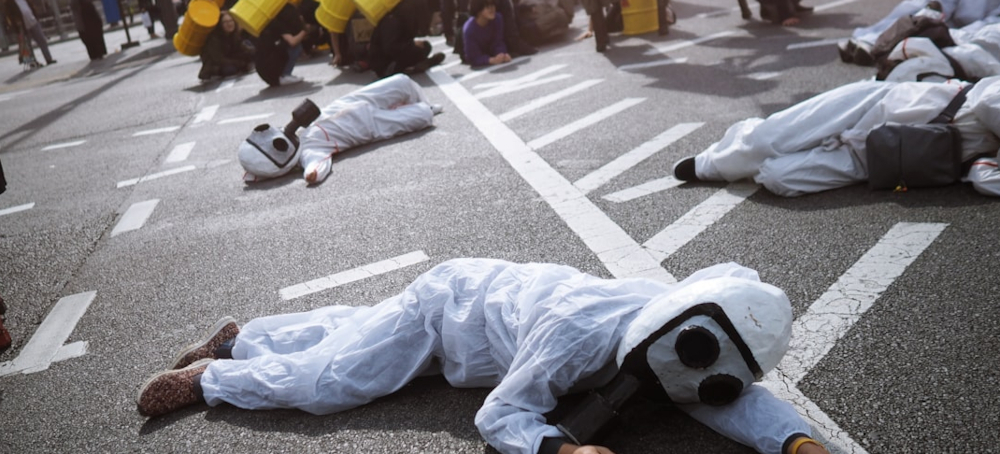 Iran’s nuclear menace is real. But that isn’t why Trump went to war — and the war isn’t going to end it. (photo: Unsplash)
 It’s Never Been About the Nukes
Bobby Ghosh SubstackALSO SEE: Ghoshworld, Bobby Ghosh on Substack
Iran’s nuclear menace is real. But that isn’t why Trump went to war — and the war isn’t going to end it.
I have been hearing some version of that sentence for the better part of two months, on television panels and op-ed pages and in private conversations with people I respect. It is offered with the air of a settled fact. It is not one. And the more often I hear it, the more I am reminded of the last time I heard people of goodwill repeat a justification that did not survive contact with the documentary record. In the autumn of 2002, I was a reporter covering the build-up to a different war, against a different Middle Eastern regime, on the strength of a different intelligence package. I would spend the next several years covering its consequences.
Let me say at the outset what I am not arguing. I am not arguing that the Iranian regime is benign, or that its nuclear program was innocent. My readers know better. Two days before the bombs began to fall, I argued in this newsletter that the Trump administration had real coercive leverage over Tehran and should use it to demand the dismantlement of an enrichment program that had no civilian justification. The Islamic Republic is a serial sponsor of terrorism, a slaughterer and jailer of its own people, an exporter of assassination, and the proprietor of a uranium stockpile enriched to 60 percent — a level no peaceful program requires. None of that is in dispute here.
What is in dispute is the case made for war.
Begin with what U.S. intelligence has actually said about Iran’s nuclear ambitions, on the public record, repeatedly, in front of Congress. The 2025 Annual Threat Assessment, published by the Office of the Director of National Intelligence, stated flatly that “Iran is not building a nuclear weapon” and that the Supreme Leader had “not reauthorized the nuclear weapons program he suspended in 2003.” The 2024 assessment said the same. Director of National Intelligence Tulsi Gabbard, testifying in March, did not retract that judgment.
Rafael Grossi, the director general of the International Atomic Energy Agency, was asked on CNN three days after the strikes whether the Iranians had been “days or weeks away from building a bomb.” His one-word answer was “no.” His March 4 statement, a few days later, was that the agency “never had information indicating that there was a structured systematic [Iranian] program to build or to construct a nuclear weapon.” Senator Mark Warner, the senior Democrat on the Senate Intelligence Committee, briefed by Secretary of State Marco Rubio in the days before the war, said in its aftermath that he had been shown no evidence Iran was preparing a pre-emptive strike on American assets — the rationale Rubio had offered in private to justify the action.
Iran’s program was advanced, dangerous, and abused beyond any plausible civilian purpose. None of that is the same as a decision to build a bomb. The threshold question — would Khamenei, who had to authorize any weaponization, do so? — was political, not technical. Every credible American intelligence assessment held that he had not.
The case for war elided that distinction. Could became would. A capability that had existed, in some form, since 2007 was repackaged as an emergency that had emerged in February 2026.
This is the move I recognize. In the months before the invasion of Iraq, the Bush administration assembled a case for war on a question — the existence of an active Iraqi WMD program — that the relevant intelligence agencies had answered with considerably more uncertainty than the public was led to believe. A small office in the Pentagon, the Office of Special Plans, was set up to bypass the cautious analysts at the CIA and produce intelligence assessments more congenial to the policy. Defectors of dubious provenance were elevated to oracular status. Aluminum tubes ordered for conventional rockets became evidence of a reconstituted nuclear program. The now-infamous 16 words about Niger uranium made it into the State of the Union. The rationale shifted, as each prior claim weakened, from weapons of mass destruction to ties with al-Qaeda to the liberation of the Iraqi people. The regime-change goal that some senior officials had advocated since the 1990s was kept off the public ledger; the public was told the war was about disarmament. Saddam was a tyrant. He had pursued WMD before. And the specific case made for that specific war at that specific moment was not true.
Iran in 2026 is not, to be sure, Iraq in 2003. The two regimes are not the same. The two intelligence pictures are not the same. Iran has weaponization-relevant infrastructure, and a documented past program, that Iraq in 2003 did not. But the rhetorical machinery deployed in Washington is recognizable. The proliferating rationales — imminent threat, missile production, navy, proxies, regime change, seizing Iran’s oil — read like a list compiled by people who could not agree on which justification would stick. The intelligence cherry-picking, with Mossad’s 15-day “crude device” estimate elevated over the more sober American timelines, has the texture of 2002. The regime-change goal that was supposedly incidental keeps reappearing as the actual objective. Mossad chief David Barnea presented Trump’s national security team in mid-January with a plan to topple the Islamic Republic; Netanyahu personally pitched the war to Trump on Feb. 11 as the trigger for a popular uprising; Trump himself, on Feb. 13, called regime change “the best thing that could happen.” Two weeks later, the bombs fell.
If the war had achieved what its public case promised, the rest of this column would be unnecessary. It has not. U.S. intelligence assessments reported by Reuters this week conclude that the time Iran would need to build a nuclear weapon has not changed since last summer’s strikes — a timeline of nine months to a year. Two months of war added nothing. The 60 percent enriched uranium stockpile that animated the case for action remains, by the IAEA’s own assessment, at the bombed sites and inaccessible to inspection because Iran has expelled the inspectors.
Khamenei is dead, succeeded by his son Mojtaba, whom regional analysts describe as a younger and more hard-line version of his father. The Washington Institute, no apologist for Tehran, concluded in April that “the war undoubtedly energized those in Tehran who have long argued that the Islamic Republic should enrich uranium to weapons-grade.” Knowledge cannot be bombed away. Intent can be hardened.
There is also the matter of what the war taught Iran. As I wrote in TIME in March, a regime stripped of its air force, much of its missile arsenal, and most of its senior leadership has discovered that it possesses a weapon cheaper, faster, and in many ways more effective than the bomb the war was sold to prevent. Iran has not had to lay a single mine to throttle the Strait of Hormuz; the threat alone, communicated by VHF radio in the war’s opening hours, persuaded the insurance market to do the work. Tanker transits fell 70 percent within a day. Brent crude is above $110. The lesson the IRGC has now absorbed — that geography is leverage, and that leverage of this kind survives even a comprehensive military beating — will outlast the ceasefire, and will shape every future negotiation.
In 2003, the war that was supposed to disarm a tyrant and remake a region instead empowered Iran, hollowed out the Iraqi state, and birthed the Islamic State. I do not know what this war will produce. Neither does the administration that started it. The honest acknowledgment of that uncertainty is the beginning of any serious policy. The diplomatic path I argued for in February is harder now than it was on Feb. 26 — the inspectors are gone, the centrifuges are buried, and the man who would have to authorize a deal is the son of the man Israel killed. But it remains the only path that can do what two months of bombing has demonstrably not.