
Is Trump Actually Having ‘Very Good’ Talks With Tehran?
Vivian Salama and Jonathan Lemire The Atlantic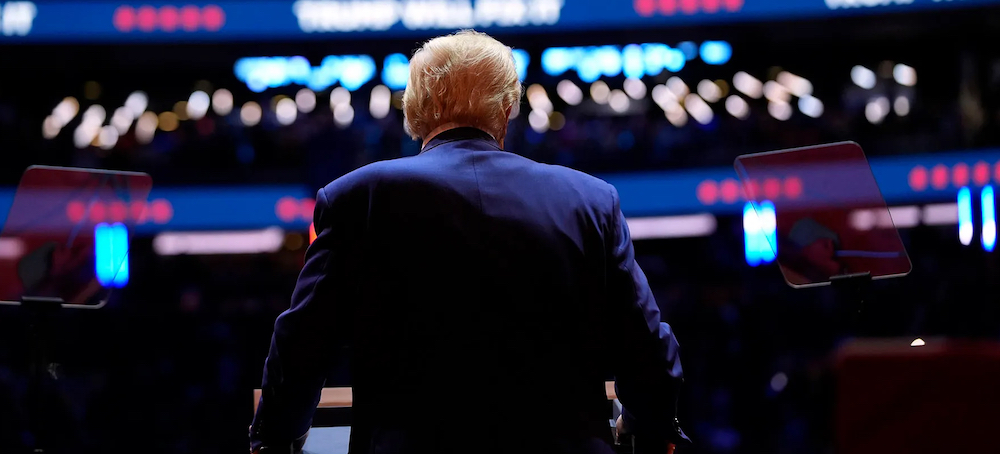 President Donald Trump. (photo: Alex Brandon/AP)
 Is Trump Actually Having ‘Very Good’ Talks With Tehran?
Vivian Salama and Jonathan Lemire The Atlantic
The disconnect between the president’s claims and Iran’s denials underscores how little control either side has over the conflict—or its narrative.
The contours of the talks were not immediately clear, though Trump suggested while leaving Palm Beach this morning that both he and “the ayatollah, whoever the ayatollah is” should control the Strait of Hormuz, through which one-fifth of the world’s oil supply passes. He boasted of “major points of agreement” and assured reporters that Iran, like the United States, wants “very much to make a deal.” Otherwise, he added, “we’ll just keep bombing our little hearts out.”
It was, by his telling, progress. By Tehran’s account, it was fiction.
The gap between Trump’s claims and Iran’s categorical denials underscores how little control either side has over the conflict—or its narrative. The White House is attempting to manage a large-scale military confrontation with an undefined exit strategy—a confrontation that is unnerving markets. As military strikes fail to reopen the waterway and allies worry about the expanding conflict, the administration is facing the limits of unilateral action.
Three foreign officials with knowledge of the U.S. efforts told us that Trump’s Middle East envoy, Steve Witkoff, has communicated with the Iranian government through Pakistan and other regional intermediaries in an effort to get the embattled regime to agree to demands regarding its nuclear program and uranium-enrichment efforts. They said that the U.S. presented a 15-point plan—based on the 15-point proposal presented to the Iranian government last year—to give the weakened regime a chance to concede and spare itself further bombardment. These officials, like others we spoke with, did so on the condition of anonymity to discuss sensitive negotiations.
Vice President Vance spoke with Israeli Prime Minister Benjamin Netanyahu today about efforts to restart talks with Iran, a person with knowledge of the discussions told us. Vance, whose long-held isolationist views have put him at odds with some in the administration—including the president—may also take part in talks in the Pakistani capital, Islamabad, in the coming days, this person said.
White House Press Secretary Karoline Leavitt told us in a statement that the situation is fluid and that any “speculation about meetings should not be deemed as final until they are formally announced by the White House.” She added that the administration would not negotiate the conflict “through the press.” Iranian officials insist that there are no negotiations. Mohammad Baqer Qalibaf, the Parliament speaker, dismissed Trump’s claims as market manipulation—they are an attempt, he said, to “escape the quagmire” and to reassure oil traders rattled by the strait’s closure.
The result is a war suspended between escalation and exit, its terms of victory as undefined now as they were at its outset.
Trump’s aides had previously urged him, advisers have told us, not to issue any ultimatums or deadlines that the U.S. would have difficulty enforcing—guidance that he followed for a time, even as his threats toward Tehran grew more belligerent. But the president grew frustrated late last week when Iran effectively closed the Strait of Hormuz and refused to reopen it, even under heavy American and Israeli bombardment.
The strait’s closure sent oil prices soaring and stock markets tumbling, and it unnerved Republicans facing close elections this fall. (Trump has often taken the stock-market indexes to be the most important metric of presidential success.) By Saturday, Trump was seething that NATO allies had refused to help secure the strait—and that he had received criticism and negative news coverage for announcing that he was glad that Robert Mueller had died, two advisers who were aware of the president’s mindset over the weekend told us. That night, Trump issued his 48-hour ultimatum to Iran.
But Iran showed no signs of budging, and some of Trump’s advisers and U.S. allies in the region warned that destroying Iran’s power infrastructure would be a mistake, one of those advisers and two other people familiar with the conversations told us. U.S. allies and experts warned that a strike of that nature might prompt Iran to attack its neighbors with much of its remaining arsenal.
And still, there would be no guarantees that the strait could be swiftly reopened. Allies also cautioned that extensive damage to Iran’s infrastructure might produce a failed state at the war’s end, which could create a refugee crisis and a dangerous breeding ground for terrorism and violence.
Since late last month, when U.S. and Israeli strikes killed much of Iran’s senior leadership, the military campaign has moved quickly (but not smoothly) toward some of the administration’s discernible objectives. American forces have hit missile sites, naval assets, and fortified positions along Iran’s southern coast near the Strait of Hormuz. Trump has said that the bombing of Kharg Island, a centerpiece of Iran’s energy infrastructure, completely destroyed the island’s military sites, though oil facilities were conspicuously untouched.
The strait, effectively closed by threats of Iranian mines, drones, and attacks on ships, has proved more difficult to reopen than to threaten. Shipping traffic has dwindled. Insurance costs have spiked.
Trump is known to pay close attention to financial markets, and he announced the five-day extension just as Wall Street opened this morning. The markets immediately rebounded, and the price of oil fell. The president acknowledged the link to reporters soon after. “The price of oil will drop like a rock as soon as a deal is done,” he said. “I guess it already is today.”
One former administration official told us that even the prospect of resuming talks is enough to give Trump cover to extend his self-imposed deadline. It has also bought the president more time to consider whether he wants to deploy ground troops to the region, perhaps a strike force to seize Kharg Island. Such an operation—pushed vigorously in public and private by allies such as Senator Lindsey Graham—could force Iran to give up control of the strait but would also come at a cost: The fighting would likely be fierce, and Trump has expressed reluctance to risk numerous American casualties.
Allies, too, have hesitated to turn to force to reopen the strait. European and Indo-Pacific partners—Japan, Australia, and several NATO states—have resisted direct military involvement, instead urging diplomacy or limited escort missions through the strait. The coalition Trump once envisioned has not materialized.
Against this backdrop, the president’s messaging has grown more improvisational. On Truth Social, Trump has alternated between declaring overwhelming victory and calling for other nations to assume responsibility for the strait’s security. His suggestion today that the passage could soon reopen under U.S.–Iranian management lacks confirmation from Tehran. The strikes threatened on Iran’s power grid—once imminent—have been paused, not canceled, and made contingent on diplomatic momentum that one side insists exists and the other denies outright. Meanwhile, the fighting continues, with no clear end in sight.