
Is the Smithsonian Really Trying to Destroy America?
Julian Lucas The New Yorker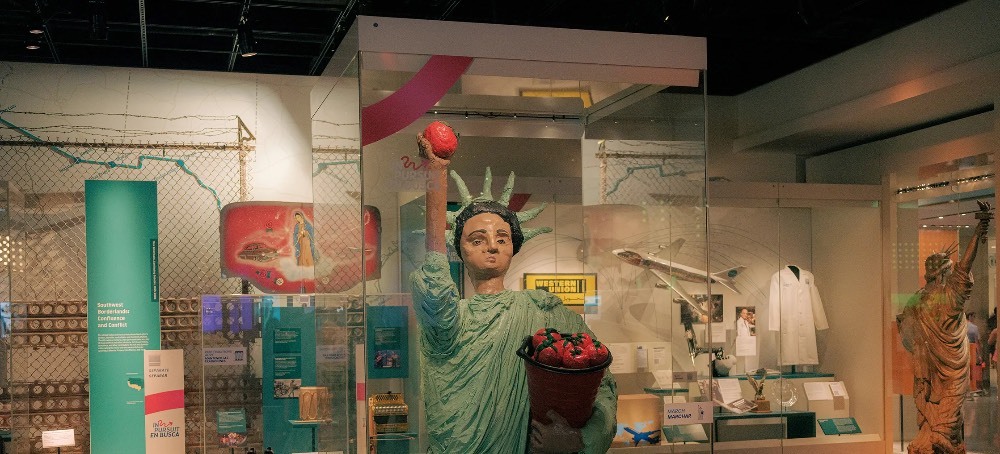 The Immokalee Statue of Liberty in “Many Voices, One Nation,” at the National Museum of American History. (photo: Lawrence Simmons)
 Is the Smithsonian Really Trying to Destroy America?
Julian Lucas The New Yorker
Trump claims that the institution has fallen into the hands of Marxist radicals. A stroll through the exhibitions suggests otherwise.
“I just think what’s going on is a false narrative,” Deborah Greenbush, a D.C. tour guide who’s taken countless visitors through the museum, said. “I have never once had any adult or youngster express the feeling that what they saw made them feel bad. If it’s factual and actual, we should talk about it.” Next to her were Cindy Stevens, a former public-housing administrator, and Pege Gilgannon, a former photojournalist, who wore a shirt emblazoned with the words “Free D.C.” (She frequently volunteers for the D.C.-statehood movement.) Leading the group was Patti Curtis, a STEM adviser at the Department of Education, who retired just before its DOGE-driven evisceration. “They eliminated the entire research department,” she said. “I’m grateful that the Smithsonian isn’t just rolling over like some of our federal agencies.”
The four women are neighbors, and belong to a nonprofit community for seniors. “It’s your second family,” Gilgannon explained. “So you don’t just sit there playing mah-jongg.” Last summer, Curtis persuaded them to join Citizen Historians, a grassroots effort to monitor Smithsonian exhibitions for political interference. She’d heard about the group from one of its founders, James Millward, a central-Asia scholar at Georgetown. “He said, ‘I’ve taught in China and seen history erased, and I don’t want it to happen here.’ ” Not long before, Trump had pressured the director of the National Portrait Gallery, Kim Sajet, to resign, in part because his official portrait’s wall text mentioned his two impeachments. Curtis organized forty volunteers to photograph its collections; altogether, more than seven hundred people have participated in Citizen Historian campaigns.
Trump’s anti-Smithsonian crusade began in March, 2025, with an executive order called “Restoring Truth and Sanity to American History.” A declaration of war against a “revisionist movement” that saw America as “irredeemably flawed,” the order called for the removal of “improper ideology” from the Smithsonian’s twenty-one museums, and threatened to slash the institution’s funding if it didn’t comply. Soon, there were panicked reports—later debunked—that artifacts from slavery and the civil-rights movement had been quietly removed.
For a year, though, the Smithsonian has been spared, in part because of its semi-independent status. It’s governed by a seventeen-member Board of Regents, which includes the Vice-President, the Chief Justice of the Supreme Court, six federal lawmakers, and nine congressionally appointed members of the general public. The institution’s secretary, Lonnie G. Bunch III, has defended its integrity, but also shrewdly avoided provocative shows of resistance. Last August, he reportedly charmed Trump over lunch at the White House, and by the start of this summer’s Semiquincentennial celebrations, it was almost possible to believe that the Administration had moved on. Then, on July 4th, the White House Domestic Policy Council published a report called “Saving America’s Story,” which alleges that the N.M.A.H. has been hijacked by a cohort of radical activists. Shortly thereafter, Trump ordered the National Park Service to install warning signs outside the museum, whose director, Anthea Hartig, was summoned to testify on Capitol Hill.
“I was disturbed to hear about the quetzal,” Morgan Griffith, a congressman from Virginia, told Hartig, alluding to the suspiciously foreign bird feathers in a children’s show about money. (Quetzal feathers were once used as currency by the Aztecs and their trading partners in the American Southwest.) Nancy Mace, of South Carolina, called Hartig an ally of “queer pedophiles,” adducing, as evidence, a photo of RuPaul from an exhibition on American pop culture. Republicans also played a montage of Hartig making land acknowledgments, demanded to know why she’d once said that “loving America is very complicated,” and expressed outrage that no special exhibitions had been mounted about the Founding Fathers or the Declaration of Independence.
Democrats denounced the proceedings as a totalitarian show trial. Their star witness, the Pulitzer-winning historian David W. Blight, called the White House report “a declaration of political war on the historian’s profession,” and scoffed at accusations of left-wing revisionism. “All history is revision,” he said. “Would you prefer your doctors not to be revisionists?” Hartig, by contrast, was polite almost to the point of meekness, constrained by her role to “Sir”ing and “Ma’am”ing her inquisitors while affirming her commitment to a patriotism that was “not instructed but inspired.” She invited lawmakers to “walk the building with me” and “stand in front of the Star-Spangled Banner, in awe”—implying, not without reason, that many had never even visited the museum they were so determined to control.
If they did come, the Citizen Historians were determined to get there first. Curtis unfolded a map of the museum with eight galleries circled in hot pink. “We powwowed last night and realized we could hit four of them,” she explained. “Rather than split up, let’s go together and saturate.”
“Can anybody read that?” Gilgannon whispered, holding her phone up like a flashlight.
“Yeah, ‘Oh say can you see by the dawn’s early light,’ ” Curtis replied.
We were standing in the darkened chamber that houses the Star-Spangled Banner, whose tattered stripes were dimly visible behind glass. The flag was made by Mary Pickersgill, who sewed it with the help of her daughter, two nieces, and an “African-American indentured servant” named Grace Wisher. Curtis frowned. “Do we really think she was an ‘indentured servant’?” she asked, wondering if the label had originally read “slave.” Gilgannon sighed: “I hate how they put it in your head that you’re gonna get tricked.”
The White House report contends that N.M.A.H. has abandoned patriotism and erased the Founding Fathers in service of an “anti-white agenda” that seeks to “divide, dispirit, and discourage our citizens.” But a quick search of the collections database revealed that nearly a hundred objects associated with George Washington and the Revolutionary War—including Washington’s uniform, his battle sword, and his dinner plates—were on display. From the Star-Spangled Banner, we made our way to Horatio Greenough’s 1841 sculpture of a shirtless, sword-bearing Washington, its caption explaining how the sculptor had captured his “highest and noblest virtues.” Greenbush, the tour guide, was amused by his neoclassically bare chest. “He would have been mortified, I’m sure.”
Behind Washington was “Many Voices, One Nation,” an exhibition about the struggle of disparate peoples to forge an American identity. A video collage showcasing America’s diversity played on loop near the entrance; Gilgannon, whose family comes from Belgium, said, “My mother’s in there.” The four women fanned out to photograph the objects on display: an Irish brooch, a Chinese-American shop sign, a collection of accessories abandoned by migrants in the Sonoran Desert. The report frames the show as “pro-illegal alien activism,” but hadn’t mentioned its Border Patrol uniform, whose caption praised the agent’s twenty-two years of service. Later, we gawked at the lavishly decorated 1963 Chevy Impala in “Corazón y vida,” another exhibit derided as a paean to “foreign” peoples—the Chicanos of Southern California, who started building “lowriders” with elaborate hydraulic systems in the nineteen-forties. “I think I’d be scared when it lifts up,” Curtis said, inspecting the undercarriage. “We went to see ‘The Odyssey’ in 4DX a few weeks ago and I was screaming!”
On the top floor was “American Democracy,” a sweeping exhibition about self-governance. Near the entrance was the desk where Thomas Jefferson drafted the Declaration of Independence. Farther in was paraphernalia from a quarter millennium of Presidential campaigns, including Trump’s. (There was even a MAGA hat.) The exhibition culminated in a display of protest signs. The report characterizes them as “almost all for various progressive causes,” and I quickly spotted slogans familiar from Black Lives Matter and the campaign for marriage equality. But equally prominent were “Secure Our Borders,” “Stop Abortion Now,” and projected footage from a Tea Party rally—all unmentioned. Gilgannon took a picture of one from the D.C.-statehood movement. “They practice and promote joy,” she explained. “At first, I thought, What’s this crazy woo-woo? But that’s what’s going to bond us together when we have to, like, fight the National Guard.”
There was plenty of joy in “Entertainment Nation,” a bright, busy, and noisily media-rich survey of American pop culture. Greeting visitors was a photo of the jazz trumpeter Dizzy Gillespie, a “cool, Cold Warrior” who used music to fight Communism. Nearby was the sheet music for Irving Berlin’s “God Bless America” and Dorothy’s ruby slippers from “The Wizard of Oz,” whose L.G.B.T.Q. affiliations somehow escaped Republican scrutiny. It took several minutes for Greenbush and me to find the exhibition’s most controversial inclusion—an animation sketch depicting Mickey Mouse’s début in “Steamboat Willie” (1928), whose caption links the character to “longstanding traditions of blackface minstrelsy.” For once, a Citizen Historian and the report were on the same side. “Who would even make that connection?” Greenbush scoffed. “Maybe I’m naïve, but I never would have thought that. And there were points where I did watch a lot of Mickey Mouse.”
During the hearings, Representative Brandon Gill, of Texas, asked Hartig a question precision-engineered to extract a disqualifying sound bite: “Is Mickey Mouse racist?” When she said no, Gill quoted the caption—and again, Hartig affirmed Mickey’s innocence. “You don’t think blackface minstrelsy is racist?” Gill asked, now genuinely confused. Hartig kept calm. “It’s not for me to determine what’s problematic,” she replied. “It’s for me to determine what’s accurate.”
It’s well established that the Mickey Mouse of “Steamboat Willie”—who wears white gloves and performs the minstrel standard “Turkey in the Straw” on a paddle steamer—has its roots in blackface, which was, for nearly a century, one of America’s most popular forms of entertainment. To Republican lawmakers, pointing this out is character assassination, an attempt to cancel poor Mickey and all who hold him dear. But if Representative Gill visited the Smithsonian’s National Museum of African American Culture, he might be surprised to learn how many great Black entertainers—including Eubie Blake and Josephine Baker—share Mickey’s checkered beginnings, and with what impartial curiosity these are explored.
Our tour of “Entertainment Nation” concluded with a video installation called “What’s So Funny?” It juxtaposed racist moments in old films and cartoons—Judy Garland dancing in blackface, Bugs Bunny fighting the Indian Wars—with excerpts from the routines of nonwhite comedians such as Margaret Cho and Richard Pryor. We laughed and cringed by turns, our faces painted by the light from the projectors. The 1946 film “Song of the South” came on, and I could feel us all torn between humming along to “Zip-A-Dee-Do-Dah”—a song that my grandmother, a Black woman, loves enough that she once bought an alarm clock with the melody—and recoiling in shame from Uncle Remus’s toothy grin. “My grandfather was actually in minstrel shows,” Greenbush abruptly volunteered. And yet, there she was, protecting our messy common heritage from being wiped clean.
How did the Smithsonian commemorate American history in simpler times, before postmodernism, intersectionality, and the many other Hydra heads of “woke”? The museum’s Semiquincentennial exhibitions struck me as neutral enough. But in order to assess their patriotism objectively, I needed to see how the N.M.A.H. had marked the 1976 Bicentennial, when the museum, the Smithsonian, and the federal government were all helmed by white men.
To my surprise, there was nary an exhibition dedicated to a Founding Father. But there had been a monumental show called “The Nation of Nations,” whose subject was America’s diversity. It opened with a survey of Native cultures, tracing the country’s identity as a “nation of immigrants” to the first Siberians who crossed the Bering Strait. A display about Ellis Island—which played recordings in dozens of languages—celebrated modern immigration, while a re-created nineteenth-century classroom was used to explain the process of naturalization. An entire section dedicated to American prejudice included anti-Japanese signage and a Ku Klux Klan hood.
Curators seem not to have worried that this would divide the American people. In the exhibition catalogue, then secretary of the Smithsonian S. Dillon Ripley—a former intelligence officer who was awarded the Presidential Medal of Freedom by Ronald Reagan—describes America as “a place of turmoil among red men, white men, black men, and yellow men.” Yet no one hauled him before Congress to answer for stoking racial tensions, snubbing George Washington, or making America sad on her birthday. Today’s Smithsonian should be equally uncontroversial—and, without the Trump Administration’s propaganda, it probably would be.
The institution remains vulnerable. Republicans have proposed cutting its budget by more than ten per cent, and if they can fill the vacancies on its Board of Regents before the midterm elections, they may be able to fire Bunch. Yet there are also signs that the right’s revisionism panic might be petering out. Senator Lisa Murkowski of Alaska recently came out in support of the Smithsonian, while the Second Lady, Usha Vance, even feels comfortable collaborating with it. In May, she led a story-time event at the N.M.A.H. in honor of Asian American and Pacific Islander Heritage Month—in other words, a D.E.I. event for children, at a museum that her party believes is full of “inappropriate sexual and ideological content.” (She read from “Masala Chai, Fast and Slow,” by Rajani LaRocca, who is also known for “Some of Us,” a book for early readers that celebrates immigrant citizenship.)
She’s not the only conservative who didn’t get the memo. The day after my visit to the N.M.A.H., I went to see “America’s Presidents” at the National Portrait Gallery, where I found a father and son snapping selfies in front of Trump’s glowering mien. “We wanted to have a last weekend together before he went off to college,” the man explained; earlier, they’d been to the National Air and Space Museum. The man proudly acknowledged supporting Trump, but seemed confused when I asked if he’d spotted anything “radical.” He recalled a caption about a “wealthy landowner back in the day” who’d enslaved Native Americans, which he wasn’t sure was relevant, but he wouldn’t go so far as to say that it ought to be removed. “I don’t know if it’s unpatriotic,” he said. “It’s all good and bad. It’s part of our history.”