
Is Netanyahu Planning an ‘October Surprise’?
Amos Harel Haaretz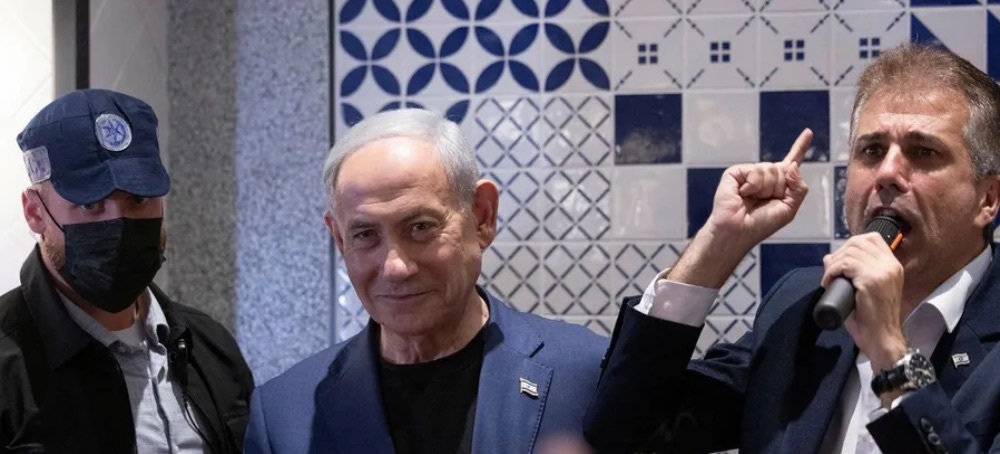 Prime Minister Benjamin Netanyahu during a visit to Holon this week. (photo: Moti Milrod)
 Is Netanyahu Planning an ‘October Surprise’?
Amos Harel Haaretz
Netanyahu again reads intelligence to suit himself, but security sources see no urgency to act. Much depends on Trump and Zamir ■ Ronen Bar's lawsuit is an opening move toward a state commission of inquiry
Likud's situation, according to the polls, is not great. Apart from a few polls conducted by supporters of Netanyahu, who tend to change their assessments according to what is likely to serve the prime minister, most media are predicting, at best (for Netanyahu) a draw between the two blocs. Even that result is only due to the one major success Netanyahu chalked up: his delegitimization campaign against the Arab parties, the result of which is that they're not counted as part of the opposition bloc.
Given these circumstances, Netanyahu's primary goal is abundantly clear: creating political paralysis, which will allow him to continue heading a caretaker government until another election is held. At the same time, he might examine the possibility of dragging the opposition parties into a national unity government.
But an election in which the military agenda features significantly, and particularly a security emergency on one front or another, can upset the apple cart. In an extreme scenario, it could even lead to postponing the election by a few months. Netanyahu has nothing to lose. From his viewpoint, failure in the elections and losing power are a disaster. Not only for the country or for his party, but above all for him.
The impression of those who have spoken to him in recent years is that he is convinced that electoral defeat will lead to his conviction in his criminal trial. And that could mean being sent to jail, despite his advanced age, and contrary to the forecasts of many legal analysts who expect that in those circumstances he will quickly sign off on a plea bargain.
If there is one thing clear from Netanyahu's recent behavior and declarations, it's that there is no ploy, no manipulation, no lie he wouldn't use, if it keeps him out of a cell in Ma'asiyahu Prison.
In the past few weeks Netanyahu has frequently mentioned the danger of a security flare-up. On Wednesday he claimed that there were growing signs that Israel's enemies are plotting something on the eve of the election. At the same time, Barak Ravid, the Washington correspondent of Channel 12 News, reported that Netanyahu had discussed with U.S. President Donald Trump the possibility of Israel attacking Iran on its own, or together with the United States, and that the president told him to prepare for a scenario of that sort, but didn't give him a green light.
Israel Defense Forces Chief of Staff Eyal Zamir said on Wednesday, during a visit to Central Command headquarters, that the potential for security escalation in the region has increased "in light of the multitude of warnings in all arenas and the sensitivity of the period." Lately, IDF systems were indeed placed on higher defense alert and initial preparatory steps were taken.
Since Trump abruptly canceled an American attack on Iran at the beginning of August, he has opted instead for economic sanctions against the Tehran regime – that is, until this week when he reverted to threats. The president makes no secret of his revulsion with the war against Iran, now simmering on a low burner.
Until recently, the president's approach was to refrain from attacking Iran, at least until after the Congressional midterm elections, which follow the Knesset elections by a week. In addition to the frustration over America's inability to decide the war and impose a concessions-rich agreement on Iran's new Supreme Leader, Mojtaba Khamenei, there is now another concern: recent intelligence about Tehran's preoccupation with various aspects of its nuclear program and ballistic missiles industry.
Netanyahu is interpreting the intelligence – and not for the first time – in a way that will serve his political purposes. The assessment of various security sources, consulted by Haaretz, is that there is no justification for launching an urgent military action in the 11 days remaining until the election. What happens now depends mainly on two people: Trump and Zamir. Without their approval, there will be no attack.
Trump is keeping a certain distance from Netanyahu and has so far refrained from expressing public support for him on the eve of the Israeli election. This is apparently due in part to his disappointment over Netanyahu's failed predictions about the ease of toppling the Tehran regime (which were voiced mainly in the meeting between the two leaders at the White House on February 11). Notwithstanding that, it is hard to ignore the great influence that Netanyahu had over Trump until the last-act complication in Iran.
As for Zamir, he has a record of delaying implementation of demands by Netanyahu and the security cabinet when they weren't to his liking, as in the summer of 2025. At that time, the prime minister pushed for the conquest of the northern Gaza Strip, instead of promoting the final hostage deal. What happened subsequently is that Netanyahu, contrary to the views of the security chiefs, ordered the assassination of Hamas' leaders in Qatar. The operation failed, Trump was furious, and a month later forced a final agreement on Netanyahu. That would not have happened had it not been for the position taken by Zamir and his moves on the ground to delay the military operation.
The trouble is that in Iran the choice is binary: 1 or 0. Delaying actions won't be useful. If there will be a government directive to attack, and Zamir suspects the motive is only fear of losing the elections, he will have to say so publicly and take steps that no IDF chief of staff has ever taken before. He'll be caught between a rock and a hard place.
The window for a decision on military action against Iran could also remain open until after the elections. In May 2021, the Gaza arena flared up, in the form of Operation Guardian of the Walls, at a stage when Netanyahu was competing with Naftali Bennett and Yair Lapid in an attempt to form a new government after yet another election had ended in a sort of draw. Creating security chaos in the event of an inconclusive result will make it difficult for Gadi Eisenkot and Bennett to form a new coalition, especially if they need the support — even from outside the coalition — of Arab parties.
In the meantime, the surging violence in the West Bank continues. Now, with the olive harvest underway, not a day passes without violent attacks by extremist settlers against Palestinian farmers. The army, manifesting its flawed performance in this regard, from the chief of staff down, is barely acting to rein in the phenomenon. The police, the Shin Bet security service and the Defense Ministry's district coordination and liaison offices in the territories are all partners to this disgrace.
There is no reason to suppose that things in the West Bank and East Jerusalem will calm down ahead of the elections. On the contrary, someone will probably think they have come up with a brilliant idea: Ignite a bigger conflagration in the hope that this will influence the political arena.
Indifference and inaction
The libel suit that former Shin Bet head Ronen Bar filed against Netanyahu on Wednesday, and the documents appended to it, read like an opening move toward the future establishment of a state commission of inquiry. That is exactly what Netanyahu has fought against with all the means at his disposal, every day since the October 7 massacre.
For the first time, Bar has presented in such great detail the warnings he presented to Netanyahu spanning from November 2022, after Netanyahu's election victory and before he formed his right-wing government, up until the beginning of October 2023. Bar cites more than 20 instances, many of which refer to the need to deal toughly with Hamas in the Strip – and he wasn't the only one who warned Netanyahu.
Some of the items in the text of the libel suit are hair-raising. According to Bar, Netanyahu rejected a strategic planning document that was presented to him in July 2023, containing recommendations to strike at the Hamas leadership, on the grounds that the Shin Bet director had ventured into an area that was not part of his domain and had thereby undermined the foundations of democratic government. In another case, the prime minister expressed apprehension at the resumption of assassinations; the rationale: this was liable to lead to attempts to harm him and his family.
בחודשים שקדמו ל-7 באוקטובר, ראש הממשלה נתניהו לא נפגש ולא שוחח עם עבאס כאמל, שעמד אז בראש שירות המודיעין הכללי של מצרים, ואף גורם מודיעיני ישראלי לא העביר לראש הממשלה אזהרה מצרית. ראש הממשלה הנחה להגיש תביעת דיבה גם בנושא זה. מעבר לכך, חשוב להבהיר: ראש הממשלה נתניהו מעולם אינו
According to Bar, there were "persons in the government" who supported transferring control of the Palestinian cities in the West Bank to Hamas, in place of the Palestinian Authority.
The general picture that arises from the documents, which are backed by quotations and specific dates, shows indifference and inaction by Netanyahu concerning the danger posed by Hamas, despite the warnings he received. Bar's documents also undermine the defense mounted by Netanyahu's supporters who argue that the four letters sent by the head of the Research Division in Military Intelligence, Brig. Gen. Amit Saar, on the eve of the war – were all warnings focused on Hezbollah and the northern front.
The lawsuit was filed in response to a tweet by Netanyahu on X on September 28, in which he attacked Bar harshly, also hinting at conspiracy theories involving betrayal within the Shin Bet on the eve of the massacre. According to Bar, that was the straw that broke the camel's back, after he had ignored numerous vilifications by Netanyahu, his family and his confidants in the past few years.
One can't ignore the timing of the lawsuit. Bar threw a grenade into the ring on the eve of the elections, in response to an attempt by Netanyahu to cast aspersions on him – and this is happening while the prime minister is dissociating himself from all responsibility for the disaster. It's worth recalling that Bar resigned more than a year ago and publicly admitted his mistakes.
It's very unlikely that many voters will change their mind at the last minute and abandon the Netanyahu bloc (or decide to stay home on Election Day) in the wake of the new accusations and revelations. That said, it's impossible to ignore the fact that this time, in contrast to the past, Netanyahu is having a hard time controlling the media agenda. The election campaign continues to revolve in large measure around responsibility for October 7, while more recent events, such as the flydubai plane incident, are only intensifying the preoccupation with the government's management failures.
All of this dovetails with the Yonatan Urich affair. Netanyahu's closest adviser caused a grave security lapse, which revealed his exchanges on messaging apps to individuals hostile to him. The revelations, which the institutionalized media is reporting only indirectly, provide a glimpse into the workings of the ramified machine at Netanyahu's service.
At the same time, more segments are being leaked from the criminal investigation against Netanyahu's advisers in the Qatar affair, including allegations that the connection with the Qataris continued for many months after the October 7 massacre.
Netanyahu, who launched an interview offensive – for now only in very friendly venues – described the new reports as also being "fake." Almost two years after the initial report by Haaretz's Bar Peleg, which showed vigorous Qatari meddling in the prime minister's closest circle, Netanyahu remains fully behind his aides.
That's not how he behaved in previous scandals, when he sometimes chose to distance himself from confidants and aides who were suspected of criminal wrongdoing. This time, apparently, his space for denial is smaller. Netanyahu is gambling on a political stalemate, and can't afford a crisis in the "beehive," as the team of top aides is dubbed, in the last stretch of the election campaign.
But Bar's suit, the leaks from Urich's breached accounts and the unending disputes over the warnings that Netanyahu received on the eve of the attack are all turning the October 7 massacre into a central election issue. And that is unlikely to serve the coalition.