
Iran War Drives Massive Surge in Planet-Heating Emissions Amid Calls to Accelerate Transition to Renewables
Jan Lee Earth.Org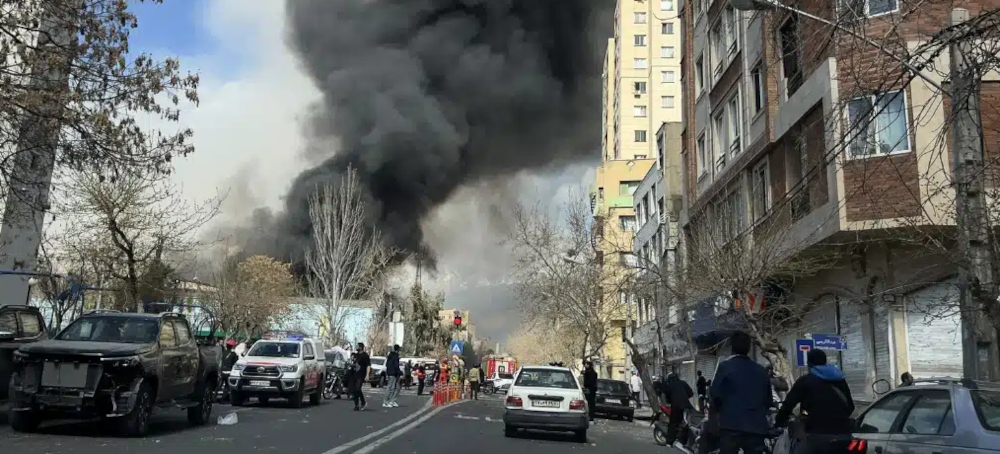 Smoke rises following a US-Israeli airstrike in Tehran on March 3, 2026. (photo: Avash Media)
 Iran War Drives Massive Surge in Planet-Heating Emissions Amid Calls to Accelerate Transition to Renewables
Jan Lee Earth.Org
With the first 14 days of conflict in the Middle East unleashing emissions exceeding the annual footprint of Iceland, the race is on to understand the short- and long-term climate impact of this latest chapter in modern warfare.
The meme has been shared widely across social media since the US and Israel attacked Iran on February 28. The conflict quickly spread across the Middle East as Iran attacked neighboring Gulf countries in retaliation, sending shockwaves across the globe.
The US has launched more than 8,000 combat flights since “Operation Epic Fury” – the coordinated US-Israeli attack on Iran from late February. Aircraft include Bombers and fighter jets, drones, reconnaissance aircraft, cargo planes and refueling tankers, as well as military helicopters.
A Lockheed Martin F-35 Lightning II fighter jet, one of these, consumes approximately 5,600 to 6,500 liters of kerosene during a single combat sortie of one-and-a-half to two hours, according to Lennard de Klerk, head of the Initiative on Greenhouse Gas Accounting of War. This emits some 14-17 tons of carbon dioxide, around that of the entire lifetime of a conventional passenger car. Meanwhile, Lockheed Martin, a major weapons manufacturer, says its products emitted nearly 14 million tons of CO2 equivalents when in use in 2024.
Difficult to Calculate
An analysis by the Climate and Community Institute has found that the total greenhouse gas emissions from the first 14 days of assault is more than 5 million tonnes of carbon dioxide, which is higher than the total climate pollution of Iceland in 2024. But exact emissions are notoriously difficult to calculate.
De Klerk’s team estimates that Russia’s full-scale invasion of Ukraine, now going into its fifth year, has already emitted 311 million tons of greenhouse gas equivalents, while the war in Gaza has emitted 32 tons over two years. “Now we’re talking about two weeks, it’s a couple of million tons of CO2 for this war. Just direct emissions from warfare,” he told Earth.Org.
Along with the emissions from military vehicles and aircraft, immediate contributions to global warming can include emissions from fires and explosions. However, de Klerk said, “People tend to think that explosions of attacks on depots and oil refineries generate a lot of greenhouse gas emissions, but the biggest impact is the fuel consumption by both Israel and US military, the kerosene used by the fighter jets and the diesel used by the US navy. The emissions from fuel consumption are 20 to 30 times bigger than those from the destruction from the energy infrastructure.”
Forced changes to commercial aviation routes are also emerging as a major short-term impact of the Iran war, with half a million passengers per day traveling through Gulf hubs under pre-war conditions – many of which are now being re-routed to longer routes, consuming greater quantities of fuel and generating more emissions. Sometimes, flights are re-routed because of deliberate jamming of their Global Positioning Systems, while others avoid the area as a precaution against being mistaken for a military aircraft.
Methane and black carbon are among the other air pollutants from conflict that may create climate impacts. “It’s not just CO2 from burning the oil, it’s the uncontrolled release of methane that concerns me,” Neta Crawford, author of The Pentagon, Climate Change, and War: Charting the Rise and Fall of U.S. Military Emissions, told Earth.Org. “It’s the same with the targeting of storage facilities in Iran – some are oil, and some are natural gas, which is not combusted but just put into the atmosphere.”
A new source of operational emissions from warfare may come from the use of Artificial Intelligence (AI). The US Department of Defense has promised that “AI-enabled warfare and AI-enabled capability development will re-define the character of military affairs over the next decade.” Data centers already consumed about 1.5% of global electricity consumption in 2024, and AI use may cause this amount to double by 2030.
Long-Term Impacts
The full scale of climate damage will not be known until after the war.
“In terms of climate impact, we need time to see the medium-term and long-term effects,” Grace Alexander, Researcher at the Conflict and Environment Observatory (CEOBS), told Earth.Org.
Russia’s full-scale invasion of Ukraine has caused massive emissions from forest fires, while attacks on urban areas tend to generate greater carbon dioxide emissions in the long term, during the reconstruction period. “Given the length of the conflict in Ukraine, rebuilding is going to be an important source of greenhouse emissions. A lot of climate impacts are unclear because it depends on the length of the war,” said Alexander.
The “other” elephant in the room, according to de Klerk, is rearmament. “Already, because of Russia’s aggression, military spending is rising,” he said. “If insecurity goes up, then many other countries around the world will ramp up spending and increase military emissions.”
Crawford pointed out that emissions from everyday operations of bases and installations, including training, food, cooling, and transportation are enormous even before a conflict begins. Scope 1 and 2 emissions from the US military’s standard operations in 2024, prior to the current war, reached almost 32 tons of CO2 equivalent.
While the overall figures for everyday operations fluctuate, for example because of the increased use of outside contractors whose emissions are not included in the calculations, greater military spending is generally expected to increase emissions. US President Donald Trump recently called for a military budget of $1.5 trillion for 2027, significantly higher than the $901 billion approved for 2026.
At a structural level, wars can also impact the way a country’s infrastructure develops. “When the military creates demand and a new system, that changes the economy,” said Crawford. “For example, when the military turned its TNT factories to the production of nitrates for soil for fertilizer [following the second world war], that changed the pattern of fertilizing fields. And we know nitrous oxide is a potent greenhouse gas.” Likewise, the US established its highway system following the first world war to transport equipment between industrial states on the coast to places where steel was made, resulting in an explosion of sub-urbanization that increased emissions.
Will War Polarize the Energy Transition?
The new war’s most lasting impact may come in its long-term effect on the energy transition, particularly driven by increased natural gas prices. “We’re looking at countries from the affected region that are reliant on LNG. This may mean a switch to other fossil fuels, even coal in some countries – and a switch comes with an investment cost, which means that countries will be locked into a fossil fuel source,” explained Alexander. According to a new analysis released by CEOBS, Pakistan and Bangladesh are particularly vulnerable to transit flow disruptions, with two thirds of their LNG supply shipped through the Strait of Hormuz in 2025.
Iran has effectively blocked traffic in the Strait of Hormuz, one of the world’s busiest oil shipping channels, following the February 28 attacks by the US and Israel. Some 20-25% of global oil supply typically passes through it, making it a critical global energy chokepoint.
“On the other hand, with this insecurity of fossil fuel supply, other countries will be more motivated to go towards an energy transition [to renewables]. A crisis like this really highlights the insecurity around fossil fuel energy infrastructure,” she added.
The most likely impact, according to the experts, is that the Gulf will be widened between those countries that are already further along their energy transition. Countries with a strong renewable energy base will embrace the energy independence that it provides, while those more dependent on LNG will turn to other fossil fuel replacements.
“The broader point is simple: the further a country advances its energy transition, the more resilient – and the more sovereign – it becomes. This war makes that equation impossible to ignore,” Sebastian Kind told Earth.Org in an email. As Argentina’s former Undersecretary of Renewable Energy, Kind led the country’s energy transition in the late 2010s.
For him, fossil fuel dependency is not just a climate risk but also “an economic burden and a national security vulnerability,” and only those countries that have already scaled up domestic renewable energy will be immune to geopolitical disruption. “The lesson is not new, but the urgency is. Every government watching oil above $100 a barrel should be asking how quickly it can build the policy and financial architecture to unlock private investment in renewables. The technology is ready and cost-competitive. What has been missing is political will, and crises like this one should provide it,” Kind said.
Meanwhile, the perception that climate change may accelerate warfare can also create a negative spiral. “For years, people have been talking about climate change as a threat multiplier – climate refugees may destabilize local governments, or climate change leads to stress on the resources for daily life like food and water, or resources for the transition like lithium. But then that [idea] has been used to say that we need to do more military preparation,” said Crawford.
Ultimately, experts emphasize, the decision to go to war has consequences not only for the combatants but for the rest of the planet. “We’re overlooking the real, present and future consequences of militarization and war in favor of paying attention to possible, avoidable, speculative conflicts with powers that do not threaten the United States in particular, and which may never,” said Crawford.