
Iran: The Treason That Changed America’s Energy Future
Thom Hartmann Substack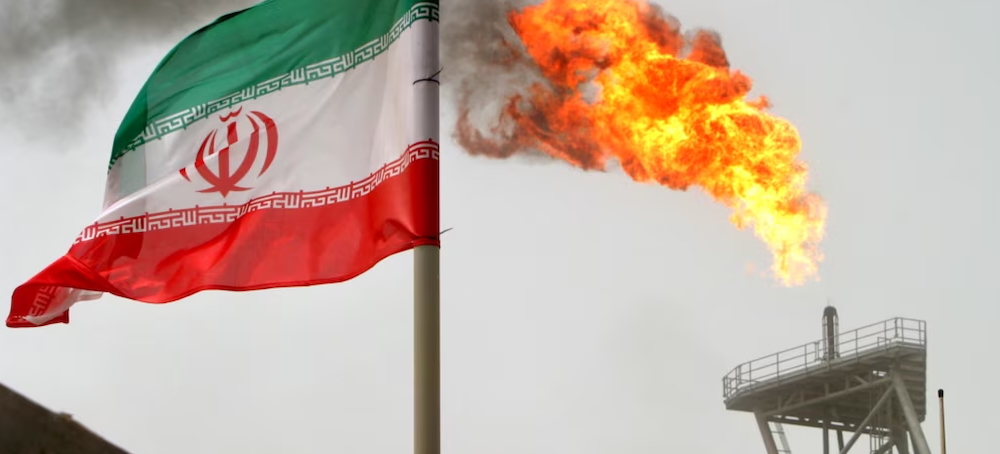 A gas flare on an oil production platform in the Soroush oil fields is seen alongside an Iranian flag in the Persian Gulf, Iran. (photo: Reuters)
 Iran: The Treason That Changed America’s Energy Future
Thom Hartmann Substack
How Reagan’s secret betrayal of America during the Iran hostage crisis helped him win the presidency, killed Carter’s clean-energy revolution, and helped create today’s crisis in the Strait of Hormuz…
Much to their dismay, the other countries of the world are largely echoing German Defense Minister Boris Pistorius, who said on Monday,
“This is not our war, and we didn’t start it.”
It shouldn’t have been our war, either, and wouldn’t be if Reagan hadn’t committed treason to become president and then sold the GOP to the fossil fuel industry. Today we’re paying the price for that Republican perfidy.
After the Arab oil embargo of 1973, the United States went on a nearly two-decade-long effort to become more energy efficient and less reliant on Middle East fossil fuel products. When Jimmy Carter became president in 1977, he declared the energy crisis “the moral equivalent of war”:
“The energy crisis is real,” Carter told the nation in a televised address that Republicans ridiculed. “It is worldwide. It is a clear and present danger to our nation. These are facts and we simply must face them.
“What I have to say to you now about energy is simple and vitally important. Point one: I am tonight setting a clear goal for the energy policy of the United States. Beginning this moment, this nation will never use more foreign oil than we did in 1977 -- never.”
He declared a national crisis that year and proposed legislation to create:
“[T]his nation’s first solar bank, which will help us achieve the crucial goal of 20 percent of our energy coming from solar power by the year 2000.”
Tragically for America and the world, it all came crashing down when a faction of Iran’s most extreme rightwing mullahs helped the fossil fuel industry’s candidate, Ronald Reagan, replaced Carter in the 1980 election. Reagan then killed the solar bank and the solar bond programs, and removed Carter’s 32 solar panels from the roof of the White House.
As a result, we’ve actually increased our consumption of fossil fuels so much that the fossil fuel industry’s billionaire investors have made an estimated $52 trillion in profits in the years since Reagan’s presidency. And global warming is now driving climate wilding that’s killing Americans and threatening all life on Earth.
It’s particularly galling when you realize that Carter’s goal to save the planet from climate disaster and insulate us from Middle East oil shocks was short-circuited by an act of naked Republican treason.
During the Carter/Reagan election battle of 1980, then-President Carter had reached a deal with newly-elected Iranian President Abdolhassan Bani-Sadr to release the fifty-two hostages held by students at the American Embassy in Tehran.
President Bani-Sadr was a moderate and, as he explained in an editorial for The Christian Science Monitor, successfully ran for President that summer of 1980 on the popular position of releasing the hostages:
“I openly opposed the hostage-taking throughout the election campaign…. I won the election with over 76 percent of the vote…. Other candidates also were openly against hostage-taking, and overall, 96 percent of votes in that election were given to candidates who were against it [hostage-taking].”
Carter was confident that with Bani-Sadr’s help, he could end the embarrassing hostage crisis that had been a thorn in his political side ever since it began in November of 1979 and support a moderate government emerging in Iran.
But behind Carter’s back, the Reagan campaign worked out a deal with the leader of Iran’s most hard-core rightwing radical faction — Supreme Leader Ayatollah Khomeini — to keep the hostages in captivity until after the 1980 presidential election. Khomeini needed spare parts for American weapons systems the Shah had purchased for Iran, and Reagan was happy to promise them.
The Reagan campaign’s secret negotiations with Khomeini — the so-called “October Surprise” — sabotaged President Carter’s and Iranian President Bani-Sadr’s attempts to free the hostages. It also catapulted the most repressive, violent Iranian religious faction into total power over that nation. As President Bani-Sadr told The Christian Science Monitor in March of 2013:
“After arriving in France [in 1981], I told a BBC reporter that I had left Iran to expose the symbiotic relationship between Khomeinism and Reaganism.
“Ayatollah Khomeini and Ronald Reagan had organized a clandestine negotiation, later known as the ‘October Surprise,’ which prevented the attempts by myself and then-US President Jimmy Carter to free the hostages before the 1980 US presidential election took place. The fact that they were not released tipped the results of the election in favor of Reagan.”
And Reagan’s treason worked so perfectly that it’s almost never mentioned in the media when we talk about the current war with Iran. For example, a TV special last week about the Iranian backstory looking at the hostage crisis even failed to mention Reagan’s treason (it was produced by CBS, now under the ownership of GOP-aligned rightwing billionaires, so this probably shouldn’t be surprising). Even though The New York Times essentially confirmed the story in 2023 when the former Lieutenant Governor of Texas confessed that he had been there for the negotiations.
The Iran hostage crisis continued through that entire election year, strengthening Ayatollah Khomeini’s grip on power and torpedoing Jimmy Carter’s re-election hopes. And the same day Reagan took the oath of office — literally to the minute, as Reagan put his hand on the bible, by way of Iran’s acknowledging the deal — the American hostages in Iran were released.
Keeping his side of the deal, Reagan began selling the Iranians weapons and spare parts in 1981, empowering the most radical mullahs and destroying the political base for moderates like Bani-Sadr. He continued giving the hard-right religious fanatics aid until he was busted for it in 1986, producing the so-called “Iran Contra scandal.” By that time, the extremists who still control Iran today had completely consolidated their power over the nation.
The consequences of Reagan’s embrace of Iran’s rightwing mullahs and that nation’s consequent radicalization have lasted for two generations, as has the damage to America from his destruction of Carter’s energy programs.
This crisis most likely will span generations, too, because, like Reagan, Trump killed off America’s programs to increase energy efficiency, generate electricity from renewable sources, and electrify our cars and trucks.
In 2024, renewables generated 40.9% of global electricity. Leading examples include Norway at 116%, Austria 88%, Sweden 88%, Denmark 80%, Portugal 63%, Spain 57%, Finland 54%, and Germany at 52% of electricity coming from renewable sources. In the US today, wind and solar supply just 17% of our electricity, with 24% overall including hydro and nuclear.
We’re the developed world’s laggards. Even China has moved ahead of us, as more than a third of their electricity now comes from renewables. Fully 59% of the cars sold in that country are now plug-ins, and drivers in other nations are clamoring to buy Chinese EVs.
As a result of Reagan’s embrace of the hard-right mullahs and the fossil fuel industry, Trump’s war with Iran is creating a gas-price crisis for Americans, a boon for Vladimir Putin, and a yawn for China. If we’d just kept to Carter’s plan to decarbonize America — which would have become an example for the rest of the world — closing the Strait of Hormuz wouldn’t have affected us anywhere near as badly.
And the entire world wouldn’t be holding its breath, hoping that Trump and his alcoholic War Crimes Secretary won’t do something else stupid and trigger World War III.