
Iran Strikes Tankers Under US Escort in Hormuz Strait as Trump Gathers Cabinet to Discuss War
William Christou Guardian UK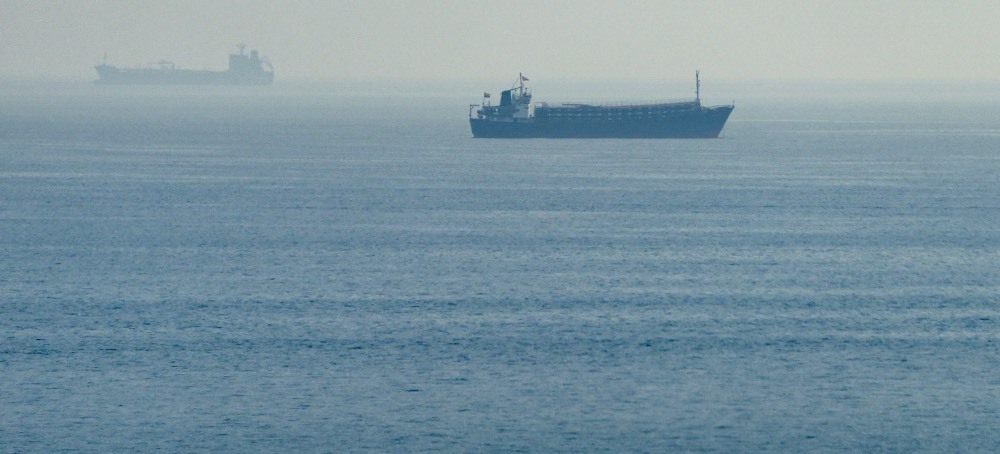 Vessels in the strait of Hormuz near Oman. The strait has been almost completely closed to traffic for the last two weeks. (photo: Reuters)
 Iran Strikes Tankers Under US Escort in Hormuz Strait as Trump Gathers Cabinet to Discuss War
William Christou Guardian UK
Energy prices have soared again since fighting between US and Iran resumed two weeks ago as conflict spreads across Middle East
Iran’s Islamic Revolutionary Guard Corps said on Friday that the “non-compliant oil tankers … were struck and brought to a halt, while four other oil tankers quickly changed course and returned to their previous positions”. The military body said the ships had tried to pass through the strait via an “undeclared route” and under US aerial escort.
Iran and the US have said ships should pass through the strait via two competing routes, with Iran bombing ships that take the southern route, close to the coast of Oman, and the US bombing ships that violate its blockade of Iranian ships and ports.
The strait has been almost completely closed to traffic since Iran and the US returned to fighting two weeks ago, sending energy prices soaring. On Thursday, the price of crude oil pushed past $90 a barrel when the US struck Iran in retaliation for its targeting of US bases in Jordan.
Fighting continued on Friday, with the Kuwaiti defence ministry reporting that it had shot down Iranian drones targeting “vital and military facilities” without any casualties.
In Lebanon, the Israeli military carried out a huge detonation overnight near the ancient Beaufort Castle. It said it was targeting Hezbollah tunnels and infrastructure. The explosion was heard across south Lebanon and covered nearby towns in ash, while photos showed the affected area levelled by the force of the blast.
Lebanese officials accused Israel of violating the ceasefire by carrying out the detonation. The Israeli military said it was ensuring the security of its northern residents.
Trump has tried to open the strait of Hormuz by force, but increasingly intense US strikes on Iran have yielded few results. The price of gas and groceries remain high in the US as a result of the energy disruption, complicating Republicans’ chances at the ballot box in November’s midterm elections.
On Friday, Trump brought his cabinet together at the Camp David retreat in Maryland to try to chart a path forward for the war. The White House press secretary, Karoline Leavitt, said at a briefing last week that the cabinet meeting would be “a lot of fun and something different for the cabinet to experience together”.
Top of the agenda will be the Iran war, which Trump promised would last a few weeks but has now dragged on for five months. A Reuters-Ipsos poll this week found that one in three Americans support the war, the lowest polling since the war began.
Support in Congress is also waning, with the US Senate narrowly rejecting a symbolic vote to express disapproval of the war. The war powers resolution asking the president to stop the war failed in a 49-50 vote.
Inflation caused by the war is a boon for Democrats, who are hoping to wrest control of the house from the Republicans.
Energy companies have posted record profits as a result of the conflict, with ExxonMobil’s profits doubling and Chevron reporting more than five times its profits in the same time period last year.