
Iran Needs Not to Lose to Win the War. The U.S. and Israel Need Total Victory
Zvi Bar'el Haaretz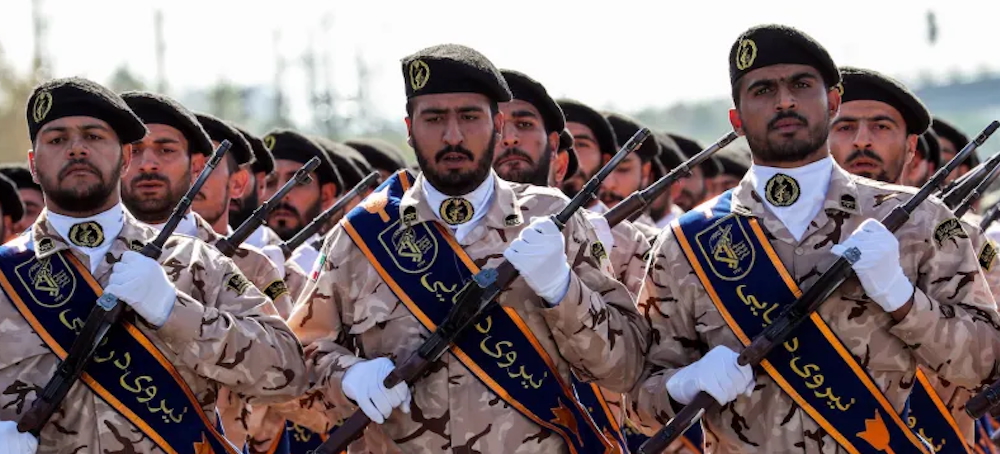 Members of Iran's Revolutionary Guards Corps march during a military parade in Tehran. (photo: STR/AFP/Getty Images)
 Iran Needs Not to Lose to Win the War. The U.S. and Israel Need Total Victory
Zvi Bar'el Haaretz
Despite the U.S. retaliatory strike on Iran's largest oil hub, no solution appears in sight for reopening the Strait of Hormuz. Meanwhile, Iran also benefits from its renewed use of proxies in Lebanon and Iraq, and from fears of internal flare-ups there
While Iran merely needs to not lose in order to succeed, the United States needs a total victory to avoid losing. This situation, in which it is hard to achieve the original goals, is bound to evolve into a long-term U.S. military presence in the Gulf, characterized by frequent tactical clashes without a decisive victory.
By now it already seems that the only remaining measure of any success relies solely on military statistics – the number of sorties by Israeli and American jets, the tonnage of bombs, the number of targets destroyed and the death count. These statistics could allow Donald Trump to declare victory, should he wish to leave the war that is spreading farther, taking longer and costing more than had originally been planned – but none of them make for a strategic success.
The three fundamental goals have not been reached: the Iranian regime has not been toppled, the 440 kilograms of 60 percent enriched uranium in the hands of the regime have not been captured, and the popular protests have not revived.
The ballistic missile threat has been significantly reduced, but its steadfast drip is sufficient to disturb the daily life of Israeli citizens and damage strategic sites located in the Gulf states. Note that the missile issue was not addressed in the U.S.-Iranian negotiations that predated the war. According to at least some of Trump's contradictory statements, this issue was a lower priority, if at all. It was added as a main objective only when the war had started.
The status of the new supreme leader, Mojtaba Khamenei, remains unclear. He has yet to appear in public or in up-to-date video footage, though announcements in his name have been issued. His quick appointment was intended to demonstrate the regime's resilience and stability, concentrated around the unique symbolic role of the mullahs. Khamenei is no military strategist, and so the war, rather, is run by the Islamic Revolutionary Guard Corps. Lastly, between staring down the barrels of the Basij militia, which is in charge of subduing public protests and rebellion, and the bombs falling, the prospect of taking to the streets appears rather daunting.
As the Americans and Israelis were seeking a tipping point in the war, Iran secured a strategic win when it closed the Strait of Hormuz. Even before declaring its official closure, Iran managed to completely halt traffic through the strait when it threatened to hit oil tankers, which were thus unable to reach the oil terminals.
Trump has yet to back his promise to send warships to protect the tankers. It is doubtful whether sending 2,500 additional soldiers to the area will convince ship owners to enter the perilous gulf, when a single drone or armed speedboat could easily rip through any American defenses that should arise.
The U.S. attacked Kharg Island over the weekend, about which Trump stated he didn't "wipe out" its oil infrastructure "for reasons of decency." However, the strike seemed more like an act of revenge for closing the Strait of Hormuz rather than a cogent plan for forcing Iran to reopen it.
Hitting the refineries, through which 90 percent of Iranian oil passes, could deal a serious blow to the Iranian economy, but here lies the trap. Any possibly U.S.-sympathetic new regime in Iran would need these facilities and the income they generate to rebuild Iran, meet the needs of its people, and remain stable.
Iran already has tens of millions of barrels of oil in storage, both in reservoirs on other islands in the Persian Gulf and in the Gulf of Oman. Even if the Kharg facilities are shut down, there's no certainty that Iran would stop attacking ships in the Gulf. It would probably expand attacks on the Gulf states' oil facilities.
It's tempting to start comparing the Iran war with the Second Gulf War, when in a matter of weeks, Saddam Hussein's regime was toppled and an American-backed regime started ruling Iraq. However, the differences are significant. In 2004, U.S. ground forces and the supporting international coalition operated inside Iraq.
Now, not only is there no international coalition, but no intent to operate ground forces in the first place is known of. Without these, effecting regime change is a very dubious prospect. Another distinction between the two cases is in their potential outreach: for all its notable intricacies, the Second Gulf War was essentially limited to Iraq; the war with Iran is a different story.
Iran has opened two additional fronts, transforming the war from a trilateral confrontation with Israel and the United States into a regional war. Not only have America's Gulf allies been hurt. Missiles and drones were aimed at Iraq, causing extensive damage to the U.S. embassy in Baghdad. That notable attack was not a one-off but part of a series of attacks beginning some ten days ago.
Pro-Iranian militias operating in Iraq have launched dozens of short-range missiles and drones at U.S. targets in Baghdad and the Kurdish region. The United States responded with air strikes, and according to reports in Iraq, also deployed special forces on the ground. However, the fear is that these exchanges will make Iraq another front, leading to a civil war between Iraqi forces and the Iranian-backed militias.
Lebanon is another front, secondary for the Americans and central to Israel. For Iran, beyond maintaining its influence in the country, the Lebanese government has become a direct target for undermining its rule after it turned its back on Hezbollah by denying its military legitimacy and started a move to disarm it.
The internal front in Lebanon is no less important to Tehran than the military confrontation. Its goal now is to thwart Lebanese-Israeli diplomatic talks and thereby deny the United States and Israel a regional win. This particular goal is important after the Assad regime fell in Syria and Ahmad al-Sharaa became a Trump ally and active partner in the effort to suppress Hezbollah.
A violent confrontation between the Lebanese Army and Hezbollah, which could lead to a regional war, and a similar conflict in Iraq between the militias and the government, would be desirable developments for Iran.
Thus, the mission of Iran's proxies that comprise its "ring of fire" in the Middle East is changing. From front forces dedicated to deterring military action against Iran and absorbing the fire instead of Iran, they may now become the vanguard for achieving a political victory, and even before that, in setting the very conditions for ending the war.