
Iran Conducts First Known Execution of Prisoner Arrested During Protests
Annabelle Timsit and Miriam Berger The Washington Post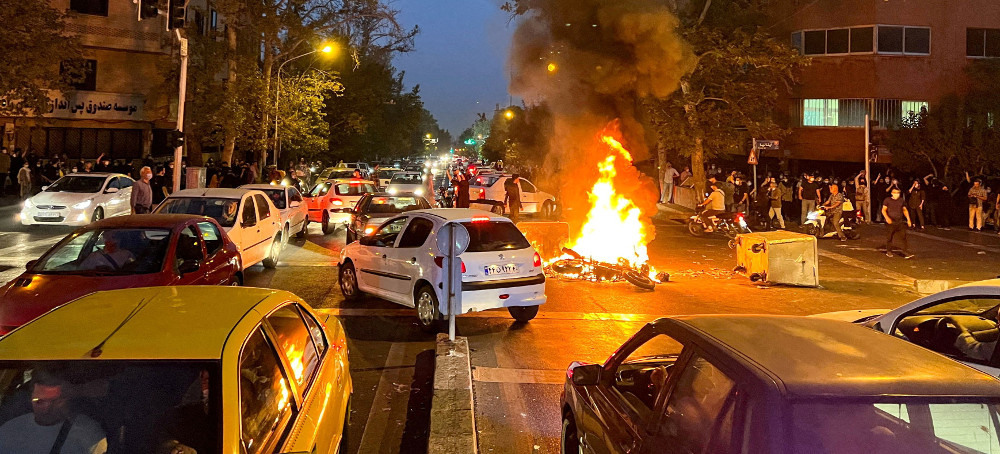 A police motorcycle burns during a protest over the death of Mahsa Amini in Tehran on Sept. 19. (photo: Wana News Agency/Reuters)
Iran Conducts First Known Execution of Prisoner Arrested During Protests
Annabelle Timsit and Miriam Berger The Washington PostALSO SEE: Iranian Forces Shooting at Faces and Genitals of Female Protesters, Medics Say
The prisoner — identified by Mizan, the news site of the country’s judiciary, as Mohsen Shekari — was convicted of “waging war against God” on Nov. 20 and sentenced to death by Tehran’s Revolutionary Court, Mizan said. Authorities accused him of repeatedly attacking a paramilitary guard with a knife and of disturbing public order by blocking a thoroughfare in Iran’s capital, Tehran, during a protest in late September.
“Iranian authorities have executed a protester, sentenced to death in show trials without any due process,” tweeted Mahmood Amiry-Moghaddam, director of the Norway-based group Iran Human Rights.
His execution “must be [met] with STRONG reactions otherwise we will be facing daily executions of protesters,” wrote Amiry-Moghaddam. “This execution must have rapid practical consequences internationally.”
The execution followed a three-day, nationwide labor strike in support of the protests that was the country’s largest in decades and raised the pressure on authorities to respond to the unrest that they appear unable, so far, to contain.
The HRANA activist news agency estimates that more than 400 civilians have been killed and some 18,000 arrested in nearly three months of protests, which began in September in response to the alleged police killing of 22-year-old Mahsa Amini and have grown into broad calls to oust Iran’s clerical leaders.
Along with Tehran’s ongoing campaigns of violence and intimidation, including military-style assaults on Kurdish areas, since mid-November Iranian authorities have sentenced at least a dozen people to death for crimes allegedly committed during protests, human rights groups estimate. More people stand accused of capital crimes and could face the death penalty if convicted.
Exact figures are difficult to determine as Iranian authorities often do not release details on the status of detainees, have blocked and restricted communication networks, and have threatened the families of deceased and arrested protesters against speaking out.
The U.N. special rapporteur on Iran, Javaid Rehman, told Reuters in late November that he was worried by the “campaign” of death sentences accompanying the crackdown.
Experts have looked to whether Tehran carries out executions as a harbinger of its response to the ongoing uprising — whether it would continue with its repression, or violently ramp up efforts to squash any protests.
On Monday, a branch of the Revolutionary Court in Karaj, outside Tehran, sentenced five people to death over charges that they killed a member of the Basij, a volunteer paramilitary force connected to the Revolutionary Guard, during a demonstration in November. Another 10 people who were part of the same mass trial were given lengthy prison sentences, including three minors who were the first known protesting juveniles to be charged with a capital crime.
Iran, which is among the world’s top countries for executions of both adults and minors, has over the last decade and a half executed several people for participating in anti-government protests. But Tehran has also commuted or quietly not applied some sentences.
Political prisoners are typically tried in revolutionary courts, a parallel-track legal system designed to protect the Iranian regime, resulting in a judicial system stacked against the protesters and little expectation of a fair trial or due process.
Trials often rely on fabricated evidence and defendants are frequently tortured or forced into making confessions and incriminating statements, rights groups such as Human Rights Watch and Amnesty International have repeatedly documented.
Defendants tried in the Revolutionary Court are also denied lawyers of their choosing; Shekari’s court-appointed lawyers’ request to appeal his sentence was denied, Mizan said.
Shekari told the court that an acquaintance offered him to money to attack security forces, Mizan reported. After his execution, state media released edited clips of Shekari’s alleged confessions.
Iran’s leaders have blamed the ongoing unrest on “foreign instigators,” such as the CIA, without citing evidence.
The judge who tried Shekari’s case, Abolghassem Salavati, is nicknamed “the Judge of Death” because of his reputation for handing out lengthy prison and death sentences.
In 2019, the U.S. Treasury sanctioned Salavati for sentencing “political prisoners, human right activists, media workers and others seeking to exercise freedom of assembly to lengthy prison terms as well as several death sentences.”