
Inside Ukraine’s Breakthrough Missile Deal
Mark Hertling The Bulwark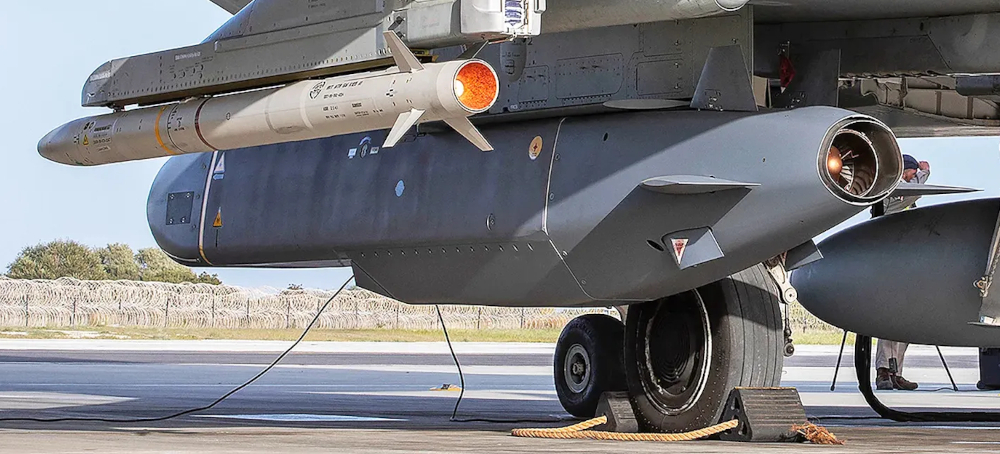 The new defense cooperation agreement with the U.K. is less about the war now than about European security for the next generation. (photo: AP)
 Inside Ukraine’s Breakthrough Missile Deal
Mark Hertling The Bulwark
The new defense cooperation agreement with the U.K. is less about the war now than about European security for the next generation.
In exchange, Britain will gain access to Ukraine’s extraordinary collection of battlefield data and combat lessons learned through a new artificial-intelligence partnership. Moscow noticed immediately. Vladimir Putin’s spokesman Dmitry Peskov accused Britain of adding “fuel to the fire,” while other senior members of Putin’s government warned that the European defense industries supporting Ukrainian weapons production could themselves face consequences.
For most of the war, Western military assistance to Ukraine has been defined by individual weapons: Javelin anti-tank missiles, HIMARS rocket launchers, Patriot air-defense systems, Leopard and Abrams tanks, Storm Shadow/SCALP cruise missiles, F-16 fighter jets, and other high-tech equipment. Each produced arguments over delivery, escalation, Western stockpiles, training, and usage restrictions. Moscow threatened consequences with nearly every delivery, but the weapons eventually arrived, Ukrainians learned to use them, and most of the supposed dangerous thresholds passed without the wider war Russia had threatened.
That is why Burnham’s announcement matters beyond the missile itself. Ukraine has a geographic problem obvious to anyone looking at a map: Russia is a land of eleven time zones, so it possesses enormous strategic depth; Ukraine does not have that geography. Ukraine has built an increasingly formidable domestic drone and missile industry to attack Russian aircraft, ammunition depots, headquarters, rail hubs, refineries, missile factories, and logistics infrastructure. As the capability progresses, less and less of Russia’s war machine will be out of range. Helping Ukraine assemble a sophisticated Western cruise missile moves the process along—and hopefully frees Ukraine from some of the constraints of Western supply chains, logistics, and stockpile requirements.
Britain isn’t simply supplying more missiles, it’s releasing sensitive technical information that will help France and Ukraine establish Storm Shadow assembly capability on Ukrainian soil. As part of the deal, Ukraine will give Britain access to something no NATO country possesses: millions of images, sensor records, targeting information, and lessons gathered during more than four years of high-intensity combat against the enemy that once had a quantitative advantage.
Ukraine has become one of the world’s greatest laboratories for modern warfare. That’s not entirely new. Armies have always adapted rapidly when survival demanded it. But Ukraine has brought that adaptation to a new level. In an age of artificial intelligence, digital communications, crowdsourcing, commercially available technology, and extraordinarily rapid software development by Ukrainian civilians supporting equipment acquisition—and with the existence of their country at stake—Ukrainians have compressed the traditional cycle of battlefield adaptation. The entire defense production chain, from laboratories to factories to the battlefield, is constantly adapting based on near-real-time information about combat on the front lines. Drones, electronic-warfare systems, sensors, targeting programs, battlefield command systems, and autonomous technologies are now designed, tested against an enemy actively trying to defeat them, modified, and returned to combat in weeks or sometimes days. Ukraine is no longer a recipient waiting for Western governments to decide which weapons they can spare. Increasingly, it is becoming a defense-industrial partner offering Europe something Europe cannot manufacture for itself: recent combat experience against a major military power. That is what they have offered to the United Kingdom.
The AI agreement signed during Burnham’s visit captures the value of Ukraine’s experience. Britain will become the first foreign partner with access to Ukraine’s Avengers AI Labs, built around roughly five million annotated battlefield images gathered largely through Ukraine’s DELTA combat system. Thousands of cameras and infrared sensors capture Russian targets under actual combat conditions. And Britain brings a sophisticated AI ecosystem of its own to exploit this wealth of data.
IMPORTANT QUESTIONS REMAIN about which Storm Shadow components will actually be manufactured in Ukraine, which will continue to come from Europe, how quickly production can begin, and how many missiles can ultimately be produced. But the strategic direction matters more than the immediate numbers. Ukraine is gradually changing from a consumer of Western military equipment into a participant in Europe’s defense-industrial base.
Moscow clearly understands what that means. A Ukrainian factory producing cruise missiles for the Ukrainian military will obviously become a Russian target. The more consequential question raised by Moscow’s threats is where Russia believes that target system ends. A modern missile isn’t produced in one building or necessarily even in one country. Its electronics, software, engines, guidance systems, explosives, engineering knowledge, financing, and transportation can stretch across Europe.
Russia has exhibited ways of attacking that system without launching a missile at a NATO country. European governments and intelligence services have identified a growing campaign of Russian-linked cyberattacks, sabotage, and espionage in Europe. Just last week, Estonian authorities were investigating suspected sabotage at a facility used by a defense company supplying unmanned ground vehicles to Ukraine. Russia always denies responsibility for these incidents, but the broader campaign of hybrid pressure has become an increasingly serious security problem.
First, Europe and the United States armed Ukraine. Then European governments and companies began investing in Ukrainian defense production. Now Ukraine is contributing something back: battlefield knowledge, technological innovation, combat data, and hard-earned experience that European militaries themselves increasingly need. The relationship is becoming less one of donor and recipient than one of partners building a common defense-industrial ecosystem.
Burnham’s visit therefore offered a glimpse of what the next phase of this war—and perhaps European security after it—may look like. Vladimir Putin went to war in part to keep Ukraine out of Europe’s security architecture. Instead he has driven Ukraine into deeper integration with the West, and he may be helping transform Ukraine from a country Europe must defend into a country helping Europe learn how to defend itself.