
Inside a Temporary ICE Holding Room: More Than 80 People, No Beds or Showers
Douglas MacMillan, Aaron Steckelberg, N. Kirkpatrick and Leslie Shapiro Washington Post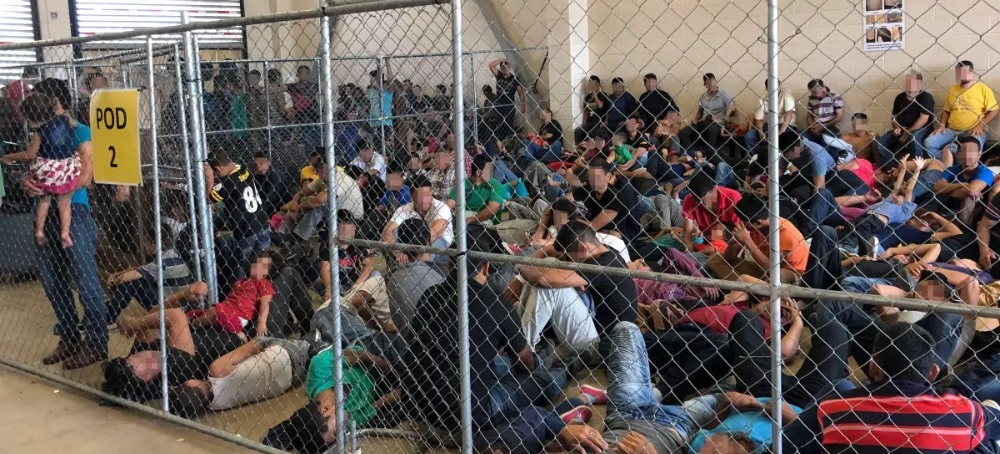 ICE has been holding immigrants in dangerously overcrowded rooms. (photo: Getty)
 Inside a Temporary ICE Holding Room: More Than 80 People, No Beds or Showers
Douglas MacMillan, Aaron Steckelberg, N. Kirkpatrick and Leslie Shapiro Washington PostIn New York, ICE agents were arresting immigrants much faster than they could be transported to longer-term detention centers, officials said in emails and text messages, waylaying dozens of detainees for days in crowded rooms that usually hold people for no more than 12 hours.
The spaces reeked of unwashed bodies. People slept sitting up because there wasn’t enough space to lie down. And because of a shortage of medical staff, people with serious health conditions, including tuberculosis, an ovarian cyst and kidney failure, lacked proper care, texts and emails among ICE officials show.
“I was just a body that they crammed into a room, almost as if to be forgotten,” Nuvia Martinez, a former detainee, said in sworn testimony.
This account of the conditions at 26 Federal Plaza is based on internal government emails, text messages, detainee testimonies and other documents released in federal court in May as part of a lawsuit one former detainee brought against the Department of Homeland Security.
The New York facility is one of many temporary holding centers around the country that U.S. Immigration and Customs Enforcement has packed with immigrants during President Donald Trump’s second term, according to daily facility population data that ICE provided to the Deportation Data Project and that was analyzed by The Washington Post. (The Deportation Data Project, based at the University of California at Berkeley and UCLA, obtains immigration data through Freedom of Information Act requests and shares it with the public.)
After campaigning on carrying out the “largest domestic deportation operation in American history,” Trump quickly moved to accelerate arrests, signing an executive order seeking to counteract what he called the “unprecedented flood of illegal immigration” into the United States. His officials directed ICE to make at least 1,200 to 1,500 arrests a day.
As ICE carried out raids across the interior of the country to arrest immigrants the Trump administration says are here illegally, the agency relied on these rudimentary holding rooms to detain far more people, for much longer periods, than is typical.
A federal judge temporarily capped 26 Federal Plaza’s capacity on Aug. 12 of last year, barring ICE from holding more than 22 people total across all four hold rooms. He warned of “a very serious threat of continuing irreparable injury.”
But government data shows that ICE continued to push the limits of holding rooms in many of the cities where it has conducted large-scale raids, packing large numbers of arrestees into small facilities in Chicago, Minneapolis, Los Angeles and Mesa, Arizona.
DHS declined to answer a detailed list of questions about its treatment of detainees at 26 Federal Plaza and temporary hold rooms around the country, citing the ongoing litigation.
In court cases, lawyers for DHS have said the agency has needed to use temporary holding rooms because the government lacks the detention space to carry out Trump’s executive order. The administration has said that most detainees are not held in these rooms for more than a few days, and that they are provided two to three meals a day as well as foil or cotton blankets for overnight stays.
By holding people for days in crowded rooms lacking basic features like beds and showers, ICE is gambling with people’s health and safety, said Dora Schriro, the founding director of ICE’s Office of Detention Policy and Planning, who helped revise the agency’s detention standards during the Obama administration.
ICE’s leaders, Schriro says, are effectively saying, “How many hours can we get away with keeping somebody in that space — as nasty as it is?”
‘Exceptional circumstances’
There are four holding rooms on the 10th floor of Manhattan’s 26 Federal Plaza. Two floors above is an immigration courthouse where, in May 2025, ICE agents began arresting migrants the moment they stepped out of their hearings, as the agency worked to meet a new White House quota of 3,000 arrests a day.
ICE officials realized they had a problem. All of the nearby detention centers were full, and there were limited flights available to send people to other parts of the country.
ICE does not permit cameras inside the facility. The Post constructed a digital rendering of one of the hold rooms based on a cellphone video that leaked to news outlets last summer, along with photos, measurements and detainee statements included in the ongoing court case.
There are no laws governing the amount of space immigrant detainees must be provided within ICE field offices, but officials overseeing the New York facility have acknowledged that they were pushing the limits of what was safe.
The holding rooms at 26 Federal Plaza were “not quite as crowded as a subway car, but certainly more people than we would prefer to have in there,” William Joyce, the deputy field office director, said in a deposition this year.
During the first week of Trump’s second term, Hold Room 1 held about two people on average, with each person getting about 410 square feet of space.
By early July, at the room’s most crowded, each person had about 10 square feet. This is equivalent to an old-fashioned phone booth.
It’s a fraction of the 35 square feet recommended for each inmate held longer than 10 hours in many U.S. jails and prisons, according to voluntary guidelines published by the American Correctional Association.
At temporary hold rooms within longer-term ICE detention facilities, the government requires each detainee in multiple-occupant rooms to have 44 square feet of space.
The judge determined that each person at 26 Federal Plaza should be permitted at least 50 square feet of space — the minimum that New York state requires per person for shared bedrooms in residential buildings.
Extreme levels of confinement can trigger people who already experience mental health problems, including anxiety, claustrophobia and panic attacks, according to J. Wesley Boyd, a psychiatrist who is a senior lecturer at Harvard Medical School.
“It’s a recipe for ongoing, long-lasting psychological trauma,” Boyd says.
The problems of overcrowding are exacerbated by the length of time people are locked inside.
The longest detention at 26 Federal Plaza in January and February of last year, before the surge in arrests, was 21 hours. In June and July, more than 60 people were held there for over a week.
In May of this year, Carlos Lopez Benitez stood in front of a New York courthouse, speaking to a gathering of reporters about his experience being detained at 26 Federal Plaza.
Moments earlier, after reviewing evidence in the lawsuit against DHS, a federal judge questioned whether ICE should be permitted to hold people in New York City at all, according to the local media outlet the City Reporter. He has yet to rule.
“No one should have to go through what I went through, or what thousands of other people who have been arrested and detained in this building have gone through,” Lopez Benitez, who was released from custody last year, told the gathering, according to a written copy of his prepared remarks, which he delivered in Spanish.
Most of the other former detainees quoted in this report have been deported, according to court filings.
But even after the federal court intervened to halt the overcrowding in New York, ICE repeated a similar pattern nationwide, keeping people in overcrowded holding rooms for days, agency data shows.
Since last August, eight other temporary hold room facilities have held more than 200 detainees at one time, according to the data.
In Chicago, during ICE’s “Operation Midway” enforcement blitz last fall, ICE data shows that hundreds of people were held for three or more days in rooms that a government lawyer previously said were “not equipped to be an overnight facility.”
At Arizona’s Mesa Gateway Airport this year, ICE packed more than 700 people into a deportation staging facility with a maximum capacity of 203, according to ICE data and the airport authority. The facility reduced its population in February, ahead of a planned visit by Democratic lawmakers, the Arizona Mirror reported.
And at a temporary hold room in Dallas in March, a 41-year-old Afghan man who had fought alongside U.S. troops in his home country called his brother to complain that he was having chest pain but that ICE staffers were ignoring his request for medical care, the brother, Naseer Paktiawal, said in an interview.
He died hours later, after being rushed to a hospital, ICE said in a news release.
The Dallas County Medical Examiner’s Office said on his death certificate that the man died from “an adverse drug reaction” to an unidentified substance, but it has declined to release the autopsy report, Paktiawal said. ICE said the man was picked up during a targeted enforcement operation and had been previously arrested after being accused of fraud and theft.
“If they know he is going through pain and he is asking for someone to help, what were they waiting for?” Paktiawal said. “The last breath?”
Methodology
Data for 26 Federal Plaza and other detention facilities is from ICE records obtained by the Deportation Data Project, an organization based at the University of California at Berkeley and UCLA that obtains immigration data through Freedom of Information Act requests and shares it with the public. The data covers Sept. 30, 2022, through March 10, 2026. Population and length-of-stay estimates for New York’s holding facility were calculated by The Post in the same manner as detailed in federal court filings, using detainees’ book-in and book-out dates and times; records without a book-out date were excluded. The Post used the daily maximum population when considering daily figures. Population estimates for individual rooms were created by dividing total facility population figures by room square footage numbers disclosed in the court filings, assuming a proportional distribution of individuals across rooms. Our estimates were checked for accuracy whenever possible against testimony from detainees and other reports and documents in the court filings.
The Post identified 177 holding facilities nationwide using a facility code that listed them as hold rooms in the Deportation Data Project’s ICE Daily Detention Population by Facility dataset. Population estimates were calculated using the same dataset, accessed by The Post on April 23, 2026. This dataset uses book-in and book-out dates but does not consider the time of day, which has the potential to create a slight overcount since populations shift frequently.
To understand the effects of confinement, The Post interviewed experts on immigrant detention, including Altaf Saadi of Harvard Medical School and Massachusetts General Hospital, Caitlin Patler of the University of California at Berkeley’s Goldman School of Public Policy and the Berkeley Interdisciplinary Migration Initiative, J. Wesley Boyd of Harvard Medical School, and Dora Schriro, the founding director of ICE’s Office of Detention Policy and Planning.