
I Watched Ukraine Build the Army Putin Feared
Mark Hertling The Bulwark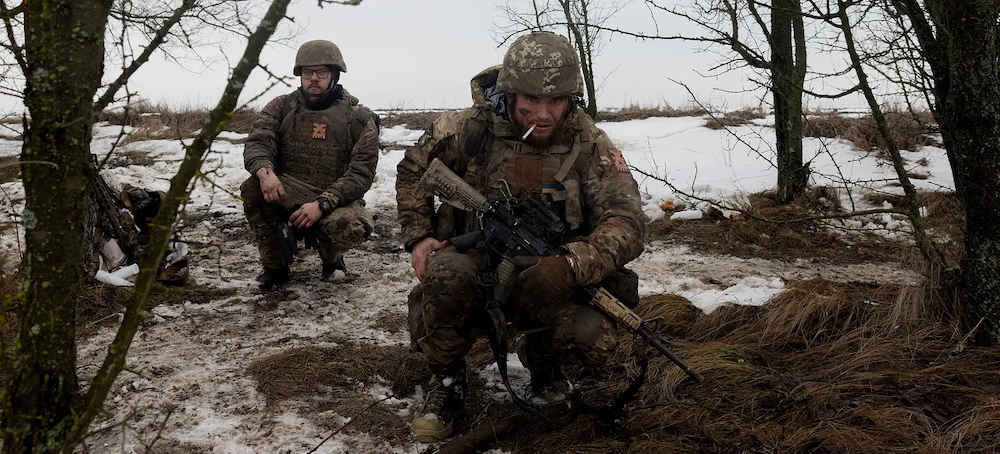 Ukrainian servicemen of the 33rd Separate Assault Regiment train at an undisclosed location in the Zaporizhzhia region on January 30, 2026. (photo: Tetiana Dzhafarova/AFP/Getty Images)
 I Watched Ukraine Build the Army Putin Feared
Mark Hertling The Bulwark
Thirty-five years on, Ukrainians are still declaring their independence.
August 24 is meaningful for me, too, because over the course of almost two decades, I had the privilege of watching Ukraine’s transformation.
My first encounters with Ukrainian soldiers was in Iraq in 2004. When our division was extended during the Sadr uprising, we were told to relieve the Ukrainians and take over their battlespace in southern Iraq, where they had been stationed since the early days of the war. My first experience with their leaders and their soldiers was not a good one; they were undisciplined, corrupt, and ineffective in their area. I remember thinking they were a military that still carried much of the Soviet Union’s institutional DNA. Officers were inept, drinking vodka and generally disregarding their duties to their own soldiers and the mission. Their sergeants were untrained and unskilled. Training, maintenance, logistics, and readiness were a shambles. And corruption was a significant problem—enough that they had been selling equipment to local Iraqi insurgents.
Later, when I commanded U.S. Army Europe, I had more opportunities to interact with Ukrainian military leaders and soldiers as they were beginning to evolve and transform. They wanted to change. Their top army commander, Col. Gen. Henadii Vorobyov, wanted to train with our forces and send his sergeants to our NCO Academy in Grafenwoehr. I worked with him closely, and I spent weeks at their Ukrainian training center at Yavoriv and watched as they developed into a much stronger force that would join our army in Afghanistan for more than a decade.
Theirs was not an easy transformation. While U.S. Army Europe and even our rotating National Guard units were working with Ukraine on military education and professionalization before Russia seized Crimea, after 2014 that cooperation expanded dramatically. Russia’s seizure of Crimea and invasion of the Donbas in 2014 exposed Ukraine’s weaknesses. But instead of convincing Ukrainians that resistance was futile, Vladimir Putin helped accelerate the creation of the very thing he feared: a formidable Ukrainian national army.
The force Russia encountered when it launched its full-scale invasion in February 2022 was profoundly different from the one it had faced eight years earlier. Junior leaders exercised initiative. Small units adapted when plans failed. Soldiers improvised. Immature senior commanders learned valuable lessons. Most importantly, Ukrainian troops understood exactly what—and whom—they were fighting for.
Western weapons and training certainly contributed. But Ukrainians deserve the credit. We did not turn the Ukrainian army into an American army. Ukrainians made it their own, and made it extraordinarily good at learning and adapting. Today, that learning increasingly flows to others, as Western militaries study Ukrainian innovations in drones, electronic warfare, battlefield intelligence, dispersed operations, and rapid adaptation.
Ukraine’s political transformation remains messy. The government has certainly not eliminated corruption, as current controversies in Kyiv demonstrate. There are now serious arguments over governance, accountability, and even the complicated relationship of the parliament to the presidency during a time of war (and afterwards).
But there is an important difference between a country that has corruption and a political system built around corruption. Ukraine has journalists exposing wrongdoing, institutions investigating it, political opponents challenging the government, and citizens protesting decisions they oppose—even during a war for national survival.
Today’s anniversary, then, is about much more than a declaration signed in August 1991. Putin, like George III during our revolution, still seems unable to accept a central proposition: Ukrainians—not Moscow—get to decide who Ukraine is.
I’ve watched Ukrainian soldiers evolve from the force I encountered in Iraq, to the military I worked with in Europe, to the extraordinary organization now fighting Russia. I’ve watched a country struggle with the difficult business of becoming a democracy while simultaneously defending itself against a neighbor determined to erase its sovereignty.
Thirty-five years after independence, Ukraine’s most important achievement isn’t that it possesses Western weapons, or even that it’s on the path to EU membership. It’s that Ukraine has a democratic identity that its citizens are willing and able to defend.