
‘I Love Viktor’: Trump and Vance Cheer on Orban in Hungarian Race
Andrew Higgins and Lili Rutai The New York Times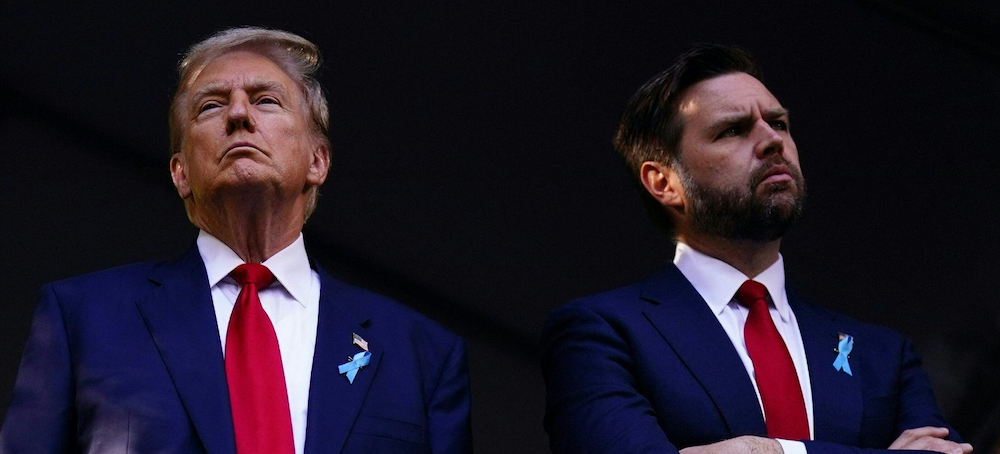 President Donald Trump and Vice President JD Vance. (photo: Adam Gray/AFP)
 ‘I Love Viktor’: Trump and Vance Cheer on Orban in Hungarian Race
Andrew Higgins and Lili Rutai The New York Times
The American leaders slathered on the praise for the nationalist standard-bearer just days before an election he could lose.
While Mr. Vance cheered on Mr. Orban in person in Budapest, the Hungarian capital, Mr. Trump offered effusive praise by telephone to a Budapest stadium packed with supporters of Hungary’s governing Fidesz party.
Their interventions marked a last-ditch effort to revive the flagging prospects of Europe’s nationalist standard-bearer before a vote on Sunday that is widely seen as the most consequential for Hungary since its first free election in 1990 after the collapse of Communism.
Mr. Orban is reviled by liberals but lauded by many in Mr. Trump’s MAGA movement and by like-minded Europeans for his previous electoral success, his open contempt for the European Union and his crackdowns on migrants and on activists pushing progressive social causes.
A defeat for Fidesz on Sunday would be a severe setback for the “patriotic European parties” — code for hard-right movements scorned by the mainstream and in some cases banned for extremism — that the Trump administration’s national security strategy has pledged to promote.
“I love Hungary, and I love Viktor. I’m telling you he’s a fantastic man,” Mr. Trump said by phone from Washington, his words blasted around a Budapest concert arena, “I’m a big fan of Viktor. I’m with him all the way.”
Mr. Orban, he added to wild cheering, “has done a fantastic job,” by not allowing migrants to “storm your country and invade your country.” The event, which featured music and a tirade against “woke” by a TV presenter, was billed, as a “mass rally on the occasion of Hungarian-American Friendship Day,” a day invented for Mr. Vance’s visit.
The introduction of Trump-style campaign rally razzmatazz to Mr. Orban’s faltering re-election effort came a few hours after a more subdued but no less fulsome in-person endorsement by Mr. Vance.
Mr. Vance arrived in Budapest Tuesday morning, welcomed by an honor guard at the airport and then taken for talks with Mr. Orban, whom he hailed as “one of the only true statesmen in Europe.”
After 16 years in power, however, Mr. Orban is struggling to find his footing as his Fidesz party trails badly in most polls ahead of Sunday’s vote.
“Viktor Orban is, of course, going to win,” Mr. Vance said at a new conference in Buda Castle overlooking the Danube River. Hungary under Mr. Orban and the United States under President Trump, Mr. Vance said, are bound together by a “moral cooperation” in the “defense of Western civilization.”
Addressing Mr. Orban’s biggest vulnerability in the election — Hungary’s spluttering economy — Mr. Vance recited favorite Fidesz talking points. He blamed the European Union instead of the corruption and mismanagement that have been cited at virtually every campaign event of the opposition leader Peter Magyar, a conservative former Orban loyalist.
European Union “bureaucrats,” Mr. Vance said, Mr. Orban at his side, had “tried to destroy the Hungarian economy” to sway Sunday’s result “because they hate this guy.” Mr. Orban’s leadership, he added, “can provide a model to the continent.”
Whether assists from the Trump administration will help is unclear. They will likely consolidate Mr. Orban’s hard-core political base, some of whose members appeared at the Budapest stadium event on Tuesday wearing red MAGA hats.
But they could alienate Hungarians alarmed by the war in Iran, which deviates sharply from what Mr. Orban has promoted as his “peace agenda.” The war’s consequent rising energy prices were something that Mr. Orban promised to prevent by cozying up to Russia in pursuit of reliable supplies of oil and natural gas.
Mr. Trump helped sway midterm elections last year in Argentina in favor of President Javier Milei but his support for conservatives in votes in Canada and Australia backfired and probably contributed to their defeat.
At a time of war in the Middle East and a global energy crisis, Mr. Vance’s trip to Budapest and Mr. Trump’s phone call underscored just how important an election in a country with fewer than 10 million people and a tiny economy is to powerful nations far beyond its borders.
Both the Trump administration and Moscow see Mr. Orban as a linchpin of their common antagonism toward Europe and are hoping the polls are wrong.
The European Union, long hobbled by Hungarian obstruction on key issues like the war in Ukraine, hopes the polls are right, though it is not saying so publicly to avoid providing fuel to Mr. Orban’s anti-European diatribes.
Mr. Orban has put hostility toward Ukraine at the center of his campaign for re-election, presenting Fidesz as the only guarantor of security in the face of what he says are dangerous threats from Hungary’s eastern neighbor.
That line dovetails with messages from the Kremlin, which has also been open in trying to tilt the election toward Mr. Orban, not least by sending a steady stream of Russian energy supplies, which other E.U. members have mostly boycotted.
Mr. Vance praised Mr. Orban’s energy policy, which revolves around keeping Russian oil and gas flowing, and scoffed at efforts by the European Union since the 2022 start of Russia’s full-scale invasion of Ukraine to cut its previously heavy dependence on Russian supplies.
Europe, he said, “should have been following the policies of Viktor Orban in Hungary.”
A day before Mr. Vance’s visit, the Kremlin offered support to claims by Mr. Orban’s government that Ukraine was involved in planting explosives near a pipeline carrying Russian natural gas through Serbia to Hungary.
Dmitri Peskov, the Kremlin spokesman, said on Monday that Ukraine had a history of sabotage and “it is most likely that signs of the Kyiv regime’s involvement will be found” in the pipeline episode.
Serbia’s authoritarian president, Aleksandar Vucic, a close ally of Mr. Orban, said on Sunday that explosives of “devastating power” had been found on a Serbian stretch of the pipeline to Hungary.
Mr. Magyar, the leader of a Hungarian opposition movement, immediately questioned the veracity of the explosives claim and accused Mr. Orban of trying to spread panic before Election Day.