
Human-Made Noise Is Harming Ocean Life. Climate Change Could Make It Worse
Kiley Price Inside Climate News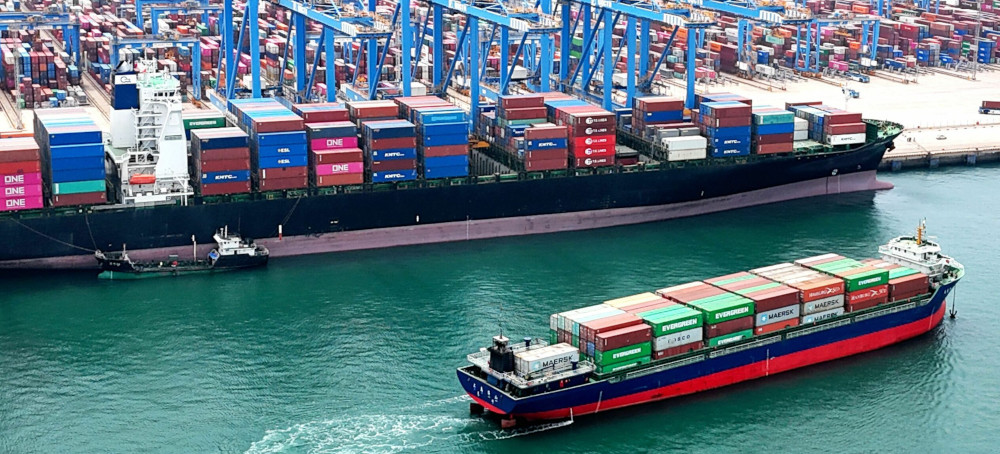 Shipping is one of the main sources of human-made sound in the ocean. (photo: NurPhoto)
 Human-Made Noise Is Harming Ocean Life. Climate Change Could Make It Worse
Kiley Price Inside Climate News
Noise from shipping and other ocean industries are drowning out the natural sounds of the ocean, and climate change could soon turn up the volume.
However, an entirely different scene was playing out under water. Baleen whales bellowed intricate songs, dolphins clicked back and forth and bigeye fish popped and pulsed—all heard more clearly due to the rare calmness above, according to a global network of researchers that study ocean acoustics.
Under normal circumstances, humans generate an exceptional level of noise at sea—from the din of propellers on massive shipping vessels to the grumble of oil drilling. These noises can drown out the ocean’s natural orchestra, posing threats to animals that depend on sound for mating and survival.
Now, climate change is altering the temperature and chemistry of the ocean, which could amplify underwater noise, a recent study found. But techniques to reduce emissions could have the side benefit of quieting down the human-made racket across this vast blue expanse.
Sound at Sea: One of the most important senses for ocean animals is sound, which travels on average four times faster underwater than in the air. It’s key to communication, mating, socialization and navigation for a variety of ocean species, many of which have specialized organs to produce and process the vibrations that underwater sounds create.
Whales in particular have long fascinated humans for their melodious songs and complex languages. In fact, scientists are currently trying to decipher the meaning behind sperm whale clicks using AI, dubbed the Cetacean Translation Initiative.
But the ocean has become an exceedingly busy place for humans. The global shipping fleet nearly quadrupled in size between 1996 and 2020, and fishing, oil and gas, wind farm construction and more have spiked in many ocean areas. This growth has been reflected in sound data as well; scientists estimate that shipping noise has doubled each decade since 1960. In fact, a 2022 study revealed that there are few “quiet” areas of the ocean left around the world.
A growing body of research shows that the anthropogenic cacophony drowning out the natural noises of the ocean can have major consequences for marine species.
Like humans, wild animals can get stressed out by too much noise (prolonged noise has been used as a form of torture for people). Similar to the pandemic, shipping significantly slowed in the aftermath of the 9/11 terrorist attacks in 2001, giving scientists a chance to collect underwater recordings and floating stool samples from endangered North Atlantic right whales in Canada. Their droppings revealed a decrease in stress-related hormone levels during the quiet, indicating a potential correlation between noise and overall emotional state.
In other cases, studies have shown evidence of human-made noise slowing growth in Atlantic cod and oysters, reducing reproductive health for toadfish and disrupting foraging for Southern Resident orcas.
And climate change could soon be cranking up the volume, according to a study published in October. Warming global ocean temperatures and acidification of seawater changes how sound travels underwater. By modeling these changes under current emissions scenarios, the study’s authors found that ice melting off Greenland will form a chilly layer of water on the North Atlantic Ocean’s surface, and potentially open up a “sound channel” in this region where ship noises could travel much further than they currently do. This could increase sound levels by as much as 7 decibels by the end of the century.
“Much is still unknown about the exact effects of underwater conditions on the speed of sound,” study author Luca Possenti, an oceanographer at the Royal Netherlands Institute for Sea Research, said in a statement. “But because of the potentially profound effects on the ecosystem, that knowledge is essential if we want to understand what the changing climate may do to marine life.”
Slowing—and Quieting—Down: Melting sea ice is also opening new lanes for shipping, particularly in the Arctic. In October, the International Maritime Organization published recommendations for ships to reduce their sound levels, which pointed to the expertise of Inuit peoples, reports Grist.
Overall, analysts say that shipping and other ocean activity is expected to likely increase in the coming years, and some governments and businesses are actively seeking ways to muffle industry’s clangor.
However, “shutting up is not easy,” writes journalist Amorina Kingdon in her new book “Sing Like Fish: How Sound Rules Life Under Water.” The book explores how aquatic animals process sound for their survival and how humans can quiet down.
One of the most straightforward solutions—particularly for shipping, cargo and cruise vessels—is to slow down. Across the U.S. and Canada, there are a variety of mandatory and voluntary speed restriction areas, primarily focused on reducing emissions and preventing ships from accidentally striking marine mammals like whales, an issue I covered more deeply in October.
These zones have the added bonus of quieting things down; one knot in speed reduction can reduce a ship’s noise by a decibel, according to the Natural Resources Defense Council. Take the Santa Barbara Channel in California, one of the busiest (and loudest) shipping areas in the country. A study published in May found that the channel is roughly 30 times louder than it was before the Industrial Revolution.
A federally led initiative known as the Protecting Blue Whales and Blue Skies Program is working with shipping companies to incentivize them to slow down in areas along the Southern California coast and outside the San Francisco and Monterey Bay. In 2023, there was an 81 percent cooperation with speed limits from the 33 companies participating in the program. Along with producing fewer emissions, ships in the area had sound levels that were 5.4 decibels per transit lower compared with levels when the program was inactive.
Other slowdown programs are specifically dedicated to reducing noise, including “Quiet Sound,” which aims to help orcas in the Puget Sound. Outside North America, the European Commission recently set its first-ever cap on underwater noise levels, stating that no more than 20 percent of a marine area can be exposed to continuous noise over one year.
But reports show that ships aren’t always compliant with boat speed limits. And new industries such as deep-sea mining could soon expose some of the few quiet areas of the ocean left to sound. As ocean animals continue to face a revolving door of threats—from devastating heat waves to pollution—research shows that perhaps one of the simplest things humans can offer is a little bit of peace and quiet.