
How Ukrainian Wheat Stolen by Russia Is Smuggled to Israel
Avi Scharf Haaretz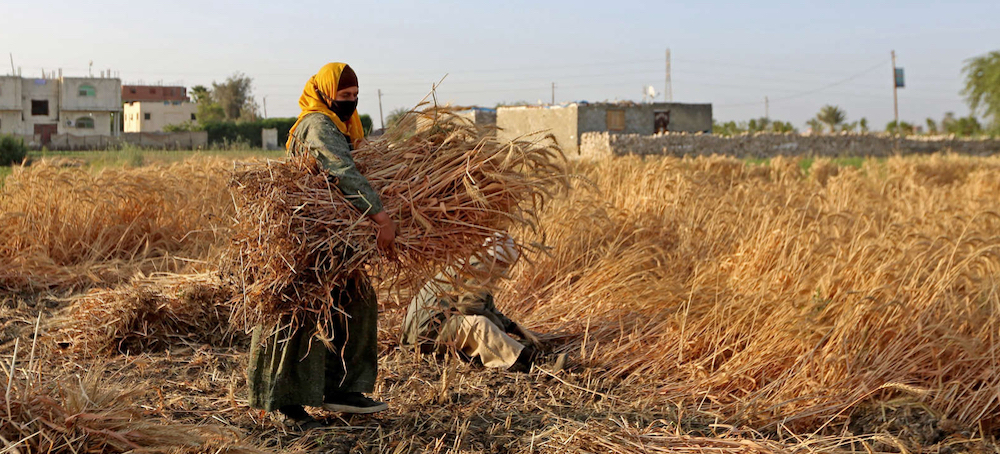 A grain farmer in Ukraine. (photo: Fadel Dawood/Getty Images)
 How Ukrainian Wheat Stolen by Russia Is Smuggled to Israel
Avi Scharf Haaretz
A Haaretz investigation reveals how grain stolen from occupied territory in Ukraine has been sold to Israel. The profits of the shady operation are financing Putin's war
However, inside the ship lay precious merchandise on its way to the Israeli market. According to an official statement by the Ukrainian government, the ship, Abinsk, was sailing under a Russian flag and bringing millions of dollars' worth of wheat, stolen from territories under Russian occupation. Profits from the selling of this merchandise in markets around the world – including in Israel – has been financing President Vladimir Putin's war machine.
The story of the Abinsk was exposed in the Ukrainian media, resulting in an outcry. The Kyiv government was quick to state that Abinsk may belong to Putin's shadow fleet, and added that it had warned Israel about the ship's cargo in advance.
However, a Haaretz investigative report indicates that this was not the first time that stolen grain from Ukraine has been imported for the Israeli market. In fact, by 2023, about a year after the Russian military's massive invasion of Ukraine, at least two ships carrying stolen grain arrived in Israel, and at least one of them unloaded here, according to documents, an analysis of ship tracking data and satellite images obtained by Haaretz.
The behavior of seven additional ships that have unloaded in Israel that year raise suspicion that they also acted to conceal the source of the grain they were carrying. In addition, internal logs kept by Russian authorities in occupied Ukrainian ports, obtained by Haaretz, list over 30 shipments of stolen goods with Israel as their destination.
Sources who spoke to Haaretz say this is an ongoing pattern. According to information obtained by Haaretz, four shipments of stolen Ukrainian grain have already been unloaded in Israel this year. Another suspected ship arrived to the Haifa Bay on Sunday morning and is waiting its turn to enter the port.
Ukraine emphasized in an official statement that it is unacceptable for Israel to allow the import of stolen goods. It added that after it approached Israel, it was assured that appropriate steps would be taken. "It is concerning that despite the information provided and contacts between the parties, the vessel [Abinsk] was allowed to unload at the port of Haifa," the statement said.
Ukraine's large grain-growing areas have earned it the moniker "the breadbasket of Europe." When the Russian military invaded in February 2022, Putin took over swaths of the country, including some of Ukraine's main grain-growing territories. Farmers in the occupied territories testified that wheat was stolen from farms that were abandoned during the heavy fighting and that farmers who remained there have been forced to work with the occupation authorities. Russia sells the wheat at prices that are significantly lower than the market price.
Kyiv estimates that so far, at least 15 millions tons of wheat have been stolen. Two Israeli grain buyers have confirmed to Haaretz that wheat stolen from Ukraine is being sold in Israel.
For Russia, stealing wheat is just the first step. However, the next step – exporting the goods – is not quite that simple, as Russia is surrounded by a wall of international sanctions levied by the European Union, the United States and the United Kingdom after the start of the war. For this reason, Russia has been employing underhanded methods to export the wheat and disguise its moves. Indeed, Haaretz's investigation, which tracked cargo ships arriving in Israel throughout 2023, shows that they employed unusual disruption techniques, making it harder to trace their paths and find the source of the goods they carried. The Russian methods include clandestine transfer at sea and violations of maritime regulations.
How the method works
The suspected bulk carriers that arrived in Israel didn't take on grain in Russian ports. Rather, they were loaded some 10 kilometers (6.2 miles) offshore, in what's known as a ship-to-ship, or STS, transfer, where cargo is transferred between ships positioned alongside each other at sea. These transfers took place south of the Kerch Strait in the Black Sea – a passage between Russian territory on one side and Russian-occupied Ukrainian territory on the other.
Before arriving in Israel, some of the bulk carriers had rendezvoused with large cargo ships that Russia uses as floating granaries. Others had cargo transferred to them from small feeder ships that brought stolen grain directly from the occupied territories. While engaging in the STS operation, the ships turned off their transponders – the ship's automatic identification system, or AIS – so they couldn't be tracked. Disabling a ship's AIS is generally illegal under the regulations of the International Maritime Organization's International Convention for the Safety of Life at Sea.
Moves of this kind are typical of ships that are attempting to conceal the source of the goods they carry, for fear that they won't be able to sell them to international clients who aren't interested in stolen goods, shipping analyst Yörük Isik, who runs the Istanbul-based Bosphorus Observer consultancy, told Haaretz. This phenomenon has also been noticed among Russia's fleet of ghost tankers – older ships that use deception tactics to hide the origin of the oil they're carrying – to circumvent sanctions and export Russian oil.
The process of transferring goods on the high seas does not, in itself, indicate illegal activity. In some situations, such transfers are necessary. But the fact that the vessels involved turned off their AIS when close to Ukrainian ports and during STS operations, and turned them on again a few days later, when they were already loaded with wheat, lends credence to the suspicion that they took on stolen wheat from occupied ports.
After taking on merchandise at sea, the bulk carriers once again turned on their radios and set sail for Israel. After a few days' passage, they unloaded the wheat at designated wharfs in the ports of Haifa and Ashdod. To work out the ships' path, Haaretz made use of ship tracking data from the MarineTraffic website, satellite images from Planet Labs and additional satellite information from the EU's Copernicus program.
From Crimea to Ashdod
One ship that stands out in this smuggling network is the St. Olga. In July 2023, it unloaded stolen Ukrainian wheat in the port of Ashdod.
To understand St. Olga's moves, one has to go back a couple of months, to May 2023. After completing a passage to Syria, Russian bulk carrier Matros Pozynich sailed north through the Bosporus, empty. After sailing into the Black Sea on May 27, it turned off its AIS for a week. On June 3, its AIS was turned on again as the ship sailed toward the Kerch Strait, at which time it reported greater draft – a figure indicating the depth of the vessel below the waterline. In practice, this means that the ship had taken on cargo.
Disabling the AIS was intended to prevent relevant tracking agencies from determining the location where the ship took on merchandise. However, the trick was unsuccessful: a satellite image taken on May 31 showed Matros Pozynich at the Avlita grain terminal at the port of Sevastopol, in Russian-occupied Crimea. The image shows three of the ship's five cargo hatches open – the loading of Ukrainian wheat was underway at the time the satellite image was taken.
One week later, Matros Pozynich arrived south of the Kerch Strait. There, according to satellite imagery, it attached itself to one of Russia's floating granaries – a large cargo ship named Greendale, which is always waiting in the vicinity and is part of the fleet of floating granaries used to take in Russian and Ukrainian grain from the mainland. The stolen cargo was transferred from the Matros Pozynich to the Greendale and to another unidentified ship.
Bulk carrier St. Olga was lying in wait empty, not far from there. On June 8 it disabled its AIS and began to approach the Greendale, the floating granary. Due to heavy clouds, it was hard to spot on the satellite imagery, but a momentary report from its transponder revealed its exact location – right next to the Greendale. Satellite images from June 14 through 18 leave no room for doubt: The St. Olga was in the midst of clandestine loading of merchandise at sea, which went unrecorded by tracking systems. On July 1, the St. Olga was again recorded attached to the Greendale, with Matros Pozynich on its other side, having already brought in another shipment of stolen wheat from Sevastopol.
The next morning, the St. Olga once again turned on its AIS: It reported greater draft and updated its destination to Israel. On July 19, it docked in the Ashdod port, carrying 27,000 tons of wheat worth some $9 million. The wheat it had brought was picked up by the new grain conveyor, which was inaugurated just a few months earlier, arrived at the nearby silos, and from there, by trucks, to Israeli flour mills.
Last year, the Ukrainian government imposed sanctions on the St. Olga for its involvement in Putin's smuggling network. It was involved in at least four wheat shipments to Israel, said the official statement.
Another ship that stands out in the stolen goods transfer network is the Sword Lion. A couple of days after the St. Olga finished taking on grain from the Greendale, the Sword Lion did the same. This encounter was recorded by satellite. After finishing, the Sword Lion went a little farther to the southwest, where it took on grain several more times from small feeder ships that had disabled their AIS in order to conceal their identity and port of origin.
However, a Ukrainian investigative journalism website exposed export documents indicating that in the two weeks the Sword Lion had spent near the Kerch Strait, it took on grain from occupied Ukrainian territory in order to bring it to Israel. In addition, a Russian quality control document shows that samples had been taken from a barley shipment on the Sword Lion that was intended for an Israeli buyer – ADM Israel, based in Beit Dagan, an importer of raw materials for the animal food industry.
Having turned on its transponder again on July 27, the Sword Lion reported that it was full of cargo and on its way to Haifa. ADM Israel's website mentioned that the ship was to arrive soon with "European barley." In early August 2023, the ship dropped anchor in the Haifa Bay, awaiting its turn to get to the wheat wharf. However, after one week – shortly after the investigative report on the export documents was published in Ukraine – it set sail again to Turkey, where it unloaded the stolen goods.
On top of the St. Olga and the Sword Lion, Haaretz identified seven other ships that unloaded wheat in Israel in 2023 that they took on from unidentified ships in the vicinity of the Russian-controlled Kerch Strait, with their AIS off and while making an effort to hide the source of the merchandise. Available information doesn't make it possible to ascertain the source of the wheat they carried.
Developing the concealment mechanism
In early 2022, before the Russian invasion of Ukraine, the two countries together were responsible for one-third of the world's supply of wheat. This is one of Ukraine's main industries. In 2021 alone, Ukraine exported $12 billion worth of wheat. After war broke out, Ukrainian wheat exports shrank dramatically due to the naval siege laid by Russia on Ukrainian ports. In addition to the siege, Russian forces have occupied extensive wheat growing areas in southern and eastern Ukraine, taking over a large amount of grain. International law experts have explained that arbitrary seizure of property at such a scope, for non-military needs, is a war crime.
Since then, many international investigative reports have shown that Russia has been exporting stolen Ukrainian wheat by sea – mainly to Syria, Turkey and Iran. Wheat sales is one of the main sources Putin has been using to finance his expensive invasion of Ukraine.
The export mechanism for stolen wheat developed gradually, becoming more and more sophisticated over time. Haaretz obtained official Russian administration documents from occupied territories in Ukraine that provide a glimpse into the process. According to the documents, early on in the war, Russia tried to export Ukrainian wheat through occupied Ukrainian ports "without concealing the source of the wheat." However, that plan failed due to international criticism and shipowners' refusal to dock in occupied ports. Without a route for large-scale export of stolen wheat, stolen wheat stockpiles in Crimean granaries grew. "There is no more room, the Sevastopol wheat terminal is all choked up," the documents say.
The slow export resulted in a decline in revenues and Russian authorities were quick to come up with solutions. One solution was to allow Russian companies to buy wheat from Ukrainian farmers, transfer it to Russia by rail and trucks and export it from there to the international market, after mixing it with Russian wheat, the sale of which outside of Russia is permissible. "It will be impossible to trace," the documents' authors promised.
In addition, Russian authorities formulated a protocol that regulates the use of small feeding ships for transferring the wheat from storehouses in Russian ports out to sea, and from there to ships that will take it to customers. At one point, due to a shortage of storing space in ports inside Russia, it was decided to make use of a large number of big ships as floating granaries – for wheat that originates in Russia and, as this investigative report indicates – also for stolen goods from occupied ports. A checkup by Haaretz indicated that, at any given moment, there were five ships operating as floating granaries in the area of activity south of Kerch Strait.
Russian administration documents obtained by Haaretz also include a list of 120 shipments of stolen Ukrainian grain that went out through two occupied Crimean ports: Kerch and Sevastopol. Between November 2022 and June of 2023, most shipments went to Syria and Egypt, others went to Turkey, Libya, Saudi Arabia and Tunisia, and 31 of them – 90,000 tons in all – were marked for Israel. According to the documents, the stolen Ukrainian wheat marked for Israel was mostly loaded in the port of Kerch onto nine Russian feeder ships that unloaded the wheat to floating granaries and bulk carriers at sea, which then carried it to its final destination.
Ship tracking data and satellite images analyzed by Haaretz match the information in these documents. Haaretz succeeded in locating two of the nine ships, even though they turned off their AIS to avoid detection – the Dagomys and the Volgo-balt 203 – while they were clandestinely taking on stolen goods at occupied Ukrainian ports, in accordance with the dates when shipments were marked for Israel. Haaretz also located those two same ships on additional dates, taking on stolen goods at occupied ports and secretly transferring them at sea to the sanctioned St. Olga.
The entire smuggling mechanism depended on the source of the wheat being kept secret. Documents obtained by Haaretz even mention that Russian wheat traders insisted that Russian authorities should make every effort to keep the source of the Ukrainian wheat they were selling a secret. Over time, this indeed came to be the reality. "I shall point out, on the positive side, that Russian wheat traders are happy about the secrecy of the export process from the port of Kerch," one local official wrote to his superior in Moscow. He wrote that unlike smuggling operations from the port of Sevastopol, when it comes to Kerch, "there are no mentions in the press."
An Israeli buyer who imports wheat from Eastern Europe told Haaretz that "the Russian suppliers state that this is wheat originating from Siberia, sent west in train cars." According to him, the suppliers present documents confirming this, and Israeli buyers have no way of checking whether they are lying. "It was only after the Ukrainian embassy contacted us and warned us that it was forbidden to buy from these specific suppliers that we realized that this was the source of the wheat."
Haaretz asked the Israeli Foreign Ministry why Israel is allowing stolen Ukrainian wheat to be smuggled from Russia, why no steps were taken even when Ukraine had warned in advance about the Abinsk ship, and whether Israel intends to take action regarding the suspicious ship that arrived in Haifa this morning. The Foreign Ministry said in response: "We have forwarded answers on the subject to our Ukrainian friends through diplomatic and professional channels."