
How Trump’s Obsession With ‘Rigged’ Voting Machines Spread Across Government
Erin Banco, Jonathan Landay, Ned Parker and Phil Stewart Reuters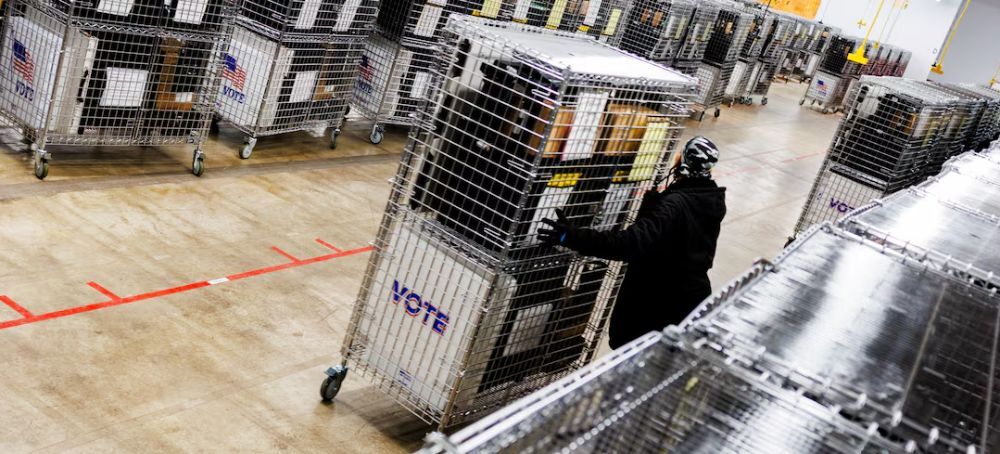 Voting machines in the US, like these in Doylestown, Pennsylvania, are overseen by local election officials but have become a focus of Trump’s effort to expand control over elections. (photo: Hannah Beier/Reuters)
 How Trump’s Obsession With ‘Rigged’ Voting Machines Spread Across Government
Erin Banco, Jonathan Landay, Ned Parker and Phil Stewart Reuters
What began with a search for evidence inside a Puerto Rico voting machine grew into a vast quest involving intelligence agencies, election deniers and White House officials for proof that the 2020 vote was stolen. It failed — but Trump diehards remain undeterred.
The operation was led by Kurt Olsen, a Washington lawyer who had spent years promoting US President Donald Trump’s false claim that the 2020 election had been stolen. To the Trump officials backing the effort, the Puerto Rico machine, which had been used in the US territory’s 2024 elections, offered a chance to prove what courts, audits, election officials and intelligence agencies had repeatedly rejected: that a foreign actor had manipulated votes in Democrat Joe Biden’s favor.
What began as a forensic examination of a single voting machine grew into an investigation spanning the Office of the Director of National Intelligence, which coordinates the nation’s intelligence agencies, the Justice Department, the Department of Homeland Security and the Federal Bureau of Investigation.
While Reuters previously reported on the inspection of voting equipment in Puerto Rico and Olsen’s hunt for evidence that the 2020 election was rigged, this account reconstructs for the first time how that operation unfolded inside the government. It includes previously unreported details about Olsen’s access to sensitive information before he formally joined the administration, his role in obtaining election records from Arizona’s Maricopa County and his push to inspect voting equipment in Venezuela.
Based on interviews with more than two dozen people with knowledge of Olsen’s operation, including two current US officials, four former US officials and two figures with direct knowledge of the Puerto Rico operation, Reuters found that the effort had two goals: to find evidence that the 2020 election had been rigged and use it to support sweeping changes to the American voting system.
Some White House and intelligence officials believed that if Olsen could prove that foreign adversaries or Trump’s political opponents had altered the results of the 2020 election, the findings could help justify expanding federal authority over elections. Some election officials fear his mission has laid the groundwork for the Trump administration to seize voting equipment or ballots during November’s midterms.
Responding to questions from Reuters, the White House said in a statement that the Office of the Director of National Intelligence, then led by Tulsi Gabbard, initiated the investigation after election officials on the island raised concerns through the US attorney’s office about the machines, and that its goal was to identify vulnerabilities, not to revisit the 2020 election. Reuters found, however, that Olsen pushed the effort toward finding evidence that foreign actors had manipulated the election, a search that later expanded into Georgia and Arizona and drew in multiple federal agencies.
The White House also said no “permanent” White House staff were involved in the decision to obtain or review the machine in Puerto Rico. But Reuters found that Olsen, who was backed by Trump, was in regular contact with White House officials in the lead-up to the operation. One person with direct knowledge of the matter described a period of coordination between the White House and the Office of the Director of National Intelligence, known as ODNI, before the voting machine and other equipment were obtained in Puerto Rico. Senior White House officials later became involved as the effort expanded well beyond Puerto Rico.
Gabbard and ODNI did not respond to requests for comment. Nor did the Central Intelligence Agency, Homeland Security or the Justice Department. The US attorney’s office in Puerto Rico declined to comment.
With the midterms a month away, election officials fear voting machines will again become a focus of misinformation and fraud allegations as theories promoted by Olsen and other proponents of stolen-election claims gain a larger platform inside the federal government.
Some election officials are hiring lawyers, drafting emergency court filings and rehearsing responses if federal agents demand machines or records. Colorado passed a law in June allowing the state to declare an election emergency in cases of federal interference, including efforts to obtain voting equipment or records. “We’ll be ready to respond,” Colorado’s Democratic Secretary of State, Jena Griswold, told Reuters.
A Republican loss of either chamber of Congress would break the Republicans’ monopoly on power in Washington, frustrating Trump’s legislative and judicial ambitions while subjecting his administration to aggressive Democratic oversight.
The campaign by Olsen and others to prove that the 2020 election was manipulated through voting machines erodes public trust in elections and could lay the groundwork for future interference, said Ben Berwick, head of election law and litigation at Protect Democracy, a legal advocacy group that has filed lawsuits defending elections from interference.
For years, Trump argued that voting systems were compromised and infiltrated by foreign actors. As his second term began, he cast the search for proof as unfinished business. Inside the White House and parts of the intelligence community, officials revisited claims already rejected by courts and the Justice Department.
Enter Olsen.
The stocky former Navy SEAL built a career as a product-liability lawyer before becoming a fixture in the movement to overturn the 2020 result, advising Trump and his allies from outside the government. His rise from little-known litigator to White House election-security chief illustrates how Trump came to rely on figures long associated with fringe legal theories and election conspiracies to pursue his political grievances.
Olsen’s investigation ultimately found no evidence that foreign actors had infiltrated US voting systems, manipulated machines or swayed the 2020 election. He told colleagues that intelligence agencies and White House officials had thwarted the effort by withholding information, according to three people with knowledge of the matter.
In May, he joined federal prosecutors in Florida examining whether the Obama and Biden administrations had weaponized the government against Trump. Olsen told Reuters that he had stepped down from that role on Monday but remains employed by the Justice Department. He declined to discuss his work or answer questions about this story. The Justice Department confirmed he remains an employee.
The campaign he helped launch didn’t end.
In June, the White House created a task force to declassify records tied to election-fraud allegations and foreign interference as part of Trump’s broader effort to highlight what he says are vulnerabilities in US elections. The White House said the effort was not intended to influence policy ahead of the midterms. A month later, Trump declassified CIA documents that he said showed the Venezuelan government had conspired to manipulate votes electronically in its 2020 elections. The documents did not show that Venezuela altered the vote, a claim it has repeatedly denied. Nor has Trump presented evidence that foreign interference caused votes to flip in the 2020 US presidential race.
The hunt for evidence that the 2020 election was rigged underscores the staying power of debunked conspiracy theories involving two voting machine companies Dominion Voting Systems, now known as Liberty Vote, and rival Smartmatic Corp. While Olsen’s investigation found no proof that either company’s technology had been used to alter votes, it did reveal how pro-Trump election activists who built new careers around those claims gained influence inside the government by persuading Trump they could uncover evidence that others had missed.
“A lot of them have come into the administration, and they’re being given access to the power of the federal government to pursue the exact same claims that they tried to pursue in and around 2020,” said Charles Stewart III, a political scientist at the Massachusetts Institute of Technology who studies election administration. “It’s relitigating 2020 for the benefit of an audience of one.”
THE HUNT BEGINS
When Trump began his second term, Olsen was already well known among activists claiming the 2020 election was stolen.
He had represented Kari Lake, the Trump-backed former candidate for Arizona governor, in challenging her 2022 defeat. An Arizona court later fined him $2,000 for falsely claiming tens of thousands of illegitimate votes had been included in the tally. During 2023 court proceedings, Olsen disputed that some of his claims were false. Later, in a disciplinary hearing over his ability to continue practicing law in Arizona, he said he had “learned a lesson about being more careful with my use of words,” according to a transcript of the proceeding.
Olsen also worked closely with Mike Lindell, the MyPillow founder and promoter of false claims that machines flipped votes in 2020. Trump, who retained Olsen as a lawyer after the election, introduced the two in February 2021, according to Olsen’s testimony in a deposition. Olsen became a consultant for Lindell on election-fraud matters, Lindell said in an interview. “Kurt and I were basically partners,” he said. “He was all in.”
One of the theories in their work held that code developed by Smartmatic, a Florida voting-technology company founded by Venezuelans, had reached Dominion equipment, giving the government of former Venezuelan President Nicolás Maduro a path to manipulate votes. Courts repeatedly rejected the allegation for lack of evidence. Both companies denied it.
In a statement, Smartmatic spokesperson Samira Saba said, “After years of audits, investigations, litigation and forensic examinations, there is no credible evidence that Smartmatic code was used to change votes in 2020.” Liberty Vote, which acquired Dominion in 2025, did not answer questions about Olsen’s investigation but said it was “focused on stability, service and transparency.”
After Trump returned to power, Olsen told White House and intelligence officials that evidence of foreign tampering could help justify expanding federal authority over elections, a power the US Constitution largely reserves to the states, according to one current and two former officials. The White House was already moving in that direction. By late February, officials were drafting what became Trump’s election executive order, issued a month later, requiring proof of citizenship for voter registration and seeking to restrict some forms of mail-in voting.
By spring 2025, ODNI had formed a task force, the Director’s Initiative Group, to carry out executive orders targeting what Trump and his allies called politicization within the government and intelligence community. Led by senior intelligence official and retired Army Lieutenant Colonel Paul McNamara, its first project was an investigation into the 2020 election.
McNamara enlisted Mojave Research, an AI and cybersecurity firm already helping ODNI develop internal search capabilities. White House officials asked ODNI to work with Olsen on election-related projects, according to two former officials. Reuters could not determine precisely how Olsen, who held no government position at the time, came to play such a central role. McNamara also recruited Jason Wareham, Mojave’s chief executive, who said he was brought in to examine voting machines in Puerto Rico alongside Olsen.
Puerto Rico offered what Olsen and his allies had struggled to obtain from US states: direct access to Dominion machines similar to those used across the US. Island officials cooperated after widespread ballot-scanner problems, including jams and vote-reading errors, disrupted its 2024 elections.
Olsen was in near-daily contact with White House officials and had begun assembling a small team of outside analysts, sharing with them election-related intelligence he obtained from inside the government to support the probe, according to the people familiar with the operation. In its statement, the White House said the administration “carefully follows the law regarding access to sensitive information.”
On a May video call, Olsen told Mojave Research staff and cybersecurity specialist Ben Cotton, who had worked on legal challenges to the 2020 election, that Puerto Rico authorities would provide machines he believed could yield evidence of Venezuelan hacking. Olsen insisted on secrecy, saying he was already encountering resistance inside the administration to reopening questions about the 2020 election. Cotton, calling from a barber’s chair during a haircut, volunteered to join. Cotton did not respond to a request for comment.
In June 2025, Wareham and Cotton flew to Puerto Rico’s capital, San Juan, with an FBI agent and a Mojave Research engineer. After inspecting dozens of machines in a warehouse, they spent several days at Puerto Rico’s State Elections Commission, the agency overseeing the island’s elections, copying data from a Dominion machine provided for analysis. The commission declined to comment on any possible ongoing US investigations.
Wareham saw the assignment as a forensic exercise: collect the data and determine whether the machine had been compromised. Olsen wanted to search for traces of Smartmatic code that, under his theory, would show how Venezuela or another foreign actor such as China could manipulate Dominion machines, according to Wareham and two others with direct knowledge.
That theory had become an article of faith among some Trump supporters. But Dominion spent years battling such allegations, which courts repeatedly rejected. In 2023, Fox News agreed to pay Dominion $787 million to settle a defamation lawsuit over false election-rigging claims.
When the Puerto Rico work ended, Wareham copied data from machines and servers onto nearly every external hard drive he could buy in San Juan, packed them into eight to 10 boxes and shipped them to ODNI headquarters in McLean, Virginia, for analysis, he said.
On June 19, a week after the Puerto Rico operation, Olsen and the FBI agent joined Justice Department officials for a six-hour meeting at a Tampa hotel with people who claimed expertise in Smartmatic technology. According to people familiar with the meeting, the group said it had firsthand knowledge that the technology had been used to manipulate elections in Venezuela and the Philippines. Reuters was unable to independently verify those claims. Representatives of the Venezuelan and Philippine governments did not respond to requests for comment.
The meeting was supposed to provide a missing link. Smartmatic once owned Sequoia Voting Systems, a US election-technology company later acquired by Dominion. The attendees were pressed on whether Smartmatic software might have passed through Sequoia into Dominion machines used in US elections. If they could connect Smartmatic technology to Dominion, it would strengthen a conspiracy theory at the heart of Olsen’s effort: that foreign actors had a path into US voting systems.
The group, however, failed to establish that connection. They said they could link Smartmatic’s software to Sequoia’s but not to Dominion’s. They offered no evidence that Smartmatic software entered Dominion machines, that US equipment was hacked or that votes were altered. Smartmatic says it has no software, ownership or business ties to Dominion.
On October 3 last year, Wareham said he briefed senior White House officials, including Gabbard, White House chief of staff Susie Wiles and deputy chief of staff Stephen Miller. He told them the team had identified some vulnerabilities, including outdated software, that were repairable but found no evidence of hacking or altered votes.
Miller pushed to bring in the FBI and potentially seize more machines, the people familiar with the investigation said. Wiles asked whether they had uncovered any new evidence the 2020 election was rigged. Later that month, ODNI submitted its own report to the White House, drawing partly on Mojave Research’s work. It highlighted vulnerabilities but, as Reuters previously reported, also found no evidence that votes had been manipulated.
In a statement, Mojave Research said it repeatedly sought additional time to examine the data and test allegations of vote interference, but that the effort was halted before it could complete the work.
By late summer, Olsen had turned on Mojave Research. He told Trump that the Virginia contractor was secretly funded by George Soros, the billionaire philanthropist who has backed Democratic candidates. Mojave Research denied the allegation in a statement to ODNI reviewed by Reuters. Wareham and a spokesperson for the Open Society Foundations, Soros’ family philanthropy, said there were no ties or investments linking the two.
ODNI terminated Mojave Research’s contract later that month. Reuters could not determine the reason for the termination.
Wareham emerged from the operation critical of both Olsen and the White House. His findings, he believed, could have spurred useful changes such as software patches, security upgrades and broader reviews of voting machines. Instead, he told Reuters, they were never acted upon or publicly released. He also faulted Olsen for pursuing debunked theories that he felt distracted from an objective assessment of voting-machine security.
OLSEN TAKES CONTROL
The inconclusive results in Puerto Rico didn’t slow Olsen’s rise. In late October 2025, Trump appointed him director of election security and integrity. He became a special government employee at the White House, a temporary role often used for outside advisers.
US voting machines and election records are controlled by state and local governments, not by Washington, a constitutional safeguard designed to limit federal interference in elections. But Olsen soon persuaded White House officials, including Wiles, that the administration should seek access to them.
His first target: Fulton County, Georgia.
The state’s most populous county holds a special place in the mythology of Trump’s stolen-election movement. After Biden carried Georgia by fewer than 12,000 votes in 2020, Trump urged the secretary of state to “find” enough to reverse the result. He portrayed heavily Democratic Fulton, which includes much of Atlanta, as the center of a vast fraud conspiracy, a claim repeatedly rejected by courts and state officials.
On January 28, FBI agents descended on the county election hub with a warrant to seize every ballot cast there in 2020, along with voter rolls, ballot images and machine records. They carted away about 650 boxes. The investigation began with an Olsen referral, according to an affidavit supporting the warrant. Gabbard attended the raid and arranged a call in which Trump thanked the agents.
The Justice Department’s continuing investigation of Fulton drew heavily on activists whose fraud allegations had been repeatedly investigated and largely rejected by Georgia officials. The FBI case gave their claims the federal backing they had lacked.
Kevin Moncla, one of several citizen researchers interviewed by federal agents, said he first shared Fulton County allegations with Olsen in 2022. He was not surprised when he learned Olsen, who he calls a friend and mentor, had referred the matter to the FBI.
“I’m only surprised it took him so long,” he said.
Dana Barrett, a Fulton County commissioner whose board funds election operations and appoints the county election board chair, said the ties between the Justice Department and amateur sleuths illustrated how pro-Trump activists who claimed the 2020 election was stolen had converged with allies inside the administration. “They are all connected,” she said. “This is not a last-minute knee-jerk plan. This has been building since 2020.”
After Fulton, Olsen again looked abroad. Weeks after the US raid on January 3 that captured Maduro, he proposed traveling to Caracas with Gabbard to seize Venezuelan voting-machine data and equipment he said would likely prove 2020 was rigged. Senior ODNI officials rejected the proposal because they considered some aspects too vague, including exactly what equipment would be seized and how it would be obtained, according to a person with direct knowledge of the meeting and another familiar with it.
In March, Olsen turned to Arizona’s Maricopa County, the largest county in a battleground state and another hotbed of unfounded 2020 election theories. He oversaw the Justice Department’s acquisition of Maricopa records through a subpoena to the Arizona Senate, according to three people familiar with his work. His role has not previously been reported.
The records included voter rolls, 2.1 million ballot images and signature-verification data that were originally provided to lawmakers during a 2021 Republican-backed audit that found no evidence Trump was cheated of victory.
Later that month, as Olsen’s 130-day White House tenure neared its end, Trump was growing impatient. Over dinner at a Washington steakhouse, Olsen told colleagues that after months of investigations, the closest thing he had found to a smoking gun lay in classified intelligence, according to one person with direct matter of the conversation. Olsen said if declassified, the documents would point to foreign interference, but the intelligence community was resisting their release, the source said.
The documents’ precise contents remain unclear. Two current and two former US officials familiar with them said none showed votes had been manipulated in 2020.
In the following weeks, Olsen’s relationship with the White House deteriorated. Administration officials pressed him for evidence they could use to support claims that the election had been rigged. Olsen responded by blaming intelligence agencies for withholding what he needed.
Olsen left the White House in May. “Special government employees are limited to 130 days per calendar year,” he explained in a brief interview with Reuters. “And my 130 days were up.”
In May, he joined a team of federal prosecutors in southern Florida examining what Trump allies call a “grand conspiracy” theory: whether investigations into Trump, including the FBI’s Russia probe and the classified-documents case tied to records recovered from Mar-a-Lago, were part of a broader effort by federal law-enforcement and intelligence officials to damage him politically and violate his civil rights.
That investigation has since lost several senior figures, including Joseph diGenova, the prosecutor who oversaw it, and one of its lead FBI agents. “Mr. Olsen was a fine lawyer,” diGenova said in an interview.
After just four months, Olsen also left. He declined to say why. “I am still at DOJ and not participating in that investigation,” he said. He remains a senior counsel at the US Attorney's Office for the Southern District of Florida, the Justice Department said.
A NEW STRATEGY
Inside the administration, some officials viewed the search for evidence of manipulation in 2020 as secondary to a larger objective: changing how Americans think about election security. The focus increasingly shifted to vulnerabilities in voting systems and support for measures such as the SAVE America Act, which would require proof of citizenship to register to vote. Trump framed the bill as a cornerstone of his elections agenda and unsuccessfully urged Congress to pass it.
Independent researchers and government agencies acknowledge that voting systems, like other critical infrastructure, contain vulnerabilities. But finding a flaw is not the same as proving it was exploited to alter votes. A 2022 review by the US Cybersecurity and Infrastructure Security Agency, created during Trump’s first term, identified flaws in some Dominion systems that might allow unauthorized access but found no evidence they had been exploited. Liberty Vote, Dominion’s successor, did not respond to questions about the findings.
In a primetime address in July, Trump told Americans they had been “blatantly lied to about the security of our election infrastructure, including electronic voting machines.” He has moved to expand the federal role in elections, pressing for restrictions on mail-in voting and deploying federal law enforcement in pursuit of fraud claims. Courts blocked a US Postal Service plan that could have delayed or rejected valid ballots.
For some Trump allies, those steps do not go far enough. They contend that the White House and a “Deep State” of career officials thwarted Olsen’s efforts to investigate machines, uncover foreign interference and overhaul elections.
“Kurt from the start was undermined,” said Patrick Byrne, an e-commerce entrepreneur and early promoter of stolen-election claims. “Even if the Deep State derailed it, it got derailed because the White House got weak-kneed and let it be derailed.”
Peter Ticktin is a Florida lawyer and longtime Trump ally who has represented people involved in efforts to overturn the 2020 election. He believes the president’s best chance to force changes before the midterms would be to declare a national emergency – or even martial law if China or other foreign powers exploited flaws in voting machines.
Any such efforts would almost certainly face immediate legal challenges, but Ticktin is hoping Trump will act anyway.
“We’re at a crossroads,” he said.