
How the Trump Administration Pushed Judges to Deport Children
E. Tammy Kim The New Yorker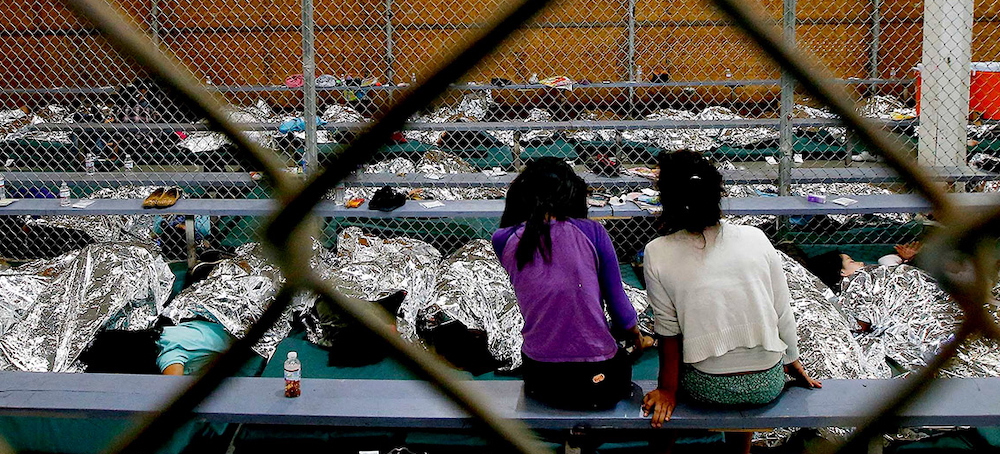 Children in an immigrant detention center. (photo: ACLU)
 How the Trump Administration Pushed Judges to Deport Children
E. Tammy Kim The New Yorker
The D.O.J. has fast-tracked immigration cases for unaccompanied minors and fired judges who appear not to comply.
The immigrants who appeared before Sponzo were classified as unaccompanied alien children, or U.A.C.s, which meant that they had entered the U.S. alone. They were mostly older boys from Guatemala, Honduras, Colombia, and Ecuador; also, Bangladesh. The judge didn’t speak their names or address them directly. They flashed into view—a vertical closeup of a face, a slumped shape at a conference table—only when they forgot to mute themselves.
Sponzo asked their lawyers to waive interpretation so that everything could move more quickly. “So waived,” they each replied. Translated jargon is still jargon. Such efficiencies had recently helped Sponzo get through more cases than any other judge in the courthouse. Many of the immigrants who appeared before her had pending applications for asylum or special immigrant juvenile (sij) status, the two main ways for U.A.C.s to avoid deportation.
sij is a type of humanitarian visa. It involves three steps: a determination by a U.S. state or family court that there has been parental abuse, neglect, or abandonment, and that it isn’t in the young person’s best interest to return to their country of origin; a petition to U.S. Citizenship and Immigration Services to recognize those findings; and an application, again to U.S.C.I.S., for the visa and green card. It was created by Congress, in 1990, to protect undocumented kids who ended up in the child-welfare system from being deported or getting stuck in a parentless purgatory. Initially, it was seldom used. Later, as more and more children travelled to the U.S. alone, it became a common form of relief—and was criticized as a loophole that encouraged unaccompanied migration. Between fiscal years 2005 and 2013, the number of approved sij petitions rose from seventy-three to more than three thousand.
In a quirk of legislative drafting, sij had been classified as a type of employment visa and capped at around ten thousand per year. By 2021, some forty-five thousand sij youth were in line for a visa and green card. By early 2023, the backlog exceeded a hundred thousand. The Biden Administration allowed these applicants to get work permits while they waited.
For most of the past twenty years, immigration judges tended to offer minors a reprieve from deportation until their sij and asylum applications had run their course. They also gave them plenty of time to find a lawyer. “This goes hand in hand with the independence of judges, their independence to control their dockets, their independence in decision-making,” Amiena Khan, the former assistant chief immigration judge in New York City, who was fired in December, told me.
No longer. Late last year, the Justice Department’s Board of Immigration Appeals held sij to be a “speculative” form of relief. Judge Sponzo began to rule accordingly: sij and asylum, she said from the bench, were “collateral” to the question of removal. Immigrants and their attorneys felt unable to plead their case. It seemed highly relevant that “a state court has said these children are vulnerable and should not be returned to their home country, and U.S.C.I.S. has determined the same,” Meena Shah, the managing director of legal services at the nonprofit the Door, told me. Yet in a number of sij cases Sponzo recognized “no application for immediately available relief,” and ordered teen after teen deported. As one court employee observed, “She never continues cases ever at this point in the game.”
Throughout President Donald Trump’s second term, all kinds of changes have roiled the immigration courts. Every month, there has been some new directive or precedential case or mass firing that spins the heads of court staff and of lawyers on both sides. The goal is transparent: “to carry out the largest, lawful deportation operation of criminal illegal aliens in history,” as a White House spokesperson said. Adults, few of them with a violent criminal record, were hit first. Certain groups, such as Somali immigrants (whom Trump has called “garbage”), had their cases fast-tracked. Now unaccompanied kids are being treated like adults, despite laws and policies meant to give them extra consideration. (A D.O.J. spokesperson denied this, adding that U.A.C.s “are afforded all special consideration required by law.”)
This shift, which became widespread in early April, raises “a lot of serious concerns around due process and the plain well-being of children,” Benjamin Remy, a lawyer with the New York Legal Assistance Group, told me. The Department of Justice declined my request for an interview, but a spokesperson said that the agency “prioritizes the timely completion of all cases, including those of unaccompanied alien children.” Delays in immigration court, the agency added, “hurts both aliens with meritorious claims and the American public who wish to see aliens with non-meritorious claims removed as quickly as possible.”
Youth had been prioritized for deportation before, including during President Barack Obama’s second term, when tens of thousands of unaccompanied children began showing up at the U.S.-Mexico border. During Obama’s full tenure, around fifty per cent of U.A.C.s either were ordered removed or agreed to voluntarily depart, according to a study by Chiara Galli, of the University of Chicago, and Tatiana Padilla, of the University of Minnesota. That number increased to seventy per cent under the first Trump Administration. Then, under Joe Biden, when there were far more U.A.C.s than ever before, the figure dropped to thirty per cent. Judges were trained to grant adjournments for pending sij petitions, and the Department of Homeland Security revived an Obama-era program that screened Central American children for humanitarian relief before they made the journey north. “The idea was to interview them abroad, to determine if they were in danger and if they had a family member in the U.S. who had legal status,” Carmen Maria Rey Caldas, a former immigration judge who worked on that program, told me.
When Trump returned to office, in 2025, he closed the country’s borders to asylum seekers, including children; shut down the Central American program; and cut funding for pro-bono representation. His immigration adviser, Stephen Miller, referred to U.A.C.s as the “children that Joe Biden trafficked into the country—that Democrats trafficked into the country.” There are now fewer than two thousand U.A.C.s in the U.S., compared with some seven thousand in late 2024, a drop attributable mostly to the sealing of the southern border. The total number of children agreeing to voluntary departure has increased sevenfold, the Vera Institute of Justice found.
In mid-May, at another online hearing of juvenile cases, I was one of two observers in Sponzo’s courtroom. Onscreen, she asked a lawyer if his client wanted to avail himself of “the privilege of voluntarily departing the United States.” A different lawyer informed the judge that her client, a girl from Russia, “has left the country” already. An Ecuadorian immigrant had decided not to show up, resulting in an automatic removal order. Her lawyer asked for permission to put an explanation on the record: “She doesn’t believe that, in this political climate, it’s worth it to try.” Some of the minors logged on alone, without any representation. (Between 2013 and 2024, only sixty-two per cent of U.A.C.s had lawyers.) Sponzo ordered more than a dozen young people deported before lunchtime.
The next day, Sponzo was fired. Despite her apparent effort to carry out Trump’s directives, her record on asylum applications had been overwhelmingly favorable to immigrants: between 2020 and 2025, Sponzo had granted asylum or other relief in eight of ten cases. (She could not be reached for comment.) Another New York judge fired on the same day, Kyle Dandelet, had a grant rate of about seventy per cent. Unlike Sponzo, Dandelet had seemed upset by the curbs on his independence. He distinguished himself at 26 Federal Plaza by denying D.H.S.’s motions to deport asylum applicants before their cases could be heard. (He declined to comment.) That same week, five new immigration judges were appointed in New York. The Department of Justice has made clear in its recruitment materials that it wants to hire “deportation judges” only. A spokesperson described the agency’s training program as “robust” and “ongoing.”
According to the D.O.J., no official “can direct an Immigration Judge as to how to adjudicate a case, including what deadlines to set in particular cases.” But immigration lawyers, from the East Coast to Illinois, Texas, Washington State, and California, say that judges on juvenile dockets have been setting short deadlines—of just two or three weeks—and rushing through fifty or more cases in a single morning or afternoon block, about double the usual number. Nina Fróes, who was fired from her Chelmsford, Massachusetts, courtroom in April, had covered a juvenile docket toward the end of her tenure. She told me that she was regularly given “a random list of cases that needed to be put on the calendar”—cases that needed to be resolved, and quickly. As of last month, some judges have had to hold preliminary hearings for a hundred people at the same time. “It seems to me,” Fróes continued, “that the Administration has people at the top who go to roundtable meetings and say, brainstorming, ‘How can we get more people removed? Anybody got any ideas this week? Yeah, great, let’s do that.’ ”
Trump’s effort to remove more children and teens is expansive; the courts are, in a sense, the least opaque piece of a wider plan. U.S. Citizenship and Immigration Services can take months just to issue notices of receipt—confirmation that forms were sent in. Processing times can be correspondingly long. The sij backlog has surpassed a hundred and fifty thousand. I spoke to Estuar Lopez, who, in 2022, entered the U.S. from Guatemala, as a U.A.C. With the help of a nonprofit lawyer, he was approved for sij, based on a judicial finding that his parents, who remain in Guatemala, neglected him, but he hasn’t been able to obtain employment authorization or deferred action (temporary protection from removal). He’s enrolled in community college, in California, in the hope of becoming a nurse. This assumes, of course, that a work permit eventually comes through. In the meantime, “if, someday, Border Patrol grabs me,” he said, “I run the risk of being deported.” Two of his friends were recently sent back home.
Many sij youth have been arrested and detained. In March, Josue Navarro Zamora, a high-school senior in Louisiana with an approved sij petition and deferred action, was pulled over by local police for allegedly driving under the influence. But instead of facing a criminal-court judge he was transferred to ice custody and has remained there ever since. In January, Hesler Garcia Lanza, a twenty-four-year-old resident of Long Island with sij-based deferred action and work authorization, was chased down by ice agents who’d mistaken him for another man. His ordeal was later summarized by a federal-court judge:
As bureaucratic cover for the arrest, agents completed a post-arrest administrative warrant and then commenced baseless removal proceedings against him. Then, DHS proceeded to revoke the deferred action and work authorization associated with his SIJ status—a reprehensible act of unimaginable cruelty. Even after this Court set the terms and conditions of petitioner’s release, ICE imposed additional, unsanctioned conditions upon him, and then DHS imposed a hefty fine to offset the cost of his illegal apprehension.
This isn’t how things are supposed to work in America.
Garcia Lanza was ordered released, but continued to face deportation proceedings in New York. An immigration judge dismissed the case against him earlier this week.
The outlook for unaccompanied young people kept in Office of Refugee Resettlement shelters is similarly dismal. Last month, in New York, I visited the courtroom of Judge Lisa Ling, who handles the docket for detained juveniles. Her clerk walked into the spectator gallery to pass out candy before the hearings began. Most of the children appearing that day, both virtually and in person, had no lawyer, though nonprofits accompanied them on a “friend of court” basis, a triage attorney-for-a-day. Unaccompanied minors were spending months in custody, shuffled between facilities, even when they had a sponsor ready to take them in. Owing to several conditions—new vetting procedures, ice arrests of sponsors going through that vetting, and lack of access to lawyers (waitlists for pro-bono counsel are in the thousands)—a child’s average length of detention jumped to four months in 2025, up from just one month the year before. The more time, the greater the risk of turning eighteen and getting transferred to an adult prison.
“Do you know where you are in the process of reuniting with your family?” Judge Ling asked a boy named Anthony, through a Spanish interpreter. “Yes, I’m in the home study,” he said, referring to the inspection of his sponsor’s residence. Increasingly, lawyers for U.A.C.s are obliged to file habeas petitions to get their clients released to relatives. And, in cities such as New York and Chicago, multiple shelters have been closed with little notice. (The Office of Refugee Resettlement declined to comment. It has said that its vetting protocol is designed to prevent trafficking, and that fewer shelters are now necessary because of the decrease in U.A.C.s.)
Shah, the attorney at the Door, told me that the government seemed to be closing shelters in places with legal and social support, and moving kids to places like Texas, whose courts are generally less friendly to immigrants. Texas was also where, last Labor Day weekend, D.H.S. boarded seventy-six kids onto planes to Guatemala in the middle of the night. Instead of allowing the children to seek relief in immigration court, the Trump Administration persuaded the Guatemalan government to take them back immediately. It argued that deportation was in the children’s best interests, and that separation from their parents was “a tragedy to be cured, not prolonged.” A federal judge disagreed, issuing a restraining order based on “irreparable harm from transportation outside the United States.” One of the planes was reportedly turned around, midair.
Other changes will make it harder for all immigrants, including young ones, to envision a future in the U.S. The asylum program continues to be shrunk into irrelevance. Immigration fees have become prohibitively high since last year: a motion to reconsider went from a hundred and ten to a thousand and ten dollars; a motion to cancel removal from a hundred and thirty to seven hundred and thirty dollars. A new executive order could vastly limit “non-work authorized populations” from accessing credit and banking systems. Some non-citizens with work permits are being locked out of jobs that require minimal background checks, ostensibly on the grounds of public safety. And a majority of green-card aspirants could soon be required to leave the country in order to apply, which, advocates say, will prevent many from being let back in.
With immigration, problems that feel devastatingly novel are often maddeningly old—repeated, recurring. As my colleague Jonathan Blitzer writes in his book, “Everyone Who Is Gone Is Here,” what’s been perceived—sometimes rightly, sometimes wrongly—as the “mass arrival of unaccompanied children” has bedevilled every recent Administration, Democratic and Republican. Presidents Obama, Biden, and Trump have all fast-tracked cases in immigration court to process as many kids as possible. The difference in Trump’s second term is that the outcome is preordained and, in most instances, final. Only so many planes can be turned around midair.