
How the Supreme Court Secretly Made Itself Even More Secretive
Jodi Kantor The New York Times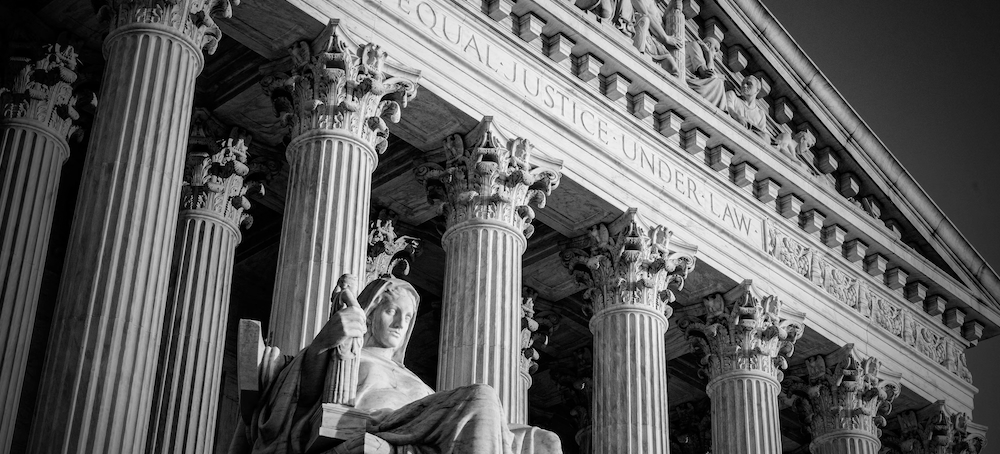 The Supreme Court Building in Washington, D.C. (photo: Mark Peterson/Redux)
 How the Supreme Court Secretly Made Itself Even More Secretive
Jodi Kantor The New York Times
Amid calls to increase transparency and revelations about the court’s inner workings, the chief justice imposed nondisclosure agreements on clerks and employees.
The chief justice acted after a series of unusual leaks of internal court documents, most notably of the decision overturning the right to abortion, and news reports about ethical lapses by the justices. Trust in the institution was languishing at a historic low. Debate was intensifying over whether the black box institution should be more transparent.
Instead, the chief justice tightened the court’s hold on information. Its employees have long been expected to stay silent about what they witness behind the scenes. But starting that autumn, in a move that has not been previously reported, the chief justice converted what was once a norm into a formal contract, according to five people familiar with the shift.
Over the years, journalists and authors have sought to penetrate the court, and the justices have tried varying methods to guard its secrets. Some generations of clerks, but not others, said they were asked to sign a different kind of confidentiality pledge.
The New York Times has not reviewed the new agreements. But people familiar with them said they appeared to be more forceful and understood them to threaten legal action if an employee revealed confidential information. Clerks and members of the court’s support staff signed them in 2024, and new arrivals have continued to do so, the people said.
A spokeswoman for the court declined to comment about the nondisclosure agreements. She also did not respond to a question about whether the justices have been asked to sign the contracts.
The people who described the agreements spoke on the condition of anonymity because they were not authorized to speak publicly about court matters.
The justices are accustomed to controlling what the public knows about their work, sealing nearly everything but their oral arguments and written opinions behind a high wall of secrecy. Courts are excluded from the open records laws that require many other government bodies to maintain and make available internal information.
The justices claim their papers belong to them, not the government or the public, and generally arrange to have them locked away until long after their deaths. The court releases no visitor logs to reveal who meets with the justices.
But in 2022, in a shock to many at the court, someone leaked a draft of the court’s decision overturning the federal right to abortion to Politico, which published the document weeks before the justices had intended to make it public. The court conducted an investigation of its staff but mostly spared the justices, and the source was never publicly identified.
More recently, The Times has been regularly publishing stories illuminating the court’s inner workings, including accounts of sensitive debates among the justices.
In September 2024, The Times published an article describing how the chief justice pushed to grant President Trump broad immunity from prosecution. The article quoted from confidential memos by the chief justice and other members of the court who applauded his reasoning. Weeks later, the chief justice abruptly introduced the nondisclosure agreements, after the term had begun.
Before then, the chief justice — fond of referring to court members and employees as a family — relied on softer measures to preserve confidentiality, delivering a lecture to clerks at the start of each term and distributing a written code of conduct to them.
“The law clerk owes the appointing Justice, all other Justices, and the Court as an institution, duties of complete confidentiality, accuracy and loyalty,” instructed a 2018 version obtained by The Times, in which every page is labeled “confidential — for authorized internal use only.” The final page mentioned that breaches could lead to “appropriate sanctions,” but did not specify what those might be.
Some Supreme Court clerks who served in past decades also recall being asked to sign a document agreeing to abide by the court’s rules of confidentiality. A version of the agreement was introduced in the years after a former clerk published a rare tell-all book in 1998, they said. Those clerks said the documents did not amount to legal nondisclosure agreements.
Peter Kaplan, a spokesman for the federal courts, said other judges have also used those kinds of pledges in the past though he and others did not believe they were currently in widespread use. He said the Judiciary’s code of conduct includes confidentiality requirements.
Former clerks and academics, told by The Times about the Supreme Court’s new nondisclosure agreements, said they were a sign that the justices felt they could no longer rely on more informal pledges or longstanding norms to guard their internal workings from public view.
“They feel under the microscope and are unwilling to rely simply on trust,” said Jeffrey L. Fisher, co-director of the Supreme Court litigation clinic at Stanford Law School and a former clerk to Justice John Paul Stevens.
The switch to formal contracts is “a sign of the court’s own weakness” and the erosion of an internal compact, said Mark Fenster, a law professor at the University of Florida.
Court employees see the justices’ maneuverings, their compromises, tensions and reversals. They read the memos and draft opinions that tell the story of how the law is really shaped. That includes the secret negotiations behind so-called “shadow docket” decisions, emergency orders the court issues often with little or no public rationale. Since Mr. Trump took office, the court has repeatedly issued such emergency orders, allowing him to implement his agenda.
Legal experts said the new agreements may be more effective at scaring employees than at legally binding them. Such agreements are tricky to enforce even in typical workplaces, they say, and most likely harder at the Supreme Court.
Nondisclosure agreements are a paradox, said Mr. Fenster, because seeking to enforce them risks further exposing the very information they are designed to conceal. “If the employer has to go to court to enforce a damages claim or an injunction, you’re in public,” he said.
For the nation’s highest court to bring legal action against an employee could create its own puzzle, he and others said. “Who would represent the Supreme Court?” Mr. Fenster asked.
The agreements may complicate another Supreme Court tradition: former clerks cashing in on what they learn there. Law firms now pay clerks signing bonuses as high as $500,000. The court requires them to avoid working on its own cases for two years. But after that, former clerks often spend the rest of their careers monetizing the knowledge they gained from working directly with the justices and also reading still-secret older case files, some said in interviews. While they are not supposed to share specifics with clients, plenty of details slip out, the former clerks said.
The debate over whether the Supreme Court is too secretive has played out since the nation’s earliest days. In 1821, Thomas Jefferson wrote that the institution was “smothering evidence” and that the nation needed to know more about the character of the justices, who are appointed for life.
Now, even as some observers of the court call for it to be more transparent, judges, including the justices, generally defend the longstanding tradition of keeping their decision-making private.
“I don’t see any need on the public’s part to see the internal deliberations,” said Paul J. Watford, a retired federal judge appointed by President Barack Obama. “What you’re trying to do as a judge in interacting with your colleagues is be completely open and wrestle with the difficult questions,” he added.
Leaks discourage judges from changing their minds and “undermine the ability of the court to function as a collegial body,” he said.
Justices have long warned of the dangers of opening their private deliberations, saying it could undermine their independence and lead to “lobbying pressures,” as Justice William H. Rehnquist, who later became chief, put it in a 1977 speech arguing for secrecy.
More recently, Justice Amy Coney Barrett relayed what Justice Antonin Scalia, her own former boss, used to tell new clerks. “He would say, If you ever leak information now or any point in your lifetime about what happened in this court, I will hunt you down and destroy your career,” she said in a talk last September at the University of Notre Dame.
She said she now gives her clerks a similar warning, though in less dire terms.
But once the decisions have been announced, and as time passes, the arguments for opacity fade, said Daniel Epps, a law professor at Washington University School of Law and former clerk to Justice Anthony M. Kennedy.
“The justices have immense power — they’re not elected. That power depends on our consent as a democracy and we have some interest in seeing how they’re using their power and making decisions,” he said.
The secrecy allows the justices to dismiss criticism on the grounds that outsiders don’t know or understand what’s happening behind the scenes, said Nikolas Bowie, a Harvard Law School professor who served as a clerk to Justice Sonia Sotomayor.
“Many of the court’s decisions are being made out of the public eye in a way that makes it difficult to assess or criticize them, or to understand what actually motivated the justices,” he said. “The lack of transparency makes it difficult for the broader public to know how to respond.”
He said it also allows the court to conceal weaknesses in its processes, including the justices’ reliance on clerks for legal reasoning and writing.
“If the public were aware of how much of the deliberations affecting millions of people are made by 27-year-olds after happy hour, they’d be shocked,” he said.