
How The Rightwing Operative David Horowitz Shaped Stephen Miller
Sidney Blumenthal Guardian UK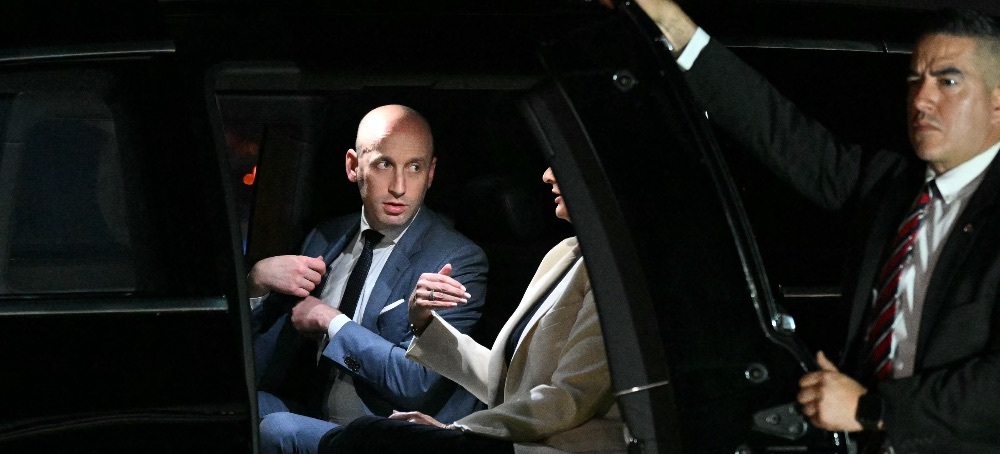 ‘Miller’s absolutism wraps him in total authority in order to intimidate and dominate any discussion.’ (photo: Alex Wroblewski/Getty)
How The Rightwing Operative David Horowitz Shaped Stephen Miller
Sidney Blumenthal Guardian UK
Horowitz, who swung from the far left to the far right, sought total political warfare against institutions and immigration
Trump has no more time for adults in the room who might want to negotiate with the new powers-that-be in the Congress. He has searched his soul, as he explained in his interview on 60 Minutes, entertaining his wish to ascend to heaven.
“I don’t want to go to hell,” he said. He must be true to himself. Asked about “forgiveness” of his critics, Trump disparaged “forgiveness”. “I can use the word hate, I do hate some of my enemies. I think they’re – they’ve been terrible. Look what they’ve put me through, the weaponization. I got indicted …” Trump is the eternal victim in a world of “enemies”.
Miller’s superiority complex neatly complements Trump’s malignant narcissism. Trump is Miller’s calling; Trumpism is his profession. His life has led to this consummation. Miller feels most superior, most himself, servicing Trump’s megalomania.
Miller is far more than a yes-man extraordinaire. Miles Taylor, the chief of staff at the Department of Homeland Security in the first Trump term, recalls being present when, after a lower federal court decision went against the administration, Trump banged his desk. “We need to get rid of the judges,” he reportedly said. In Taylor’s account, Miller piped up: “Yes sir, a country without judges would help.”
Miller projects his superiority complex as more than the lament of the lonely truth-teller. He debases opponents as “dumb”, “stupid”, “ignorant” and“foolish”. He construes every issue as Manichean, zero-sum and existential. Those who disagree with him are not only illegitimate but also threaten the survival of the nation. “If it wasn’t for President Trump, the United States of America would not exist right now. This man saved America,” he said this month.
Miller’s technique of vicious denigration denies that his opponents have any credibility without ever engaging their arguments. His absolutism wraps him in total authority in order to intimidate and dominate any discussion. His vehemence signals he is fighting a righteous crusade against nefarious enemies, from “wokeism” to “diversity” to the “deep state”.
Miller’s sophistry echoes the “great replacement theory”, still another expression of his superiority complex, which recycles white nationalist tropes. He is a fan of the 1973 neo-fascist, racist novel The Camp of the Saints, in which third-world masses invade a decadent Europe.
Miller uses the word “invasion” routinely to characterize immigration. “We are being conquered,” Miller has said. “This is a complete resettlement of America in real time … a generation from now … people will not know the country that they are living in.”
He is the prime mover behind Trump’s challenge to birthright citizenship in the 14th amendment. Once again, Miller uses the word “invasion”: birthright citizenship is “the biggest, costliest scam in financial history … it is the number one magnet for illegal immigration and invasion.”
The omnipotent Trump is yet another of Miller’s projections of superiority. “The powers of the president to protect our country are very substantial and will not be questioned,” Miller said. His Führerprinzip inferentially includes the leader’s shadow, Miller himself, who also “will not be questioned”.
Miller’s fanaticism has its sources in obvious rightwing motivation, but in his case his tutelage took place under an unusual mentor in the Bolshevik style of invective. If ever there is a classic contemporary example of status anxiety as the origin of radical right resentment, it is that of Stephen Miller.
Miller’s father, a real estate investor, lost money, and the family moved from a luxurious home in Santa Monica to a smaller one in a more diverse neighborhood. Instead of attending a private school, Stephen went to Santa Monica High, highly ranked with a large Latino student presence.
“Hi, I’m Stephen Miller, some of you may or may not know who I am,” Miller said to an assembly when he ran for the student council. “I’m the only candidate up here who stands out … Am I the only one who is sick and tired of being told to pick up our trash when we have plenty of janitors who are paid to do it for us?”
Miller cut ties to a childhood friend, Jason Islas, according to Islas, “because I am Latino”. Miller chose a quote for his yearbook to highlight his opposition to multicultural events at the school: “There can be no fifty-fifty Americanism in this country.”
Miller began calling into a local rightwing talk radio show to denounce students and teachers for “stupidity”. According to Miller’s biographer, Jean Guerrero, he took the initiative to reach out to the best-known and most provocative rightwing operative residing in Los Angeles to invite him to speak to the school.
Horowitz flipped from far left to far right but was completely unchanged in his Leninist tactics and apocalyptic mindset. “Politics is war: Don’t forget it,” he wrote in his 1999 book, The Art of Political War: How Republicans Can Fight to Win.
Now, in charge of a lucrative rightwing operation, Horowitz took on Miller as his protege. Horowitz also mentored Charlie Kirk, who called him “a titan in the battle of ideas”, bankrolled the Islamophobe Robert Spencer, allied with the then unknown Stephen Bannon, and promoted the rise of Ron DeSantis.
After Miller graduated from Duke, where he used the Horowitz front group, Students for Academic Freedom, to attack multiculturalism and liberalism as the campus crank, Horowitz secured for him a series of jobs, first as press secretary for the representative Michelle Bachmann, of Minnesota, a Tea Party radical, and then with Senator Jeff Sessions, of Alabama.
Miller was an eager receptacle for Horowitz’s core ideas and tactics – of total political warfare against the evil enemy within of mainstream institutions, from the media to the universities to government agencies; and that immigration is an elemental multicultural threat to civilization.
Virtually every notion and formulation Miller advanced came from Horowitz, who remained close to him into the second Trump term, until he died in 2025, upon which Miller got Trump to tape a memorial video tribute to Horowitz as “a great patriot”.
Just as Trump was the protege of Roy Cohn, Miller was the protege of David Horowitz. But Trump had his own experience apart from Cohn in a variety of worlds and demimondes. Miller, however, was Horowitz’s test-tube experiment, his mimetic creation, a kind of homunculus, a mini-me.
Cohn was a liar, a thief and a scoundrel, but he was not a convert. He had his own independent and expansive social and political base in New York. Highly influential people who were not conservatives embraced him because he was useful and amusing. If Cohn had dropped Trump as a client, or Trump dropped him, Cohn’s influence and wealth would have been unimpaired.
Miller, by contrast, has no independent existence apart from Trump. He is as disposable as his inner circle of administration staffers and hangers-on. He is universally loathed, which he takes as a sign of his superiority, but though being the focus of such hatred commends him to Trump, it cannot substitute for a constituency.
He may be Trump’s retribution, but he’s also an appendage. Miller is fated for the bunker, to accelerate the pyrotechnics of Trump’s final act, his Götterdämmerung.