
How the Iran War Is Shifting Power Toward China
Ishaan Tharoor The New Yorker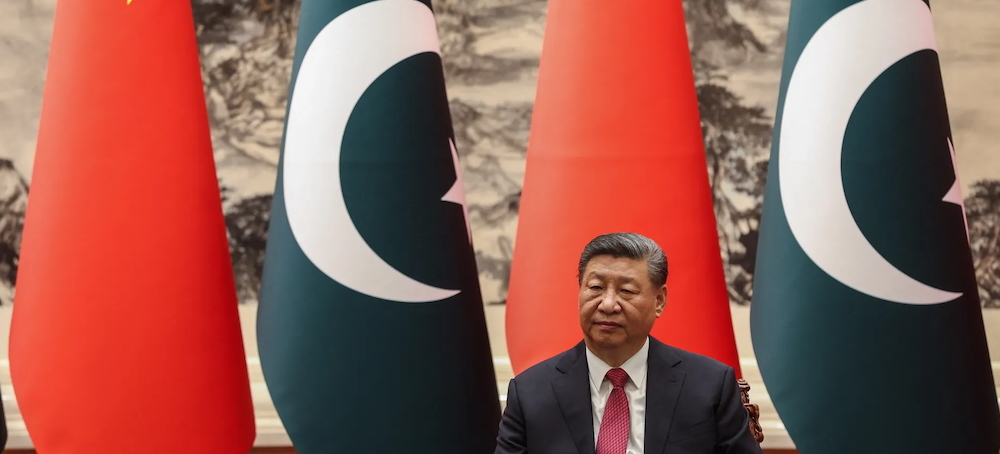 Xi Jinping during a visit to Beijing by Pakistan's president last year. (photo: Wu Hao/Pool/AFP/Getty Images)
 How the Iran War Is Shifting Power Toward China
Ishaan Tharoor The New Yorker
As the U.S.’s credibility and military capacity are tested abroad, China has gained leverage by staying out of the fight and learning from it.
This is all welcome news in Beijing. For years, the Chinese Communist Party has tried, with middling success, to cast itself as a responsible world power in the face of what it has labelled imperialist America. It has issued one jargon-filled statement after another warning against American “hegemony,” condemning Washington’s “Cold War mentality,” and framing China as the true custodian of a rules-based international order—the same order that the U.S. helped build but now undermines. In 2023, the Chinese President, Xi Jinping, unveiled a grandiose, if vague, project called the Global Civilization Initiative, which proposed an appeal to comity between civilizations and cultures—something of a Chinese counterpoint to the Western status quo. For China’s neighbors, such airy visions are unlikely to assuage fears over China’s own perceived hegemonic designs; meanwhile, smaller countries in the so-called Global South are already seeing their societies and politics bend to Chinese influence. But the war in Iran—and Trump’s disruptive behavior on the world stage, including his chaotic social-media presence—is helping China reframe its geopolitical role, according to Yuen Yuen Ang, a professor of political economy at Johns Hopkins University. “The war in Ukraine left China in an awkward position: narrowly aligned with Russia and viewed with suspicion by Western powers,” she told me. “For China, the Iran conflict brings no economic upside, but it creates diplomatic space. It allows China to step out of a previously isolating alignment and reposition itself more broadly, not just in the Middle East but globally.”
Since the start of Trump’s second term, a parade of Western leaders has filed through Beijing, often in barely disguised signals to Trump that they won’t put up with his bullying. The visits amount to what the Canadian writer and former diplomat Michael Kovrig described as a “political and propaganda bonanza” for China. In mid-April, Xi, sitting across from Spain’s Prime Minister, Pedro Sánchez, said that China and Spain, which have condemned the U.S.’s war against Iran, were both “on the right side of history” and that the two countries should “oppose the world’s retrogression to the law of the jungle.”
For China, this rhetoric isn’t just posturing. The country is at the heart of twenty-first-century trade networks, so Beijing’s strategists prioritize geopolitical calm and market predictability. The tumult of Trump’s tenure provides a foil for Xi’s greater ambitions. “For decades we thought of Chinese foreign policy as mainly seeking stability to facilitate economic development, but Xi is projecting confidence in the face of the more volatile, violent world of the second Trump term,” Julian Gewirtz, a senior researcher on China at Columbia University and a former official in the Biden Administration, told me. China, despite its immense strategic oil reserve, isn’t immune to the economic disruptions created by the ongoing impasse over the Strait of Hormuz. Still, Gewirtz argued, Xi “believes that China is better able than the United States to ‘eat bitterness’—that is, to endure hardship and emerge stronger from periods of struggle.”
China’s economy was already sluggish before the war, and new bottlenecks in global logistics are raising costs for the country’s vast manufacturing and export sectors. But the war has offered an upside: Asian countries, which are far more dependent than the U.S. on the fossil fuels coming across the Strait of Hormuz, now have fresh urgency to insulate themselves from future oil shocks and expand their renewable-energy capacity. China already dominates green-energy supply chains, and its exporters of solar systems, batteries, and electric vehicles all posted record sales in March, Ember, a global-energy think tank, reported. There is evidence of a wider reckoning in motion, too: “As we face the second fossil-fuel shock in less than five years, the lesson for our country is clear. The era of fossil-fuel security is over, and the era of clean-energy security must come of age,” the British secretary of state for energy, Ed Miliband, said, calling on the U.K. to wean itself off gas-generated electricity. The Trump Administration, sitting atop its fossil-fuel bounty and contemptuous of investment in renewable energy, seems content to let China steer this global transition.
China has also benefitted from the Iran war simply by sitting on the sidelines. It has watched the Trump Administration relocate major military assets from Asia to the Middle East—redeploying air-defense systems over the objection of South Korea’s President. In just weeks, the United States burned through an arsenal of critical munitions, including stockpiles of Patriot, Tomahawk, and stealth cruise missiles, and of THAAD interceptors. For U.S. partners in the Pacific, these moves deepen the sense of a waning Pax Americana and could reshape their long-term calculations on how to hedge against China.
The war has exposed other vulnerabilities, too. U.S. struggles against Iran, a weaker opponent—and its inability to neutralize Iran’s cheap drone campaign in the Gulf—have cast doubt on any prospect of sustained U.S. military dominance in Asia. Beijing has also gained a front-row seat to new U.S. methods of warfighting, specifically its widespread use of unmanned and autonomous weapon systems. Chen Yixin, China’s Minister of State Security and a prominent adviser to Xi, recently published an article mentioning the deep applications of A.I. in intelligence fusion, decision-making, target recognition, combat support, and cognitive shaping on display in the conflict. As it did when the U.S. rallied to Ukraine’s defense after the 2022 Russian invasion, China is watching and taking notes.
The war with Iran—or its uneasy aftermath, should there somehow be a diplomatic breakthrough in the coming days—will loom over Trump’s upcoming summit with Xi, in Beijing. The meeting, initially planned for March, was delayed by the war. The situation has only intensified since: in a bid to put more pressure on both Tehran and Beijing, the Trump Administration placed sanctions on several Chinese oil refineries and forty Chinese-linked shipping firms and vessels involved in trade with Iran. China, meanwhile, laid out new rules that could penalize foreign companies trying to shift from China-based supply chains. The project of “de-risking” from China—encouraged by both President Joe Biden and Trump—had been embraced by various countries in the West, but seems more complicated in Trump’s second term, as those same countries now feel the need to hedge against the U.S., too. It’s another tacit victory for Beijing, whose own soft power is growing just by existing in contrast to Trump’s wrecking-ball politics. “The more that U.S. allies and partners undertake to de-risk from Washington, the less diplomatic capital Beijing has to expend on assuaging their misgivings about its own conduct,” Ali Wyne, a researcher on U.S.-China relations at the International Crisis Group, told me.
Prior to Trump’s most recent meeting with Xi, last October, the White House made a string of threats, including an additional hundred-per-cent tariff on top of existing levies and sweeping export controls. Ahead of this meeting, it has been much more restrained. The difference could reflect Xi’s stronger hand in the wake of the Iran war, Wyne told me. “The United States will be unlikely to bring Iran back to the negotiating table without China’s support,” he said. “Nor will it be able to replenish its stockpile of missile interceptors in the Middle East without gallium, a critical material whose production China dominates.” Xi wants to use this period of stalemate to boost China’s strength and extract further concessions on trade and tech, Gewirtz told me. “Chinese leaders are hoping that a delayed trip and a distracted, beleaguered President make buying time and extracting concessions even easier,” he said. “They know Trump is hoping to spin the trip as a win, and that gives them leverage.”
China, too, may be in a more conciliatory mood. Its leadership wants to see de-escalation in the Gulf and an end to the blockade that is inflicting real damage on Asian economies, including its own—and the country isn’t aggressively propping up Iran’s war effort or trying to supplant the U.S. in the Middle East. Instead, China has helped nudge Iran toward negotiations with the U.S. and encouraged Pakistan, a neighbor and close partner, to play the role of intermediary.
The war also illustrates the limits of Chinese power. For decades, Beijing relied on U.S.-provided security architecture in the Middle East as it powered its economy on Gulf energy imports. Now it can do little to check U.S. military action in the region, and Xi’s call to open the Strait of Hormuz went unheeded. His stoic image may get a boost every time Trump posts a new absurdity on social media, but China remains in America’s geopolitical shadow. “Maybe we won’t come away from this conflict with any new appreciation for Chinese global leadership,” Esfandyar Batmanghelidj, the head of the Bourse … Bazaar Foundation, a London-based think tank on the economies of Middle East and Central Asia, told me. “What at least we will come away with is a real, even more diminished view of American leadership.”