
How Prepared Are We for a Public-Health Emergency?
Dhruv Khullar The New Yorker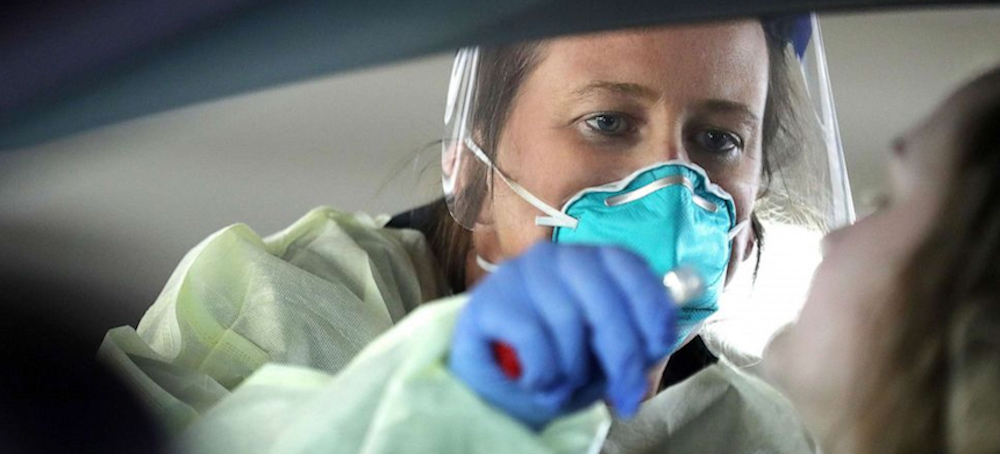 A healthcare worker and a patient. (photo: ABC News)
 How Prepared Are We for a Public-Health Emergency?
Dhruv Khullar The New Yorker
The outbreaks of hantavirus and Ebola expose the shortsightedness of America’s retreat, under the Trump Administration, from its role as a global-health leader.
At a time of escalating viral threats, this is a take better suited to online feuds than to biosecurity strategy from the apex of American public health. Last month, the ill-fated Dutch cruise ship M.V. Hondius left Argentina carrying around a hundred and seventy-five people from some two dozen countries. What followed is well documented: a seventy-year-old man developed fever, diarrhea, and severe respiratory distress; he died of what turned out to be a hantavirus infection. Soon afterward, two more passengers sickened and died, and at least eight others were infected. Dozens of people have since returned to their home countries to quarantine, but the process has been less than airtight. After disembarking, a Turkish travel influencer attended a wedding in Istanbul; a British man exposed to the virus was tracked down in a bar in Milan.
Hantaviruses are usually found in rodent droppings, and they spread when someone inhales aerosolized particles or eats foods contaminated by them. But the version of the virus on the ship, known as the Andes strain, can transmit directly from person to person through bodily fluids or the air. There are no specific vaccines or treatments for the virus, which can cause a life-threatening condition known as hantavirus cardiopulmonary syndrome, whereby fluid pours out of the capillaries and into the lungs. The death rate is as high as fifty per cent. Notably, the first known hantavirus death in the U.S., in 1993, was of a nineteen-year-old marathon runner. Metabolic health only gets you so far.
Health authorities have sought to ease concerns about the outbreak. Federal officials have avoided using the word “quarantine,” and the C.D.C. didn’t activate its Emergency Operations Center or issue an advisory to health departments until some American passengers of the ship had already returned to the U.S. The agency has indicated that the risk to the public remains low, because transmission requires “prolonged close contact,” but what, exactly, constitutes “prolonged” and “close” is a matter of some dispute.
According to a report in The New England Journal of Medicine, hantavirus has previously been implicated in superspreader events. In 2018, a person infected with the virus attended a birthday party in Epuyén, Argentina. At least five people sitting nearby developed symptoms, including a man with an “active social life,” who went on to infect half a dozen other people before dying, a few weeks later. The man’s wife is thought to have infected ten more people at his wake. All told, nearly three dozen people contracted the virus, and eleven died. The report’s authors estimated that, before mitigation measures such as patient isolation were initiated, the virus’s reproduction number was above two, meaning that each infected person spread the virus to more than two others. (The initial COVID strain had a reproduction number of around three.) Hantavirus can incubate for nearly two months before a person shows symptoms, and several dozen Americans are now being monitored at U.S. quarantine facilities or in their homes. The full extent of the outbreak may not become clear for weeks.
Then, last week, as the M.V. Hondius prepared to dock in Rotterdam, unloading the last of its crew, the World Health Organization declared an Ebola public-health emergency. At least seven hundred people have been infected and more than a hundred and seventy have died, mostly in a conflict-ridden region of the Democratic Republic of the Congo. On Tuesday, the W.H.O.’s director general said that he was “deeply concerned about the scale and speed” of the spread: by the time authorities learned of the outbreak, it was already unusually large, suggesting that many more people are probably infected or at risk. The Ebola strain currently circulating doesn’t respond to the vaccine or the antibody treatment that were developed for a different version of the virus, which caused a years-long outbreak a decade ago, killing more than eleven thousand people.
Neither Ebola nor hantavirus is likely to unleash a pandemic: Ebola usually spreads through direct contact with the bodily fluids of a person showing symptoms, and hantavirus hasn’t proved itself capable of sustained community transmission. Still, these outbreaks expose the shortsightedness of America’s retreat from its role as a global-health leader. This year, the U.S. formally withdrew from the W.H.O., which has since struggled to obtain sufficient funds to monitor and address infectious threats. The C.D.C. largely received information about the hantavirus outbreak secondhand—forced, as one expert put it, “to rely on the good will of international partners for data that it once would have helped generate.” (Even this is an improvement over last year, when the Trump Administration banned C.D.C. officials from communicating with their counterparts at the W.H.O.) Since Trump returned to office, the C.D.C. has lost roughly a third of its staff, and cuts to foreign aid have hampered on-the-ground programs intended to respond to Ebola and other diseases. According to a study in The Lancet, the shuttering of the U.S. Agency for International Development could result in millions of deaths around the world by the end of the decade. Bhattacharya and other officials have said that they are simply “restoring trust” in science, but polling suggests that faith in federal health agencies has plummeted.
All this is properly understood as a grave and avoidable loss—for the country’s standing and for the health and security of Americans. But, in the fog of the post-COVID culture wars, it’s easy to lose sight of the power we still possess. America’s public-health institutions helped subdue polio, eradicate smallpox, slash smoking rates, transform H.I.V. from a death sentence to a chronic condition—and save millions of lives during the coronavirus pandemic. This has been a story of great ambition and repeated success. It can be again. ♦