
How One Billionaire’s Crusade Against Homelessness Became Trump’s Playbook
Elizabeth Dwoskin Washington Post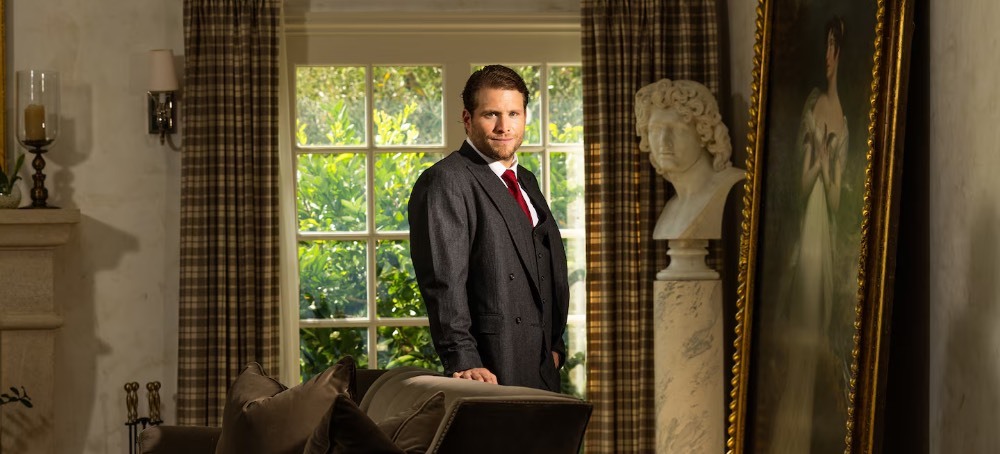 Joe Lonsdale at his home in Woodside, California. Though he relocated to Austin in 2020, he keeps a residence in the Silicon Valley. (photo: Christie Hemm Klok/The Washington Post)
 How One Billionaire’s Crusade Against Homelessness Became Trump’s Playbook
Elizabeth Dwoskin Washington Post
Long before Silicon Valley embraced Trump, Joe Lonsdale wanted to remake government and shift the nation’s approach to homelessness. Now, his friends in the White House are listening.
At the time, Lonsdale, who had long seen himself as a moderate conservative, was already growing discontented with the liberal Bay Area. Everywhere he looked, he found reasons to be enraged. Environmental zoning codes prevented development, raising housing costs, which meant his household staff had to travel more than an hour to work at his estate in the wealthy Silicon Valley enclave of Woodside. The rise of “wokeism” and Black Lives Matter, with its oppressed-versus-oppressor framework, was pushing the culture away from the meritocratic values that he felt made America exceptional.
Even worse, the pandemic was a match that lit San Francisco’s homelessness crisis on fire; tent encampments filled large stretches of sidewalk, making the city a frequent target of ridicule on Fox News. Lonsdale called it a “scary civilizational moment.”
He instructed his staff to fire off a round of friendly emails to the mayor’s office, members of the city’s board of supervisors and state legislators, and asked connected friends to get him meetings to help them fix these problems. Almost no one replied, he said, and those who did were curt and disdainful. He thought that officials had little interest in his views because he was wealthy and conservative.
“It’s like having a scarlet letter on you in SF and Sacramento if you’re on the right,” and rich, he said in an interview. “I would have no ability to be part of fixing things, which is what I like to do.”
So Lonsdale made a decision — for his family and for his worldview — that would help him propel a movement now reverberating in Washington and around the country. If California would not let him go after the state’s problems, Lonsdale would try to do so elsewhere. In 2020, he pulled his children out of school, moved his family to a sprawling compound outside Austin and launched what would become the nation’s most influential effort to change how America addresses a pressing social problem.
A year earlier, he had started the Cicero Institute, a think tank dedicated to bringing market-based solutions to social issues like criminal justice, health care and homelessness, but the group’s ideas got virtually no traction in solid-blue California. In Texas, Lonsdale urged the Cicero team to go bigger, to target the toughest societal problems with “bold” solutions that challenged the status quo.
Over the next year, the group developed a controversial policy proposal: Cities should make it a crime to sleep outside, forcing people off the street, placing them in temporary shelters or treatment facilities, and sending them to jail if they refused.
No one paid much attention to Cicero at the time. The proposal ran counter to more than 15 years of federal and state policy, which held that forced treatment rarely works and that getting society’s most vulnerable into long-term housing should come before any intervention.
But five years later, Cicero’s vision has spread across the country. It is now the official policy of the Trump administration, and versions of Cicero’s proposal are law in 15 states, with 11 making it a crime to sleep outside.
Scott Centorino, who coordinated the White House’s homeless policy, told The Washington Post that Cicero was a critical partner in driving the administration’s position. “They are the best group out there with a lot of knowledge at the state level,” said Centorino, who left government a few months ago and is now a senior fellow at Cicero.
The extent of Lonsdale’s and Cicero’s influence on the Trump administration’s homelessness policy has not previously been reported, and the effort is just one piece of a broader project that has made him a singular force in the Trump era. Interviews with a dozen advisers, administration officials, friends and business associates — many of whom spoke on the condition of anonymity to describe private deliberations — show how Lonsdale spent years cultivating the relationships and networks needed to push society and government in the direction he believes they should go.
A Silicon Valley investor, Lonsdale has a political reach that now extends well beyond homelessness, into housing, public safety, education and health care — issues far removed from the technology businesses that made his name.
In hours of interviews, Lonsdale said his relentless efforts to advance a wide array of issues are built on countering the ways the state is captured by powerful companies and nonprofits. He says that he is animated by a deep belief in classical Western values and in what he calls the human capacity for “excellence” — and that a capitalist system coupled with the right incentives is the best way to achieve it.
“Our society has all of these cartels and special interests that are very powerful, and people are very afraid of pissing them off,” he said. “I’m so frustrated at the lack of people on all sides with the courage to confront the broken things.”
Before a cohort of tech titans rallied behind Trump in 2024, many of Silicon Valley’s most prominent figures — from Mark Zuckerberg to Elon Musk — preferred to steer clear of Washington, viewing the government as a staid institution that stifles growth.
But Lonsdale has long been invested in reforming government, believing it is a critical lever for making business — and by extension society — prosper. Rather than leaving policy solely to career officials, Lonsdale argues that entrepreneurs are natural problem solvers who understand the pain points in social systems and can help policymakers make decisions — a conviction he has put into practice to great effect in the Trump era.
Across the country, Cicero has worked behind the scenes to shepherd 214 pieces of legislation into law in 29 states since 2021, on issues related to public safety, education, artificial intelligence and health care, according to the think tank. States passed 85 Cicero-backed bills in 2025, double the previous year’s tally.
In Texas, a Cicero-backed bill prohibits colleges and universities from maintaining diversity, equity and inclusion offices or conducting DEI trainings. Idaho adopted a Cicero-backed bill requiring that all regulations undergo a sunset review, making it the least-regulated state in the country. And Utah, which has changed its entire approach to homelessness under Cicero’s guidance, is planning to have facilities with hundreds of beds scattered throughout Salt Lake County to house homeless people — sometimes forcibly, which activists have likened to Nazi-like efforts to remove unsightly beggars from the streets.
Now Cicero has taken its playbook inside the Trump administration, with its experts holding weekly calls with White House officials and sharing lessons from their victories in the states, said three people familiar with the dialogues, who spoke on the condition of anonymity to describe private meetings. Cicero helped shape an executive order and policy directing federal agencies to treat homelessness as a public safety crisis, pushing states to ban camping and enact involuntary-treatment rules, while dramatically curtailing funds for permanent housing.
Lonsdale’s involvement in the homelessness issue has made him an adversary of housing activists, who argue that the billionaire venture capitalist is pushing punitive and cruel policies — what one publication called a “grim march toward death” for the unhoused — that are well outside his domain of expertise.
“I just can’t imagine having that much wealth and power and using it to kick people when they are down instead of lifting them up,” said Jesse Rabinowitz, campaign and communications director at the National Homelessness Law Center, which has sued the Trump administration over its approach.
The National Homelessness Law Center, the Democratic Socialists of Austin and other groups have picketed Cicero’s offices and events, and activists have likened forced commitment to Nazi work camps and the detention of Japanese Americans during World War II.
Cicero has “been really effective at dismantling and undermining through misinformation campaigns what has been really well-accepted evidence,” said Margot Kushel, an addiction medicine physician and director of the Benioff Homeless and Housing Initiative at the University of California at San Francisco.
“What has been so effective is how they have done it so quietly,” she added.
Though Lonsdale says he spends 90 percent of his time on his companies, his closest associates say he is drawn to policy because he believes that prosperous people have a responsibility for the well-being of the nation.
“In some ways he is like a 16th-century knight who was dropped into present day,” said Zac Bookman, who co-founded the government database company OpenGov with Lonsdale. “There’s this code of honor and duty that he is trying to advance.”
A longtime political fundraiser who has worked with Lonsdale said he is different from other wealthy donors. “In his spare time, he is not buying yachts on the Mediterranean. He is thinking about these issues,” said the fundraiser, speaking on the condition of anonymity to describe private interactions.
For decades, Lonsdale has cultivated a personal network of investors, entrepreneurs and policy-minded conservatives; under Trump, many people in that Rolodex are now running the federal government.
On any given day, he might be meeting at home with a senator, lunching in D.C. with the head of a federal agency or consulting over text with Vice President JD Vance, a friend since Vance worked for billionaire investor and Palantir co-founder Peter Thiel, said three people familiar with his dealings, who spoke on the condition of anonymity to describe a personal relationship.
A Trump spokesman declined to comment on private meetings. “President Trump has taken historic action to clean up America’s cities,” said White House spokesman Davis Ingle. “The Trump Administration is encouraged by state and local leaders who follow suit.”
For years, Lonsdale discussed his ideas on meritocracy, efficiency, and fighting fraud and corrupt nongovernmental organizations with billionaire Elon Musk, a fellow adopted Texan, according to three people familiar with the conversations, who spoke on the condition of anonymity to describe private talks. These ideas were a core premise of the billionaire’s controversial Department of Government Efficiency.
Guests on “American Optimist,” the podcast Lonsdale hosts from his Austin home, are a who’s who of the administration: Michael Kratsios, Trump’s top science adviser and a former chief of staff to Thiel; Ben Black, who runs the U.S. International Development Finance Corporation, a financing agency; Scott Kupor, director of the Office of Personnel Management; the Defense Department’s chief technology officer, Emil Michael; and NASA chief Jared Isaacman have all come on to talk shop.
The officials oversee portfolios that Lonsdale has long opined on — and, in some cases, that touch his business interests. Michael’s office is reshaping the Pentagon’s use of emerging Silicon Valley technology, including from companies Lonsdale is invested in. The Office of Personnel Management recently revived the Civil Service exam, which Lonsdale has championed as a way to restore meritocracy in hiring. And with the U.S. Agency for International Development shuttered, the administration effectively adopted a vision that Lonsdale and Black laid out last year in a white paper: shifting foreign aid spending to the private sector.
To Lonsdale, who communicates with rapid-fire energy, leaving virtually no pauses between sentences, anything that thwarts “merit” is an evil that must be forcefully attacked. He co-founded Palantir because he was upset that institutions couldn’t make efficient use of their data. He started the University of Austin, a college dedicated to “free speech principles,” because he believed that mainstream universities were stifling the open debates that lead to the best ideas.
Lonsdale says online rabble-rousing is a form of courage: When advocates picket Cicero, he posts photos of the protests on X, calling the groups crony nonprofits that live on government largesse. He has maintained this digital presence, he says, in spite of a rash of threats. He has been targeted by the far-right influencer Nick Fuentes, who has called Hitler “awesome” and devoted a segment of his show to Lonsdale and other prominent Jewish leaders.
His Austin home is decorated with busts of historical figures, including the Roman emperor Caesar Augustus, and two busts each of George Washington and Winston Churchill, as well as original letters from Abraham Lincoln and first lady Abigail Adams. (Lonsdale says she was a “strong woman and confidante” like his mother and his wife.) He uses the term “boldness” so frequently that it might come off as a joke — or to critics, as a caricature of a tech billionaire drunk on his own Kool-Aid.
But in Lonsdale’s growing influence, detractors see something more insidious: a powerful person interfering far beyond his purview.
“These guys don’t have interesting ideas; they have little-boy fantasies,” said Paul Barrett, a New York University professor and a former deputy director of the Center for Business and Human Rights at NYU Stern School of Business. “These tech guys are part of an illiberal tradition that is truly corrosive. … [Lonsdale] wants to create an environment where his mythological meritocratic heroes can thrive and everyone else can go f--- themselves.”
For as long as Lonsdale, who is 43, can remember, he has felt compelled to fix things, a quality he admits could come across as “obnoxious” to family and friends.
In the early 1990s in Fremont, California, his father, a Ronald Reagan supporter and tech worker, would yell at the television in frustration. As a child, Lonsdale wondered why his dad seemed content to spend his time playing sports and socializing rather than solving the problems that so upset him.
“I always had a lot of opinions about what was broken and what wasn’t,” he added, noting that as the eldest of 19 cousins and three brothers whose mother passed away when Lonsdale was 20, he always felt a responsibility to lead.
His father also wasn’t concerned about earning a lot of money. “Obviously, I’m different,” Lonsdale said.
Today, the list of things Lonsdale sees as broken or incompetent — what he calls “civilizational threats” — is very long: Diseases aren’t being cured because the Food and Drug Administration bogs down the drug patents process while China races ahead; “radical left” politicians like Zohran Mamdani and Alexandria Ocasio-Cortez are turning a generation against capitalism and Western values; health care and defense “cartels” are stifling excellence and competition.
He finds it ironic that his critics peg him as a billionaire pulling the strings of political influence because, in his eyes, he has long been an outsider tackling entrenched power — the “crony capitalists” he believes use their influence to capture an outsize share of the government’s resources and rewards.
This perspective stems directly from his experience at Palantir.
In 2004, Lonsdale was less than a year out of college when he and his fellow co-founders started the software company, through a web of connections stemming from Thiel. He’d arrived at Stanford an overachieving computer nerd steeped in Austrian economics — the classic libertarian school of thought that emphasizes individual agency. He studied under the prominent conservative economist Milton Friedman and became editor of the Stanford Review, a libertarian student-run publication founded by Thiel.
Lonsdale went on to a summer internship at PayPal, the payments company that incubated a generation of Silicon Valley leaders, including Trump’s former AI czar David Sacks, Musk and Thiel himself, who served as the company’s president.
Thiel, 15 years his senior, was less a mentor than an intellectual sparring partner, Lonsdale says. Lonsdale went to work for Thiel’s hedge fund, Clarium Capital, after graduation, and quickly rose through the ranks. The men would spend hours debating philosophy, politics and economics, but Lonsdale was particularly drawn to Thiel’s conception of progress.
Thiel argued that the most important feature of human advancement is the effort to “grow the pie” — to expand the availability of technology, goods and services so that more people can experience prosperity. The political left, he said, is more concerned with breaking up and redistributing the pie, which leads to chaos.
“Peter kind of has this really strong intuition, which is clearly right to me, that the world ought to be positive sum, not zero sum,” Lonsdale said. “If you’re in a society where growth goes away, then everyone starts fighting over the pie.”
Thiel declined to comment.
Lonsdale’s college years also coincided with the 9/11 terrorist attacks, driving the Palantir co-founders to a then-unorthodox belief that technologists needed to play a role in protecting the country.
The early years of Palantir pitching its tools to government officials had a formative effect on Lonsdale, convincing him that the government was rigging the system for certain businesses. The fledgling start-up thought the Army’s procurement system explicitly favored the giants of the defense industry, nicknamed “primes,” even when they produced subpar tools. Palantir would successfully sue the Army in federal court over the issue in 2016.
“The whole ethos that came out of Palantir is to change government … so the best ideas win,” Lonsdale said. “Not so that the connected people win.”
As Palantir grew in the 2010s, Lonsdale became wealthy, and he branched into new pursuits. He founded a venture capital firm, then called Formation 8, and co-founded several companies.
Many associates describe knowing Lonsdale as a “six degrees of Kevin Bacon sort of experience,” because he is connected to a dizzying number of people in different domains.
During these years, a longtime friend and associate said, he showed up to Shabbat dinner at Lonsdale’s house in Woodside and found himself seated next to the Nobel Prize-winning biochemist who invented the CRISPR gene-editing technique. “I could rattle off 50 examples” like these, the person said, including interactions with A-list actors, European royalty and government leaders from different countries.
“He just becomes like this nexus for so many different reasons and for so many different people all around the world,” said Eric Poirier, CEO of Addepar, a data management platform for private wealth managers that Lonsdale co-founded, noting that this wasn’t “networking for networking’s sake.”
“If we’re actually trying to solve deep problems … then let’s find truly the world’s best experts.”
Lonsdale’s efforts to fix government started in 2011, when he helped a group of Stanford Review-affiliated students launch a sprawling data project to map, in detail, the spending of every department in California’s state government.
The transparency project highlighted inefficiencies and made him want to push for accountability in a bigger way, Lonsdale said. In 2019, he created Cicero to promote his brand of accountability-driven solutions to government administration, housing, health care and criminal justice issues.
Early on, the group proposed a “pay-for-performance measure” that would tie parole offices’ funding to reductions in recidivism and to work requirements, said Judge Glock, an academic researcher and one of Lonsdale’s first hires at Cicero. But corrections officers unions and lawmakers resisted the plan. Cicero also pressed, unsuccessfully, on homelessness — including with proposals tying nonprofits’ funding to reductions in the number of unhoused.
That effort also hit a wall. “We weren’t going to get many reforms in California,” Glock said.
Glock, now a policy director at the conservative Manhattan Institute think tank, said that the pandemic, which sent San Francisco’s already robust homeless population soaring, was a political awakening for what was then a small but growing group of right-wing figures in tech. “They saw the absolute chaos in the city and realized that pure libertarian ‘live and let live’ was not a solution to these problems,” he said.
Lonsdale was leading the charge. When he left California, in 2020, he resolved to be much more vocal about his beliefs. Times were dire, he thought, and while his fellow elites were content to grumble among themselves, few were willing to put themselves on the line to fix what was wrong.
***
Arriving in Austin in 2020, Lonsdale set about learning how power operates in Texas. He met Dick Weekley, a Houston billionaire GOP megadonor whose Texans for Lawsuit Reform had made it harder for residents to sue doctors and insurers in the 1990s. He became friendly with Gov. Greg Abbott (R) and his wife, and with tech magnate Michael Dell, CEO of Dell Technologies and a longtime Austin resident. He flew out to West Texas to get to know old-guard oil families.
Aside from a few cultural faux pas — he once wore “dancing boots” to a shooting range — Lonsdale said he found Texas culture to be welcoming and “much, much healthier” than California. People replied to his emails and invited him to the Capitol.
In early Cicero meetings in Austin, Lonsdale set much higher ambitions for the think tank, telling the group that “we needed to go after problems that other people were scared to touch,” Glock said.
Cicero’s initial campaign in Texas coincided with growing public frustration over homeless encampments. Austin had just passed a public proposition to enforce the city’s camping ban, which had been ignored for years. Cicero worked with the state legislature to mandate that all Texas cities enforce camping bans, essentially making Austin’s decision a statewide rule.
Glock spent the next few years traveling across the country, working to get similar laws passed in Missouri, Georgia, Utah and Arizona. In 2024, Cicero’s efforts got a huge boost when the Supreme Court, in a ruling known as Grant’s Pass, found that camping bans do not violate the Eighth Amendment’s prohibition of cruel and unusual punishment — even when there aren’t places to move people other than jail. Following the decision, at least four other states and dozens of municipalities passed camping bans and other regulations.
Some of Cicero’s solutions, as in its homelessness crusade, hark back to traditional conservative ideas that government services should have a solid return on investment. But Cicero has emphasized data-driven transparency, including in an Indiana bill it recently helped pass that allows consumers to be credited if they find lower-cost health care services out of network. And though the think tank’s experts cultivate close relationships with lawmakers, they are quieter about their wins than other groups are, making it hard to track Cicero’s actual impact.
In Utah, Cicero’s vision became a model. There, its entire slate of recommendations has been passed into law with some bipartisan support, including camping bans, ankle monitors for homeless sex offenders, requirements that government-funded housing be drug-free, and bans on the provision of needles and other harm-reduction services at encampments.
Though Cicero has been a singular force in helping to pass camping bans nationwide, Lonsdale says he is opposed to criminalizing homeless itself. He says jail should be a last resort for a homeless person who breaks a law. Rabinowitz, of the National Homeless Law Center, says this contention is absurd. If he didn’t want to criminalize homelessness, “then don’t pass laws that make it a crime to be homeless,” he said.
Though Cicero has worked extensively with moderate Democrats — and not all of Lonsdale’s business partners share his political views — Lonsdale has increasingly become a right-wing firebrand online. Before his Austin move, he largely tweeted about issues related to Silicon Valley. In Texas, his rhetoric has been more divisive.
In one since-deleted tweet, Lonsdale named “average Black culture,” including “out of wedlock births” and a devaluing of education, as the reason fewer Black people have succeeded in venture capital. Lonsdale, who has six children, called men with important jobs who take six months of paternity leave “losers.” He argued for restoring public executions for the most violent criminals, saying the United States needed to “bring back masculine leadership to protect our most vulnerable.”
His stances have troubled some friends and colleagues, and caused concern among employees at several companies. “Short-form Joe, I think, is easy to misinterpret,” said the longtime associate and friend. “If you actually have a full conversation with him, it’s very principles-based … not radical.”
Lonsdale’s rhetoric did catch the attention of one person who seemed to like it: Elon Musk.
The tech magnates had moved to Austin around the same time, and Musk was going through a political awakening of his own. He was moving to the right — enraged by covid-19 lockdowns, which ground his flagship Tesla factory in California to a halt, and furious over his daughter’s gender transition, which he blamed on a “woke” California school system, according to his public statements.
Musk and Lonsdale reconnected online and then in person. The tech culture of Austin also made for easier social relations. Lonsdale began hosting large monthly barbecues, and often Musk would show up with his partner Shivon Zilis and their kids, who were around the same age as some of Lonsdale’s children, said two people familiar with the gatherings, who spoke on the condition of anonymity to describe them. The kids would play together in Lonsdale’s gym and play area, an auditorium-size room off the main house’s pool that is larger than a full-size basketball court.
“Joe and Elon view the world similarly,” said a consultant who has advised both men politically, and who spoke on the condition of anonymity because of the sensitivity of the relationships. “Both are willing to put themselves out there and fight and let the chips fall where they may.”
In 2023, Musk came over to Lonsdale’s house for an introduction to a rising GOP star who was planning to make a presidential run: Florida Gov. Ron DeSantis. Musk ended up quietly supporting DeSantis through a secret PAC — the billionaire’s first major involvement in a political race and a preview of the 2024 election.
A year later, after DeSantis dropped out of the primary contest, Lonsdale was one of the first high-profile tech leaders to support Trump. Musk announced his support a month later, in July. He then quietly tapped Lonsdale to corral tech friends to be donors for his America PAC, according to two of the people. The group poured a record $275 million into the election, according to public filings. That summer, Trump made homelessness a campaign plank, vowing to ban urban camping and force the homeless into tent cities on inexpensive land.
When Trump announced the creation of the cost-cutting Department of Government Efficiency, headed by Musk, Lonsdale tapped into his far-flung network of Palantir alumni, which served as a major recruiting pipeline for DOGE — though he was not involved in the day-to-day work of the group, according to three of the people.
But for advocates who work on homelessness, Lonsdale’s influence is particularly hard to miss.
“I don’t actually think you can separate [Trump’s homelessness policy] from Cicero,” said Rabinowitz, of the National Homelessness Law Center. “I think they’re so embedded in this administration, when you look at Trump’s executive order or the HUD funding, it is not a coincidence that it is parroting Cicero.”
Research going back to the George W. Bush administration has shown that forcing people into treatment, jail or temporary shelter does not solve the core challenges underlying homelessness, said Kushel of the University of California at San Francisco.
Affordability of housing is the fundamental force driving homelessness, she said, and housing is the basis of security and safety that people need to potentially resolve other issues, such as substance abuse.
Cicero’s experts, Kushel said, have repeatedly promoted misinformation about the level of crime committed by people who are homeless to “demonize people who experience homelessness” for the sake of a “pro-criminalization narrative.”
Cicero points out that a significant number of homeless people die from overdoses in long-term, government-funded housing, which its experts say implies that such housing is not serving the homeless population, either. They contend that the policy of providing permanent housing, known as Housing First, has not actually lowered the overall rate of homelessness.
In interviews, advocates and Cicero supporters said the group’s solutions, which once seemed very controversial, have become more normalized — with even California’s Democratic governor, Gavin Newsom, talking about how cities should clear encampments and writing an amicus brief in the Grant’s Pass case.
Business elites like Lonsdale have become so politically influential in the current environment because of an opening created by Trump, said Barrett of NYU. “At the core of the Trump administration is an absence of substantive policies. So there’s an opportunity for people to impose ideas that have an authoritarian flavor.”
Lonsdale, however, still sees himself as something of an outsider — fighting against forces that prevent progress. He has stayed close to the Trump administration through friends in senior positions and, aside from a few pointed public fissures, is largely pleased with the administration’s direction.
Still, this outspokenness has come at a personal cost. A rash of death threats mean that he no longer goes out with his children in public. Accessing his home office, which he uses frequently to be near his kids, requires passing through multiple layers of security.
But he sees this as his opportunity to help steer a broken government back on course — and reshape the nation in the process.
“The rebel alliance is still much smaller than the empire,” he said. Yet, he’s optimistic. “We’re going to win,” he said. “The ideas behind Western civilization are not going to be defeated.”