
Growing Up in the Weather Underground
Zayd Ayers Dohrn The New Yorker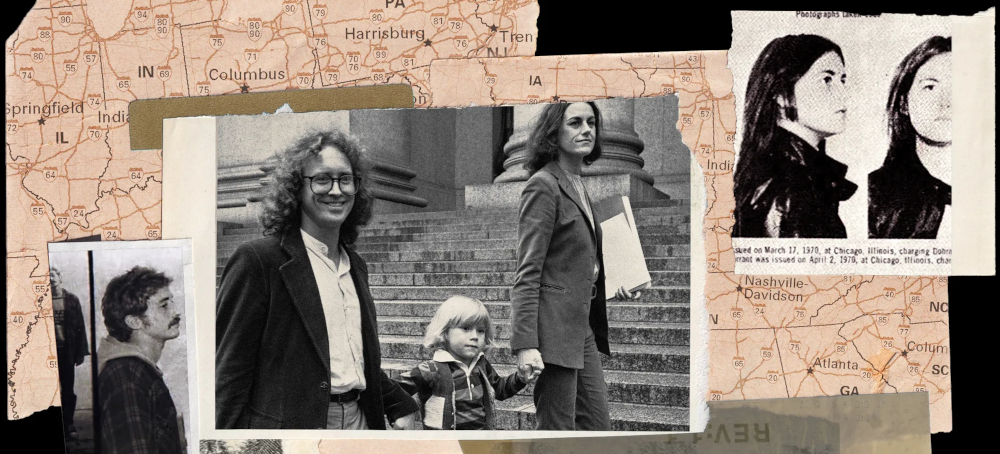 My parents founded the radical revolutionary group, then became fugitives. I was born in hiding, and spent my early years on the run. (photo: AP)
 Growing Up in the Weather Underground
Zayd Ayers Dohrn The New Yorker
My parents founded the radical revolutionary group, then became fugitives. I was born in hiding, and spent my early years on the run.
My mom stood in the doorway. Her hair, which she had kept short and dyed red, as part of a disguise, was starting to grow out, straight and dark down to her shoulders. She stood still, cradling my baby brother, but her eyes kept flickering to the Harlem intersection, following each car that passed. Finally, my dad whistled twice, our usual signal—one short, one long—and she led me into the back seat. My dad glanced behind us once to see if we were being followed, winked at me in the rearview mirror, and then swung our car toward Interstate 80, headed west.
My memories of this time are hazy, of course. I remember them the way anyone “remembers” the important moments of their childhood—overlaid with family lore, stories my parents told, and details I’ve reconstructed from recent conversations. But underneath it all there are real sense memories. Among my earliest, maybe imprinted by the fear of that night: the cold smell of the city, and the fuzzy disorientation of waking up while it was still dark out. I remember wondering why we were leaving, and what was going to happen to us next.
A decade earlier, my mother, Bernardine Dohrn, had declared war on the United States government. She and my father, Bill Ayers, helped found the militant revolutionary group the Weather Underground, and committed themselves to opposing the Vietnam War and fighting back violently against what they saw as a fascist police state here at home. They and their friends set off bombs at the N.Y.P.D. headquarters, the Capitol, the State Department, and the Pentagon. They wore disguises, lived under fake names, built a network of safe houses, and became the focus of an international manhunt. In 1970, the F.B.I. director J. Edgar Hoover called my mom “the most dangerous woman in America.” That October, she became only the fourth woman in history on the F.B.I.’s “Ten Most Wanted” list.
I was born underground and spent my early years on the run. By 1980, though, my parents had finally decided to turn themselves in. A plea deal awaited us in Chicago, but, for the deal to work, we had to make it to the courthouse in person. If we were caught along the way, my mom would spend decades in prison. It was a tense drive that night; my dad says that he kept our station wagon well below the speed limit.
The next morning, we pulled into a rest-stop Burger King. While my mom stayed in the car to nurse the baby, my father and I went inside, and a nice elderly couple started talking to me in line, just making conversation. “Hey, sweetheart,” the man said, smiling down at me. I had shoulder-length blond hair at the time, and people always assumed I was a girl. “You all on vacation?”
I knew I wasn’t supposed to talk to strangers, but my dad was busy ordering our food, and I felt like I had to say something. My response has, in the years since, become a running joke in my family.
“We’re going to Chicago,” I told them, “so my mom can turn herself in to the F.B.I.”
My dad turned, surprised, trying to catch up. “Oh. Yeah, I don’t know,” he said, trying to force a laugh. “Maybe something he saw on TV? Hey, Z, you need to use the bathroom before we go? Say bye.”
I waved. And, before we got our food, he picked me up and ran for our car. As he peeled back out onto the highway, he told my mom that he thought somebody had recognized him. He was trying to protect me, I think. My dad knew that I was desperate not to disappoint my mother—that I wouldn’t want to admit I had broken the underground’s strict codes of secrecy. I looked up to her. I admired her. I wanted to be like her.
Of course, as I got older, that got more complicated. My parents’ brand of violent resistance, I now know, had tragic consequences for our family, and deadly costs for the people around us. Three of my parents’ closest friends were killed in an accidental dynamite explosion as they planned an attack on a U.S. Army base. Others spent decades behind bars, leaving their children without mothers or fathers. And years later, when the group splintered into increasingly militant factions, some took part in a disastrous bank robbery that killed an innocent guard and two police officers—three men who were just doing their jobs that day, and who left behind their own kids, their own families.
Of course, I didn’t know any of this at the time. I just remember watching my mom’s face in the rearview mirror, wondering what she was thinking—whether she was also scared—as she scanned the maps in our faded Rand McNally road atlas. In our family, my father was usually the one driving, but there was never any doubt who was setting our direction.
“Get off at the next exit,” she ordered him. “We’ll switch to local roads.”
My mother wasn’t always a revolutionary. She grew up a middle-class white girl in Whitefish Bay, Wisconsin. Her dad was the credit manager for a local chain of appliance stores, a second-generation Jewish immigrant, and a lifelong Republican. My mom seemed, at first, eager to please; she was a straight-A student, and, at seventeen, became the first person in the family to go to college, at the University of Chicago, where she soon went on to law school as one of only a handful of coeds in her first-year class.
But letting your daughter see more of the world than you did means that she might come to see that world quite differently. In 1966, Martin Luther King, Jr., came to Chicago to lead a series of protests against racism and housing discrimination. “Seeing King, night after night, speaking in churches,” my mom told me recently, “it changed my life.” The civil-rights movement needed lawyers—ideally people willing to work for free—and she soon signed up to volunteer. “I knew nothing,” she said, laughing. “Second-year law student. I had an armband that said ’Legal.’ It was ridiculous!”
In 1968, my mother was in New York when she heard screams coming from the street outside. Dr. King had just been killed in Memphis, Tennessee. My mom grabbed her purse and got on a subway to Forty-second Street. “I don’t know why I did,” she told me. “But, by the time I got there, there were thousands and thousands of people in Times Square. I wanted to be in a crowd of people who were mourning. And angry. Both.”
That rage drove her away from King’s politics of nonviolence and toward a more militant ideology. She was soon elected to the national leadership of Students for a Democratic Society, the largest student protest group in the country at that time. It was through S.D.S. that she met my dad, the son of a prominent utilities C.E.O. He had grown up in a wealthy suburb of Chicago, burned his draft card at the University of Michigan, and then dropped out of school to protest full time.
Then, in 1969, my mother split S.D.S. in half, forming a more radical faction of the group called Weatherman. (The name was taken from the lyrics of Bob Dylan’s “Subterranean Homesick Blues”: “You don’t need a weatherman / To know which way the wind blows.”) That October, Weathermen rampaged through Chicago’s upscale shopping district—the Magnificent Mile—with bricks, chains, and baseball bats, breaking windows, smashing cars, and brawling with armed police officers: the so-called Days of Rage riots. Their statement following the protest gave the title to Paul Thomas Anderson’s recent film about modern American revolutionaries:
FROM HERE ON IT’S ONE BATTLE AFTER ANOTHER—WITH WHITE YOUTH JOINING IN THE FIGHT AND TAKING THE NECESSARY RISKS. PIG AMERIKA BEWARE. THERE’S AN ARMY GROWING IN YOUR GUTS AND IT’S GOING TO BRING YOU DOWN.
My mother had found a new, more revolutionary role model to follow—Fred Hampton, the charismatic twenty-one-year-old chairman of the Chicago Black Panthers. They became friends and comrades. The Weathermen and Panthers held meetings together and exchanged intel about government surveillance and police informants. It seemed for a moment that they might help realize Hampton’s dream of an interracial “rainbow coalition” of radical activist groups.
But, two months later, Hampton was also dead, executed by Chicago police while he slept in his bed with his pregnant girlfriend beside him. An F.B.I. informant had spiked Fred’s Kool-Aid with a sedative so he wouldn’t wake up during the deadly late-night raid. This new killing drove my mother and her friends over the edge. “I was in a rage,” she told me, still visibly furious decades later, “at the absolute stench of American life.”
The next night, Weathermen placed plastic coffee cups filled with black powder under the hoods of police squad cars across Chicago. The explosion wrecked the cruisers and blew out the windows of nearby buildings. A few months later, my mom and dad, along with roughly a hundred other members of the group, changed their names, cut ties with their families, and disappeared.
On May 21, 1970, an audiotape was delivered to newspapers across the country on behalf of their newly renamed group, the Weather Underground. “Hello, this is Bernardine Dohrn,” the recording begins. “I’m going to read a declaration of a state of war.” Two weeks later, a dynamite bomb exploded on the second floor of the N.Y.P.D. headquarters. President Richard Nixon immediately called an emergency Oval Office meeting. “Hundreds, perhaps thousands, of Americans—mostly under thirty—are determined to destroy our society,” he told his intelligence chiefs. “I do not intend to sit idly by while self-appointed revolutionaries commit acts of terrorism throughout the land.”
hen I was still a kid, driving with my parents across the country, I think I imagined that the underground was a physical place, as if it might have its own two-page spread in the road atlas mapping a hidden archipelago of safe houses, communes, and meetup spots—a whole secret subterranean geography. But it wasn’t a place, really; my father used to say that it was just a state of mind. “I went underground by changing my name,” he told me. “One day I was one thing, and the next day I was another.”
Finding a new name was surprisingly easy. A Weatherman would drive out to a rural graveyard and look around until he found the headstone of a person who would have been about his age but had died as an infant. Then he’d head over to the county courthouse and ask for a replacement birth certificate. Soon, he would have an official government license with his photo, but a new name and a whole new identity.
My dad grew his beard out. My mom cut her hair short, dyed it red, and started dressing like a California hippie—big glasses and flowing dresses—rather than in her signature black leather, miniskirts, and knee-high boots. They set up safe houses—cheap apartments in working-class neighborhoods. They took jobs as construction workers, longshoremen, and nannies—work that didn’t require a Social Security card and always paid at the end of the day, in cash.
Meanwhile, their bombing campaign intensified. In July, a bomb shook a U.S. Army base near the Golden Gate Bridge. The next day, an explosion shattered the glass-and-marble lobby of the Bank of America building in New York. The method they used was simple: a young white woman dressed up as a secretary would walk into a building, place a bag or a purse in an empty rest room or office, set a timer, and walk out. A few hours later, someone would call in a warning. Minutes after that, the bomb would explode.
The warning calls mostly prevented serious casualties. After an accidental explosion in a West Village bomb factory killed three Weathermen, those who survived, shaken by their friends’ deaths, swore off deadly violence. But the attacks, though meant to be symbolic, were still dangerous—and reckless. And, although Weathermen today still insist that they were not terrorists—that their bombs were intended not to maim or kill but to send a message—the fact is that setting off bombs carries an implicit threat of violence. It can terrorize people. And while there may be moments in history when some of us would concede the necessity of illegal, violent resistance—Nazi Germany, say, or the South under chattel slavery—dynamite is a self-defeating tool in a democracy, however imperfect. Blowing up buildings doesn’t help build a mass movement or create momentum for lasting change.
But, if the goal was to draw attention, the Weather Underground’s bombing campaign was a huge success. It turned my mother into a symbol—a heroic anti-government outlaw to some, a violent, un-American terrorist to many more. Actors and rock stars from the counterculture scene—including the band Jefferson Airplane—started donating money and cars to the cause. Alt-weeklies reprinted my mother’s mug shot with the message “Bernardine Dohrn welcome here!” Teen-agers hung the page in their windows or on their walls, like today’s dorm-room posters of Che Guevara or Malcolm X or Tupac—less a sign of a specific political ideology than an impressionistic display of youthful rebellion.
That September, my parents were contacted by a cult of weed and LSD dealers in California with the incredible name the Brotherhood of Eternal Love, who wanted help breaking their hero, Timothy Leary, out of prison. Leary, a Harvard psychologist turned acid guru, had become famous for urging young people to use LSD to “turn on, tune in, drop out.” He had been sentenced to twenty years behind bars for possession of two joints—an early test case in the government’s “war on drugs”—and the members of the Brotherhood were determined to free him. In exchange for a paper bag full of cash—twenty thousand dollars in unmarked bills—the Weather Underground agreed to do the job.
They came up with a plan. Using blueprints smuggled in by a radical lawyer representing both Leary and my mother, they gave Leary instructions on how to climb, hand over hand, along a telephone wire for more than two hundred feet across the prison campus, in the middle of the night. Once over the concrete wall, he dropped down to a patch of grass, where a group of Weathermen were waiting in a van, dressed to look like a family on a fishing trip. They quickly dyed Leary’s hair, gave him new clothes and a passport, and spirited him out of the country—but not before he and my parents celebrated together in a forest clearing, smoking a joint and listening to Jimi Hendrix. “It was fun,” my mom remembers. “I mean, we’re standing there in a redwood grove in California, and there’s all these headlines about him being gone.”
As the decade wore on, though, my parents grew up—as happens to young rebels—and my mother, unexpectedly, started thinking about having kids. “Maybe it was turning thirty,” she told me. “I was so adamant until that moment. I was really sure—that wasn’t going to be me. And suddenly it was me. I don’t know how to explain it.” She found out she was pregnant from a free clinic in the Haight-Ashbury neighborhood of San Francisco. Home pregnancy tests were not yet widely available, so she had to risk showing up at the clinic in person, then calling for the results a few days later. The nurse on the line sounded apologetic as she broke the news; most unmarried women were apparently eager for a negative result. “I’m really sorry to tell you this,” she said. “But you’re pregnant.” My mother, though, was ecstatic. “Ahhh!” she shouted into the phone. “That’s so wonderful!”
My parents rented a scruffy one-bedroom apartment overlooking a park in the Fillmore District. They bought bags of thrifted baby clothes and decorated the apartment with cheap wall hangings and stuffed toys. “We’d been safe for a long time,” she told me, when I asked whether she considered the dangers of having a child while she was a fugitive. “I felt that we knew how to be safe.” They found a midwife through trusted friends. And I was born at home, in the spring of 1977, in a safe house, underground.
y parents never lied to me about any of this—except maybe by omission. My mom says she tried to explain it to me so a four-year-old could understand. We were part of a rebel alliance, like Luke Skywalker or Princess Leia, fighting an evil empire. We were outlaws, like the animated fox from Disney’s “Robin Hood,” stealing from the rich to give to the poor. So I knew, from my earliest memories, that my parents had broken the law, and that the F.B.I. was chasing us. But I don’t think I ever understood exactly who—or what—“F.B.I.” was. Why did F.B.I. want to catch us? What would happen if it did? I had no way to imagine a federal agency. To me, it just felt like a scary presence pursuing our family all the time—a childhood bogeyman.
According to my parents, by the time I was three I had learned to recognize plainclothes cops and F.B.I. agents in a crowd. You had to look at their shoes (cheap leather loafers, well shined) and their cars (American-made, stripped-down, but with souped-up radio antennas and the telltale rumble of an upgraded V-8). They taught me never to use landlines that could be traced—we carried rolls of dimes in our pockets and made our calls from pay phones. I learned to speak in code. “Brown shoes” meant undercover agents. Living on the run was being “in on the joke.”
When I was four, I learned to walk a “trajectory,” the complicated mix of turns and switchbacks we used to lose a tail. Up the stairs onto the elevated tracks, wait two minutes, double back again, through the park, across the basketball courts, around the corner. It was a bit like playing a game—a grownup version of dress-up or hide-and-seek, but only my family knew all the rules. At every place we stopped for more than a week or two, my parents got new jobs, dyed their hair strange colors, spoke in new accents, and took on unfamiliar names. My mom went by Louise (Lou) Douglas, Rose Brown, Lorraine Anne Jellins, H. T. Smith, Sharon Louise Naylor, and Karen Lois DeBelius. My dad became Joe Brown, Tony Lee, Jules Michael Taylor, Hank Anderson, and Michael Joseph Rafferty, Jr. I wanted to be part of their grownup world. So, even though no one knew my real name anyway, and I wouldn’t have a birth certificate until I was five, around strangers they started calling me Z.
It all seemed strangely normal. Pretty much everyone I knew back then was a fugitive. And, over the years, I met other kids whose parents were also on the run—“Panther cubs” and “Weather kids” like me, with no school and no regular place to call home. Jad Joseph, whose father, Jamal, was an underground member of the New York Black Panthers, remembers his dad telling their family to get ready for a car trip, and snapping, “If you’re thirty seconds late, someone could die!” Jad told me, “I was just, like, ’Dad, no one’s gonna die because we’re late to Grandma’s.’ ”
Other friends remember being toted around as “beards” when their parents were out scouting bombing runs. The idea was that a couple with a kid in tow wouldn’t look too suspicious taking a walk near a police station or an Army base. My friend Thai, whose parents were part of the Weather Underground leadership, remembers his father, Jeff Jones, coming home one day to find their family’s Hoboken apartment surrounded by cops—a fire inspector had spotted his tiny crop of marijuana plants on the fire escape. Jeff picked Thai up at preschool that afternoon, and their family never went home. They abandoned everything they owned overnight—medical records, books, baby pictures, toys.
My family spent time at communes in Oregon, where I played with other kids in a waterfall we called “the washing machine” and learned to milk the cow (named, naturally, Emma Goldmilk). We stayed in trailer parks in Virginia and flophouses in the slums of Detroit. But I noticed, leafing through the road atlas, that we never visited the tourist sites the guide suggested: Disneyland, the Hoover Dam, the Alamo. On the rare occasions we took time to sightsee in my family, it was to visit monuments to injustice—the bloody sites of lynchings and massacres and violent uprisings—so I could internalize lessons in radical resistance. “These were freedom fighters,” my mom would whisper. “This is where they were murdered. Remember. You’re a freedom fighter, too.” I didn’t much feel like a freedom fighter, and, given the gruesome, tragic ends that seemed to meet most of my parents’ heroes, I wasn’t at all sure I wanted to become one.
Still, despite all the obvious danger, I knew that my parents would always protect me, no matter what. This was the foundation on which my shaky sense of security was built—that my birth had changed everything. My mother and father always told me that they had stopped taking part in violent “actions” after I was born, that they had committed themselves, for the sake of our family, to a different kind of future. But, like most origin stories, I now know that ours was mostly a myth.
By the late seventies, my family was back in Harlem. My father, as Tony Lee, had taken a job as a teacher at my preschool so he could keep an eye on me. My mother was pregnant again, working at an upscale kids’-clothing boutique on Eighty-first Street called Broadway Baby. As I learned only recently, the job offered an unexpected side benefit: whenever my mom met a customer of a certain type—a woman who was young, white, and pregnant, like her—she would ask for an I.D. to verify a check, and then quickly memorize her personal information. A few days later, a woman would walk into a D.M.V. office and tell the clerk she’d lost her I.D. She would verify her identity with the correct name, birth date, address, and license number, and be issued a replacement on the spot. These I.D.s were then used to rent vehicles that were used in a spree of bank robberies by former members of the Black Panthers and the Weather Underground, fugitive splinter cells determined to keep the revolution alive.
Sometime around 1978 or 1979, my parents took me on my first camping trip, to Alderson, West Virginia. My memories of the trip are vague and impressionistic, mostly based on stories I heard later. But I think of it as a fun few weeks: my first time pitching a tent, cooking on a portable gas-powered stove, lying on a blanket under the stars. Recently, though, as I reconstructed my family’s path through the underground, I noticed something strange about that particular dot in the road atlas: our campsite was right next door to a federal prison, F.P.C. Alderson, which, in 1979, was best known for holding a female inmate named Assata Shakur.
Shakur had been a leading member of the New York Black Panthers, a group that joined my parents underground in the early seventies, rechristened itself the Black Liberation Army, and launched an all-out war against the N.Y.P.D., sparking a series of bloody confrontations in which both police officers and members of the Black underground were killed. Shakur was, like my mom, young, militant, female, and photogenic, and she soon became a political symbol and the focus of a joint F.B.I./N.Y.P.D. manhunt. The N.Y.P.D.’s former deputy commissioner called Shakur “the soul” of the B.L.A., “the mother hen, who kept them together, kept them moving, kept them shooting.”
Shakur was finally arrested in 1973, after a traffic stop turned into a deadly firefight that killed two state troopers, wounded Shakur, and killed her best friend—the man I’m named after—Zayd Malik Shakur. By 1978, when we took our family camping trip to West Virginia, Assata had been locked up for four years, and her friends in the Black underground were desperate to free her.
When I pointed out to my father the “coincidence” of our camping location, he finally admitted—though their involvement isn’t publicly known—that they had been recruited to case the prison. “We took a lot of pictures,” he told me. “Drawing maps and trying to figure out if there was a way to get Assata out. There was a sense that a couple of young white people with a baby could do anything without attracting any attention.”
The maps were never used, because Shakur was transferred from West Virginia to a prison in New Jersey. That fall, an old friend reached out to my father through the underground communications network, dialling a number printed on a faded piece of plastic Dymo tape and speaking to him from a public phone booth. A few days later, my dad watched from a high rock outcropping as the man walked a trajectory through Central Park. Finally, they fell in step on the bridle path around the reservoir, and the man got down to business: the Black Liberation Army had a job for Bill to do—something illegal, and potentially dangerous. “I remember weighing it with Bernardine very heavily,” my dad told me, when I asked him about the choice he made that day. “I didn’t really want to do it on some level. But, on another level, I wanted nothing more than to do it.”
“You were a father,” I reminded him. “Didn’t you think about that? About the risks you were taking?”
“Well, it’s like everything else about being involved in the movement,” he said. “On the one hand, like every other human being, the speck of the universe you understand best is your life. So, you want to have that. On the other hand, if you’re a person who’s made a commitment to something larger, you want that larger thing to work also. And so it’s never quite left me—this contradiction. How do you take responsibility for yourself and your family, and at the same time take some responsibility for the larger world?”
A few weeks later, my dad called in sick to work at my preschool. He left me at home with my mom, who was now seven months pregnant with my brother, and caught the 1/9 train to a parking garage downtown. There, he found a van waiting for him. The key was under the mat. A garage ticket was tucked into the visor. An hour later, he parked the van outside a Laneco department store in a strip mall in New Jersey and settled down to wait.
A few miles away, the B.L.A. paramilitary leader Sekou Odinga arrived at the prison. He handed over an I.D., signed the visitors’ log with a fake name, and was taken in to see Shakur. They embraced, and, under cover of the hug, Odinga passed her a .357 Magnum revolver. The pair quickly took a prison matron hostage. Within minutes, two more armed B.L.A. soldiers arrived, handcuffed a guard at gunpoint, and, with Shakur, piled into a hijacked van, drove out through the gates of the prison without firing a shot, and scattered into waiting getaway cars driven by white friends from the underground.
A few miles away, my dad’s B.L.A. contact knocked on his window, loaded something or someone into the back of his van, and told him to drive. My father still isn’t sure what he was carrying; he doesn’t think it was Shakur herself, but the underground had to disperse a wide range of people and equipment that day—guns and fugitives and members of the support network. “One of the things about an action like that,” he told me, “is the elaborateness of it means that you can play a very small role in a small corner, not even fully understanding what the larger piece is.”
But as he pulled the van onto a road in New Jersey, heading toward Manhattan, he started to feel nervous. “I had my hands on the wheel at two and ten,” he remembered. “I was trying to look as normal as I could possibly look.” Then he saw a roadblock ahead, a state trooper waving half the cars over for a search. “They were onto it,” he told me. “It was really terrifying. But, of course, the whole point of me driving the van is I’m a young white guy driving a van, and they’re not looking for that.” He held his breath, hoping the white edge would hold. “He looked right at me. And I . . . just went by. I remember, very clearly, being absolutely giddy once I passed that cop. I made it! I got through! I had survived!” He parked the van, left the key and the parking ticket, called in its location, and came back home.
In 1984, Shakur surfaced in Havana, where she was granted political asylum by Fidel Castro’s leftist government. She lived in Cuba for decades, giving talks and writing her autobiography, and became a global symbol of Black liberation—what she called a “maroon,” or escaped slave. Shakur died last year, having inspired generations of Black writers and activists, hip-hop artists like Nas and Mos Def, and the character of the militant Perfidia Beverly Hills, played by Teyana Taylor, in the film “One Battle After Another.”
But for me the story of Shakur’s jailbreak was not just a piece of radical political history but a surprising revelation about my own family. Because, though I had always understood, growing up, that my parents were willing to sacrifice their friends, their freedom, and even their lives for their cause, it had somehow never occurred to me that they were willing to sacrifice my brother and me, too.
“Did you really think about what would happen if you were caught?” I asked my father, recently.
He’s eighty-one now, with glasses and wisps of white hair sticking out from under his baseball cap. “Yeah,” he said. “I thought my life would end.”
“So why?”
“Because it mattered,” he said. “Because the world needed it to happen.”
Shakur’s escape turned out to be the final successful action of the revolutionary undergrounds of the nineteen-seventies. Two months later, in early 1980, my brother Malik was born, and my parents decided to turn themselves in. Our flophouse in Harlem was growing crowded. Not with possessions—Malik’s crib, like mine, was a dresser drawer lined with blankets. But, just as some parents realize after their second kid that they’re going to need a larger place, or a minivan, my mother decided that a family of four was just too big for the underground life style. “I felt like we hadn’t hurt you too much by having you be a fugitive,” she told me. (I didn’t agree, exactly, but I let it slide.) “Two kids was another thing. And you were getting older. The world had moved on.”
So, that December, my parents woke me up in the middle of the night for our last cross-country drive through the underground. In a courthouse in Chicago, surrounded by police and microphones, my mother read a brief statement, making it clear that surrendering didn’t mean she was giving up. “I regret not at all our efforts to side with the forces of liberation,” she told the judge. “I remain committed to the struggle ahead.” She pleaded guilty to bail-jumping and to aggravated battery, misdemeanors left over from the Days of Rage riots, ten years earlier, when a cop had tried to grab her and she’d kicked him in the balls. She paid a fifteen-hundred-dollar fine and was released that same day, with three years of probation.
It still amazes me that a former most-wanted fugitive could escape with a slap on the wrist. But my mom had been underground for a long time; most of the charges against her had been dropped due to F.B.I. misconduct exposed in the COINTELPRO scandal—warrantless wiretapping, break-ins, burglaries, and blackmail attempts. The government had its own crimes to cover up. And, by 1981, the sixties must have felt like ancient history; Ronald Reagan was about to be sworn in as President, elected on a promise to “make America great again.” Most of the country seemed ready to move on.
As it turned out, my parents got out just in time. Later that year, some former members of the Weather Underground and the B.L.A. tried to hold up a Brink’s armored car in upstate New York; it turned into a deadly firefight, with the robbers shooting a guard and two police officers. This was a moral and political catastrophe for the movement; it led to dozens of arrests, and the end of the last fragments of the underground. My parents’ friends David Gilbert and Kathy Boudin had driven a getaway truck in that robbery. Both were sentenced to decades behind bars. They left behind their infant son, Chesa, telling the babysitter they’d be back soon, and simply never came home.
My parents adopted Chesa when he was just eighteen months old. He became a part of our family, my second brother, and a living reminder, for me, of how easily I could have lost my mother and father the way Chesa lost his. “I was still breast-feeding when they were arrested,” he told me, recently. “Later, I would say to them, ’Why did you both have to go? . . . It only takes one person to drive a car.’ ”
Years passed. My brothers and I grew up. We went to high school. We played Little League. There were sometimes flashes from our fugitive past: a clicking sound on the phone that could be (or was I being paranoid?) an F.B.I. wiretap; letters from Canada or Cuba arriving without postmarks. But by the time we were teen-agers my parents had regular middle-class jobs, and our family had a fairly typical American life. Our story faded from the news. Most people we met had never heard of the Weather Underground. When our friends or neighbors discovered our family’s past, their reaction was usually disbelieving or mildly titillated, as if they’d found out a parent in the P.T.A. had once been a porn star.
After years of struggle and therapy, Chesa became a straight-A student, a Rhodes Scholar, and went on to Yale Law School. He eventually became the district attorney of San Francisco, part of a wave of progressive prosecutors elected during the racial reckoning over George Floyd’s killing. He was later recalled—part of the backlash to that moment—and now runs a legal advocacy center at U.C. Berkeley’s law school, working to reform the criminal-justice system from within.
Assata Shakur also left behind a child—her five-year-old daughter, Kakuya—who is now a social worker in Chicago, with her own family. She last saw her mother more than twenty years ago. “I think about that a lot,” Kakuya told me, before her mother’s death, “that she remembers me as a fifteen-year-old. Like, wow, my mother really doesn’t know who I am as a woman. She doesn’t know my children.” Kakuya told me she still admires her mother’s radical commitment but also feels a sense of loss and regret about the costs of her mother’s struggle. “Why would you have a child?” she asked, rhetorically. “Why did you do that when you knew you couldn’t raise me?”
All of us kids who grew up in the underground know that feeling—of being unwilling casualties of our parents’ war. None of us decided to follow in our parents’ violent footsteps. Most dedicated our lives to raising families, and to a more incremental, peaceful type of change. Our parents—our childhood heroes—turned out to be flawed human beings who never quite lived up to their own revolutionary ideals, and we all had to live with the knowledge that their radical choices had costs not just for us but for the other families who were hurt, the other kids who had to grow up without their parents.
I’ve spent years trying to untangle what I admire about my mother and father—their sacrifice and commitment, their radical solidarity with the Black freedom movement—from the violence and factionalism that often undermined their cause. That contradiction may be why I became a writer instead of a revolutionary—because I never quite felt their black-and-white moral certainty about what comes next, or their radical instinct to blow things up in an effort to change the world.
But I’ve been thinking a lot lately, in this new era of racial reckoning, police violence, and rising authoritarianism, about what the future will look like for our children. My wife and I have two daughters of our own, and I think often about how to explain to them their family story. Of course, our girls don’t need to learn to recognize undercover cops or walk a trajectory—not yet—but I still wonder what parts of their revolutionary legacy they might find useful, either as inspiration or as cautionary tale. Because this is the funny thing about inheritance: It starts as something you receive, maybe reluctantly, from your past. But it becomes something you have to decide how to pass on to the future.
Recently, I sat down with my mother in her living room, in Hyde Park on the South Side of Chicago. She’s eighty-four now, with silver in her hair and a network of fine wrinkles across her skin. But her green eyes are still intense as always, watching me.
“You know, it’s funny,” she told me. “You’ll see when you’re this old—I hope you get to be this old. I think about my parents more now than I have for years and years. My dad cut himself off from his family for so long.” Her father, Bernard, had run away from his own parents at fourteen to chase his version of the American Dream. “It was ironic when I kind of replicated that pattern,” she said. “Went on the run. Although it’s a very American, immigrant pattern, isn’t it?”
“Is it?” I started. “I’m not sure. . . . Nobody else in our family ever became a revolutionary, or a federal fugitive.”
She suddenly smiled, looking straight at me.
“Your kids might,” she said. “You never know.”