
Graham Platner Wins Democratic Nomination for U.S. Senate in Maine
AP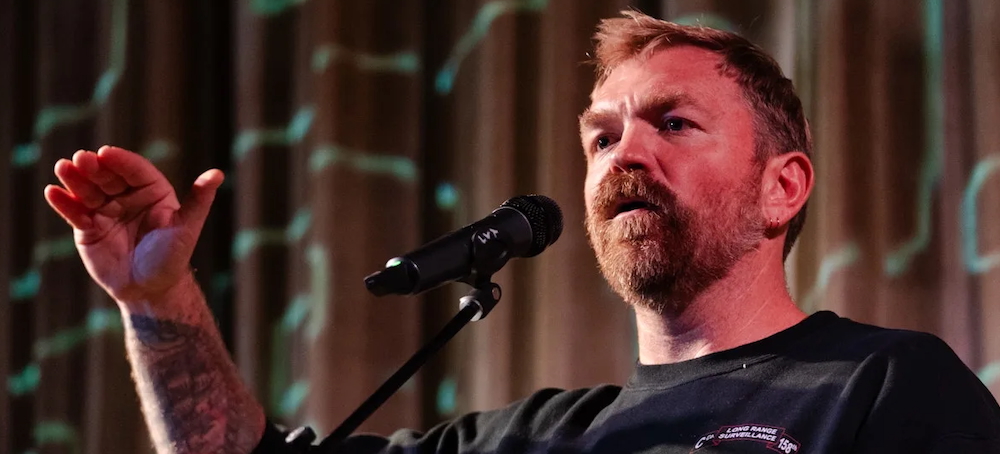 Graham Platner speaks at a rally. (photo: TNR)
 Graham Platner Wins Democratic Nomination for U.S. Senate in Maine
APALSO SEE: Graham Platner Wins Democratic Primary to Face Susan Collins in November
The results were marked by success for Democrat political newcomer Graham Platner in Maine, defeat for congresswoman Nancy Mace in South Carolina and mixed results for candidates given public backing by President Donald Trump.
Platner, a 41-year-old oyster farmer, secured the Democrat nomination in Maine and will face longtime Republican incumbent Sen. Susan Collins in November in one of the biggest midterm contests across the country.
His victory over Democrat rival Maine Gov. Janet Mills had been inevitable. However, it came despite Platner facing major question marks over his credibility during a campaign plagued by scandal.
Acknowledging a succession of controversies, Platner said on Tuesday night: "Any of those who feel let down or disappointed or disillusioned, it is my job to earn your trust, faith and support.
"I've made mistakes in my life, mistakes that I regret, that I live with, that I continue to learn from."
Platner first sparked contention following the revelation that he had a tattoo resembling a well-known Nazi insignia tattooed on his chest. He claimed he didn't know the symbol's origin and has since covered it up. He has also faced criticism for several online posts from his past, including one in which he said sexual assault victims should "take some responsibility" for what happened to them. In May, multiple news outlets reported that Platner, who is married, sent sexual messages to a campaign aide.
The most recent allegation came last week, when several women who once dated Platner detailed what The New York Times described as "unsettling" behavior from Platner during their relationships.
Nonetheless, Platner has continued to enjoy the support of Democrat heavyweights like Sens. Elizabeth Warren and Tina Smith, as well Sen. Bernie Sanders. While scandals haven't derailed Platner's march to the Democratic nomination, they will likely loom over his candidacy in the months leading up to his general election matchup with Collins.
Elsewhere on Tuesday, Republican voters in South Carolina delivered a more mixed verdict on candidates backed by Trump. Lt. Gov. Pamela Evette failed to secure a majority, despite receiving backing from President Trump. She will face State Attorney General Alan Wilson on June 23.
In what had been a close contest throughout, Trump gave a late boost to Evette by endorsing her two weeks ago, putting her ahead of high-profile Republican representatives Nancy Mace and Ralph Norman. Mace, a high-profile Congresswoman, blamed her fifth-placed finish on her support for the release of the Epstein files. She has endorsed Wilson.
Another ally of the president, South Carolina Sen. Lindsey Graham, avoided a runoff and secured the Republican Senate nomination over businessman Mark Lynch. Trump had warned that it would be a "DISASTER for the Republican Party" if Lynch won.
In Nevada, Trump-backed Marty O'Donnell won the Republican primary for the state's third congressional district, which will be a key battleground in November.
Nevada Gov. Joe Lombardo, a Republican, will face Democrat Attorney General Aaron Ford to set up what is likely to be one of the most competitive gubernatorial races in November.
In North Dakota, GOP Rep. Julie Fedorchak looks to have a clear path to reelection. Her seat is the only major office on the ballot in the state this year.
There are many more important dates on the primary calendar as the road to the midterms continues to heat up. Here's a rundown of the races to watch across the country.
June 16 — Alabama, Georgia, Oklahoma
Senate and gubernatorial races
Rep. Barry Moore and former Navy SEAL Jared Hudson are facing off head-to-head in a runoff for the GOP nomination after both defeating Alabama Attorney General Steve Marshall in the first round of voting. Moore and Hudson are both staunch Trump supporters who centered their campaigns around their MAGA credentials. Moore secured Trump's nomination earlier this year, which helped him secure 39% of the vote in the first round, 14 points higher than Hudson's tally. The winner of the runoff will be the overwhelming favorite to replace outgoing incumbent Tommy Tuberville, who's on track to become Alabama's next governor, in the Senate.
In Georgia, Republicans are holding runoffs to choose their candidates in two of the most important midterm races anywhere in the country. Rep. Mike Collins and former football coach Derek Dooley face off in a key Senate runoff, with the winner moving on to face Democratic incumbent Sen. Jon Ossoff. Ossoff's seat is one of the GOP's few opportunities to flip a spot in the Senate in a year in which they will mostly be playing defense across the rest of the country.
The GOP also has a runoff in the gubernatorial race, with billionaire Rick Jackson taking on the state's current Lt. Gov. Burt Jones in a classic outsider-versus-establishment matchup. Jackson has contributed $83 million of his own money to his campaign and blanketed the state in political ads. However, Jones has Trump's endorsement, which helped him come out on top in the first round of voting. The runoff winner will go on to face Keisha Lance Bottoms, who is seeking to become Georgia's first Democratic governor in more than two decades.
Oklahoma's Senate race suddenly got interesting in March, when Trump tapped incumbent Republican Markwayne Mullin to become homeland security secretary. Oklahoma's governor, Alan Armstrong, named the CEO of an oil and gas company as Mullin's replacement. Under a unique state law, Armstrong is not eligible to run for a full term in November. Five Republicans have joined the GOP primary, which will essentially decide who will be the deep red state's next senator.
June 23 — Maryland, New York, Utah
House races
Maryland Democrat Steny Hoyer set off a mad scramble in January when he announced that he'd be giving up the House seat he's held for the past 45 years. More than 20 candidates have entered the Democratic primary in his deep blue district. Democrats are also locked in another primary in Maryland's sixth district, where former Rep. David Trone is trying to regain the seat that he gave up in 2024 to launch an unsuccessful Senate bid. To do that, he'll have to oust incumbent Rep. April McClain Delaney in the primary. Trone, the co-owner of the Total Wine … More retail chain, has a massive self-funding advantage, but McClain Delaney has secured the endorsements of most of Maryland's high-profile elected officials.
There's plenty of intrigue across the primaries for New York's 26 House districts, but the race with the most national interest is in the state's 10th District. Incumbent Democrat Dan Goldman, a relative moderate in the party, is facing a challenge from his left by former New York City Comptroller Brad Lander. Lander, who ran for mayor in the city last year, built a strong support base among young voters for his embrace of eventual winner Zohran Mamdani after suspending his own campaign.
Utah is using a completely new congressional map this cycle after court rulings that found that its old, Republican-drawn map violated state law. Now, instead of four safe GOP seats, Utah has one Democratic-leaning district, in which four Democrats are competing in the primary, and three red districts, but four incumbent Republicans. Rep. Burgess Owens ended up being the odd man out, and he announced in March that he wouldn't seek another term. His exit means that none of the other incumbents will face each other in the primary, but at least two of them have fielded challenges from other GOP candidates.
June 27 — Louisiana
Senate runoff
The biggest headline in Louisiana's Senate race happened in the first round of voting, when incumbent Republican Sen. Bill Cassidy, one of the few remaining GOP lawmakers on Capitol Hill who voted to impeach Trump after the Jan. 6 attack, failed to reach the runoff in his bid for reelection. Instead, either Rep. Julia Letlow or State Treasurer John Fleming will be the Republican nominee and become the strong favorite to replace Cassidy in the Senate. Letlow, who was endorsed by Trump, came close to winning the primary outright in the first round with 45% of the vote.
July 21 — Arizona
Gubernatorial race
Two Republican congressmen, Reps. Andy Biggs and David Schweikert, have entered the GOP gubernatorial primary for the chance to challenge Democratic Gov. Katie Hobbs in the general election. Their decision to potentially give up their seats in the House has prompted several Republicans to launch campaigns to replace them.
Aug. 4 — Kansas, Michigan, Missouri, Virginia
Senate, House and gubernatorial races
Kansas Gov. Laura Kelly is the rare Democrat who has enjoyed consistent electoral success in an otherwise strongly red state. After leading Kansas for eight years, Kelly is not eligible to run for reelection. Two state lawmakers, Ethan Corson and Cindy Holscher, are running to succeed her at the top of the Democratic ticket. Meanwhile, six Republicans are vying for the chance to turn the Kansas Statehouse red, including the state's Senate president, the secretary of state and former Gov. Jeff Colyer.
Michigan Democrats will be playing defense in two of the most pivotal elections in this year's midterms. The race to replace popular Democratic Gov. Gretchen Whitmer, who is term-limited, seems to be all but settled. Michigan Secretary of State Jocelyn Benson appears to have a clear path through the Democratic primary, and Rep. John James looks primed to secure the GOP nomination. Things are much tighter in the Democratic Senate primary, where state Sen. Mallory McMorrow, Rep. Haley Stevens and physician Abdul El-Sayed are locked in a close three-way contest. The winner of the Democratic primary is likely to face Republican Mike Rogers, who was 19,000 votes away from being elected to the Senate in 2024.
Missouri's First Congressional District will feature a rematch of one of the most-watched primaries from the 2024 election. Former Rep. Cori Bush, a progressive member of "the Squad," is challenging Rep. Wesley Bell, a moderate who defeated her in the Democratic primary last cycle. Their matchup two years ago was the second-most expensive House primary race in history, due to the $8 million that a pro-Israel group spent to target Bush.
Virginia's congressional races have been subjected to severe whiplash in the past month, after a court ruling overturned a voter-approved ballot measure tied to a district map that favored Democrats. Primary races for seats under the previous district lines are still taking shape.
Aug. 11 — Connecticut, Minnesota, Vermont, Wisconsin
Senate, House and gubernatorial races
Democratic Rep. John Larson of Connecticut is seeking a 14th term in the House, but he's facing his first serious primary challenge since first winning his seat in 1998. Three other Democrats have entered the primary, with each arguing that it's time for Larson, 77, to step aside and let a new generation lead the district.
Minnesota is on track for significant turnover in its most important elected offices. With Gov. Tim Walz not seeking reelection, Sen. Amy Klobuchar has chosen to leave the Senate to pursue the chance to replace him. At least eight Republicans, including MyPillow CEO Mike Lindell, have joined a wide-open GOP gubernatorial primary. Klobuchar could potentially name her own temporary replacement if she becomes governor. Minnesota's other Senate seat is open this year because Democrat Tina Smith is retiring. Lt. Gov. Peggy Flanagan and Rep. Angie Craig are the main candidates in the Democratic Senate primary. Former sports broadcaster Michele Tafoya is the frontrunner for the GOP nomination.
Vermont's gubernatorial race had been mired in uncertainty for months as Republican Gov. Phil Scott, who was recently declared the most popular governor in America, left open the question of whether he'd seek another term. Scott finally announced his reelection bid in late May, and he has a clear path to the Republican nomination. Even with a possible blue wave looming, Democrats face a steep challenge as they try to unseat Scott, who won by more than 50 points the last time he was on the ballot.
In Wisconsin, Democratic Gov. Tony Evers has chosen not to seek another term. Seven high-profile Democrats, including former Lt. Gov. Mandela Barnes and state Rep. Francesca Hong, have entered the race to replace him. That's a stark contrast to the Republican primary, where Rep. Tom Tiffany appears poised to coast to his party's nomination.
Aug. 18 — Alaska, Florida
Senate and gubernatorial races
Alaska's unique nonpartisan "jungle" primary system means that the four highest-ranking candidates in its Senate and gubernatorial races will move on to the general election, which will be decided by a ranked-choice vote.
Florida will elect a new governor this year. Rep. Byron Donalds, a strong Trump ally, is the overwhelming favorite to win the GOP nomination. Democrats haven't won a governor's race in Florida since 1994, but one March poll showed Donalds leading the two main Democratic candidates — Orange County Mayor Jerry Demings and former GOP Rep. David Jolly — by single digits. It's a similar story in the Florida Senate race: Incumbent Republican Ashley Moody was outpacing potential opponents in the crowded Democratic field by roughly 8 points.
Sept. 1 — Massachusetts
Senate race
Progressive Democrat Ed Markey, 79, is running for another term in the Senate. He's being challenged by Rep. Seth Moulton. Despite age being a major issue throughout the Democratic electorate, polls show Markey holding a solid — although not insurmountable — lead over his 47-year-old primary opponent.
Sept. 8 — New Hampshire
Senate race
Democratic Sen. Jeanne Shaheen is not running for reelection. Rep. Chris Pappas has a huge lead in polls of the Democratic Senate primary. Republicans have recruited two former senators in their effort to flip Shaheen's seat. Polls show John E. Sununu, who Shaheen knocked out of the Senate in 2008, with a healthy edge over former Massachusetts Sen. Scott Brown.
Sept. 9 — Rhode Island
Gubernatorial race
Rhode Island's Democratic governor, Dan McKee, seems to be at serious risk of being knocked out of office by a member of his own party. With a disapproval rating among likely voters of 76%, he trails former corporate executive Helena Foulkes by a significant margin in recent polls.