
Global Warming Unmakes Winter in the US West
Bob Berwyn Inside Climate News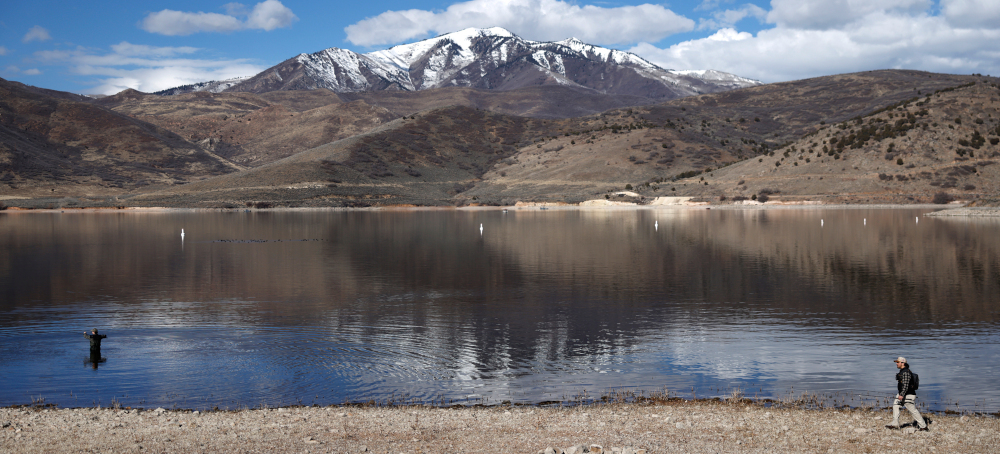 People fish along the Deer Creek Reservoir near Heber City, Utah, on Feb. 7, as the state experiences about one-third of its normal early-February snowpack. (photo: Mario Tama/Getty)
 Global Warming Unmakes Winter in the US West
Bob Berwyn Inside Climate News
A new climate attribution study shows that heating from greenhouse gases could drive extreme snow droughts in the region every third year by 2050.
What little snow did fall melted much too quickly, leading to the worst snow drought on record for nearly the entire mountain backbone of the region, from northern Montana to the Sierra Nevada and the Cascades, through Wyoming, Nevada, Colorado and Utah, and into New Mexico and Arizona. It disrupted daily life and caused economic hardships, dried up streams, left reservoirs depleted and primed forests and grasslands to burn in wildfires.
And if the planet continues warming at the current pace, a snow drought as severe and widespread as last winter’s could occur every third year by 2050, and nine out of 10 years by the end of the century, said a team of researchers from Montana, Wyoming and Colorado who analyzed how human-caused warming of the climate system influenced the drought.
Their extreme event attribution study, published this week in the Proceedings of the National Academy of Sciences, found that global warming has already made such a drought about four times more likely today than in a climate without industrial fossil fuel emissions.
As dry and especially warm conditions persisted for months, uneasiness spread through mountain ski towns and ranching communities. Fearing the summer—and years—ahead, “scientists, the recreation industry, and the press asked whether the low snow anomaly was attributable to climate change,” the authors wrote in the paper.
It became apparent that the 2025-2026 snow drought would make a compelling case study for extreme-event attribution research, said lead author Adrienne Marshall, an assistant professor and hydrologist at the Colorado School of Mines.
The findings have serious implications for state and federal agencies managing water and other natural resources. The study found that global warming made such an extreme snow drought about 14 times more likely in the Upper Colorado River Basin, where accumulated snow usually melts slowly into the summer, providing water to river ecosystems, orchards and power plants thousands of miles away in the deserts of the Southwest.
Marshall said it was a ”gut punch” when the study showed how much more frequent extreme snow droughts will likely be if greenhouse gas emissions aren’t reduced. It really hit home, she added, when she went on a spring snowpack survey to several high-altitude measuring sites at Hidden Valley and Trail Ridge Road in Colorado’s Rocky Mountain National Park.
“There was just so much bare ground where there should have been snow,” she said. “It was really striking, and it brought home what we were seeing in the analysis.”
Recent progress in climate modeling bolstered their confidence in the results, she said.In particular, co-author Stefan Rahimi, an assistant professor of computing and atmospheric science at the University of Wyoming, used a new generation of high-resolution Earth system models that simulate the atmosphere and mountains at a resolution fine enough to capture rugged terrain where snowfall and the accumulation of frozen precipitation can vary dramatically over short distances.
At the heart of the effort was a high-resolution physics-based snow data set for the Western U.S., which took him four years to compile, even with some time on the University of Wyoming-based Derecho supercomputer, a flagship system for climate modeling and a partnership between the National Center for Atmospheric Research and the National Science Foundation.
Simply running climate models at higher resolution without improving how well they represent the underlying physics is a bit like doing a jigsaw puzzle with more pieces, but many of them are blank or blurry. For an attribution study on a snow drought, those pieces have to be filled with detailed information on how mountains shape storms, how snow collects and how it melts. Without that, finer-scale simulations are a “fool’s errand,” he said.
Co-author Marianne Cowherd, a climate and Earth scientist and assistant professor at Montana State University, said she used to mainly think of snow as a transportation headache, and a source for school snow days, having grown up in Michigan. When she moved to California, she came to see mountain snow as stored water, a shift in perspective that made snow a compelling way to study climate change.
The snow drought started unfolding even as the winter seemed about normal at first, she said, with only slightly below average precipitation in the Northern Rockies. The problem was persistent warmth. Every major river basin in the West experienced either its warmest or second-warmest winter on record, according to federal agencies. Often, rain fell instead of snow even at elevations higher than 8,000 feet above sea level, where winter rain is historically rare. It evaporated into the warm air, slowly at first, and then all at once when the region was blistered by a March heatwave that left some snow-measuring sites snow-free in early April, when the snow should be at its deepest.
Around Bozeman, people were shocked by early ski area closures and started worrying much sooner than usual about dry forest fuels and the wildfire danger. What struck Cowherd the most was when “people around town started thinking farther ahead than they normally would, and connecting poor snowpack with fire, water and the rest of the climate system,” she said.
One of Cowherd’s contributions to the research was developing ways to define and categorize snow droughts in measurable terms, for example by the total water content stored in the regional snowpack in spring, when supplies for the summer season are assessed.
If extreme snow droughts happen frequently by the end of the century, she added, “We may need to reexamine how we’re defining drought, and even what we intuitively mean by a drought. Is it about an expectation? Is it about supply?”
Among people who spend a lot of time thinking about climate change and studying climate models, “there’s this sense that you just know that certain trends that you see must be driven by climate change,” she said. But a statistical evaluation, considering whether climate change is a factor, or whether an event would have happened without warming, “is a much more rigorous type of question,” she said.
“I think the most surprising thing was just how much the Upper Colorado stood out as being just quite scary,” she said. As the study began, she focused on how unusual it was that so many places were experiencing snow shortages simultaneously. “And then this project really showed me how much worse it was in the Upper Colorado than in any other part of the West.”