
Gavin Newsom Sure Sounds Like He’s Running
Joe Hagan Vanity Fair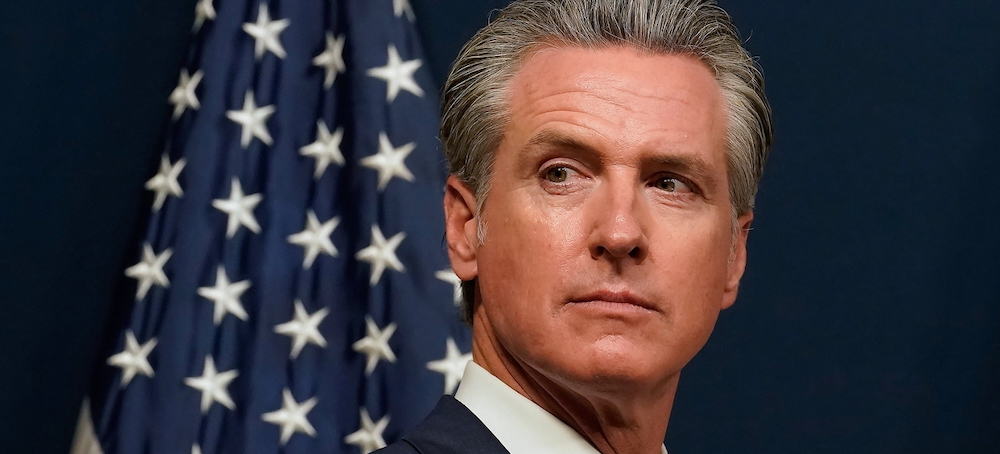 California Gov. Gavin Newsom. (photo: Rich Pedroncelli/AP)
 Gavin Newsom Sure Sounds Like He’s Running
Joe Hagan Vanity Fair
As the governor looks beyond California, he opens up about his political ambitions, his vision for the country, and why he's chosen Bill Clinton as his 2028 spirit animal.
“Slick,” Newsom ventures when I ask what he assumes people say when his name comes up in 2028 speculation. With his dazzling white teeth, open collar, and hair Brylcreemed to a silver sheen, it’s not a bad guess. I had another association in mind: California itself.
“God, how lucky am I?” he replies, reflexively.
Answers may vary.
This summer I went to meet Newsom and found him in a sunbaked shopping plaza near downtown Las Vegas. He’d just wrapped up the last state budget of his eight-year term in office, leaving California with billions more in debt than when he arrived, and was visiting Nevada—a swing state, and the second, after South Carolina, on the Democratic primary calendar for 2028—to rally local Democrats and support a gubernatorial candidate named Aaron Ford. A handful of protesters stood in the parking lot, in 107-degree heat, flapping handmade posters that read “We Can’t A-‘Ford’ California.”
Newsom has been prepping for ever-higher office since he ran for mayor of San Francisco 23 years ago. But California remains the quintessential liberal hellscape of the national imagination and perhaps Newsom’s biggest impediment to any White House designs: nation-leading poverty and income inequality, and that pervasive and widespread homelessness you read about.
“I get all that,” Newsom counters. “Look, there’s a whole industry that’s been created to attack our state, and it’s pretty ironic. We’re the tentpole of the US economy. Think about where Donald Trump would be today if he didn’t have California. It’s the only thing holding up GDP growth.”
Newsom calls it “California derangement syndrome,” his spin on the MAGA attack line for Trump haters. He giddily machine-guns facts and quasi-facts about California and his governance thereof: the first major decline in people sleeping on the streets in nearly two decades, a 59 percent jump in housing construction (his housing number has since come under scrutiny for excluding major areas like San Diego), a $25 minimum wage for health care workers (federal minimum wage is $7.25). And did you know California is home to more Nobel laureates than anywhere else in the country?
When we met, Newsom was taking a victory lap after the passage of Proposition 50, which could flip five congressional seats in California in a tit-for-tat response to newly drawn seats in Texas meant to tilt the midterms in favor of the GOP. It was a controversial move, a sign of Newsom’s willingness to get down in the mud and beat Republicans at their own game. Democrats thrilled to it, giving Newsom a shiny trophy to campaign on.
While he spoke to Nevada canvassers, somebody yelled out “President!” and Newsom did a sheepish cut-the-mic gesture at his neck, signaling he wasn’t ready to go there. Oh, but he is. Submitting himself to a Vanity Fair interview, under fluorescent lights in an empty back room of a local ministry, he comes off as loose and playful, dodging and parrying like a political athlete, part salesman, part jocular bro, with just enough comic self-deprecation to make the whole soufflé rise. Earlier, when he was presented with a baseball jersey by local pols, Newsom pretended to unbutton and remove his shirt for a quick change, saying, “I’ve been working out,” inspiring squeals and wolf whistles.
But the more immediate and pressing question before Newsom—before he ever has a chance to try explaining California to middle America—is whether his charms can tame a restive and dyspeptic Democratic Party currently besotted with democratic socialists. The political progeny of Bernie Sanders are gaining ground from New York to Michigan on promises of burning the billionaire class to the ground, eager to cast the likes of Newsom as not only the avatar of California’s gross income inequality, but the model of a failed and corrupt establishment.
A clue to how Newsom might navigate the rocky terrain comes almost as soon as we sit down. I notice, as he starts talking, a vintage hand gesture: the thumb resting on bent forefinger to emphasize a point, unmistakably borrowed from a certain former president. “I watch videos of Clinton,” he tells me. “I seek his counsel, his advice, and even in his absence, do that. I’ve been a student of his from day one.”
The two have an actual relationship, talking late at night about strategy and ideas, including how to tackle the California problem. “He calls me late at night, wanting to talk about it, and he goes, ‘I’ve been thinking just nonstop about this. I just think you represent what they fear.’”
Even a master cynic like Steve Bannon, the MAGA philosopher king, can’t help but be impressed by Newsom’s tactical chutzpah: “Game respects game.”
“He’s very mindful of that,” Newsom says. “It’s a problem to be solved, and no greater problem solver in that respect than Bill Clinton, in my mind. Master of his craft. Next-level.”
Invoking Clinton would seem a risky maneuver, not least because of Clinton’s apparent association with Jeffrey Epstein, but also because the man critics called “Slick Willie” is the very model of the kind of compromised liberalism the new left reviles. Clinton’s public favorability is middling at best, rating well below Sanders, the closest thing to a genuinely popular Democrat. (Clinton has denied having any knowledge of Epstein’s crimes and wrongdoing. He declined to be interviewed for this story.)
With a decision to run for president just over the midterms horizon—“I don’t think you have the luxury of much more time,” he tells me—Newsom is pitching himself as the Reasonable Man, a seasoned technician of center-left governance who steered the fourth-largest economy in the world with one hand and fought MAGA with the other. He is even drafting policy ideas and calling it Project 2029. After years of herding his state’s liberal cats, Newsom treats the new breed of progressive ideologues—New York mayor Zohran Mamdani being the exemplar—as Johnny-come-latelies.
“So much of what the DSA is promoting, I’m like, Been there, done that,” says Newsom, pointing to Assembly Bill 1482 as the “most progressive rent control in America.” “I’m the biggest climate champion that you know, but I’m not antibusiness.”
The Democratic Socialists of America trades in “slogans,” Newsom observes. When he sees Democrats applauding for what he calls “pablum and rhetoric,” he asks, “For that?”
Newsom may look like a chip off the Nancy Pelosi bloc (they’re distantly related and share a donor base), but that doesn’t mean he’s part of any so-called establishment. “Well, I’m not,” he insists. “I’m not. I mean, I’ve been at this awhile. To the extent I’m established, in that context—but I’m notoriously a disrupter at heart. I’ve never been for the status quo. Quite the contrary. I have a record that consistently challenges the status quo, and I tend to take risks to a degree that few elected officials do.”
Sounds like a sales pitch. Before we leave Vegas, Newsom invites me to California to see him in his natural habitat. “Bring security,” he jokes. “And bring extra money.”
I’m wearing an orange hard hat on a construction site in Oakland, and Newsom, conspicuously, is not.
“I’ve got my OSHA-approved hair,” he jokes to a small group of helmeted functionaries standing inside a half-built apartment complex in Chinatown. “I got a waiver a few years ago.”
Decked out in six feet three inches of blue suit, he’s signing a bill meant to speed up housing construction. California remains a brutal state for the working class and poor. I ask him why it took eight years to get to housing reform when he might have done it in his first hundred days. “I didn’t have the political capital,” he tells me flatly.
Newsom also credits Ezra Klein, the New York Times columnist, for pressuring him during a podcast conversation and in his 2025 book, Abundance, to dig into the environmental laws that block infrastructure and housing. “Ezra kicked my ass,” he says. “I respect my critics. I love them. Thank them. Pay attention to them.”
Newsom has been crowing about a 9 percent drop in unsheltered homelessness over the past year, though the numbers are in dispute. The state’s Legislative Analyst’s Office argues that they’re underreported. Newsom vetoed a bill meant to improve accountability, arguing that it was “duplicative.”
Klein, for his part, is reluctant to take credit for Newsom’s come-to-Jesus on housing, pointing to other intense political pressures. But he agrees with Newsom himself that Clinton is an accurate political ancestor.
“I think a lot about Bill Clinton when I think of Gavin Newsom,” Klein tells me. “The thing that defined Bill Clinton, his political strength, was to reconcile opposite political tendencies and, at the same time, to fluidly move with reality. You can say that of Gavin: He changes and adapts. I think that’s been his great political strength.” (Klein declined to weigh in on Newsom’s broader prospects.)
When the DSA championed a one-time 5 percent tax on California’s billionaires, they painted Newsom’s opposition as proof he was “trying to protect 250 prospective 2028 presidential donors, even if that means 3 million of his constituents are medically bankrupted,” as liberal journalist David Sirota put it. Newsom, openly worried about losing his tax base, parried with his own proposal, a national billionaire’s tax. Upon close inspection, it was more of a federal tax-bracket adjustment for people making over $100 million and headlined with a populist slogan. But it performed a neat piece of political jujitsu: blunting the attack from his left flank while inviting cries of “socialist!” from the right, thereby burnishing his progressive cred.
Even a master cynic like Steve Bannon, the MAGA philosopher king who was an early guest on Newsom’s podcast, This Is Gavin Newsom, can’t help but be impressed by his tactical chutzpah: “Game respects game.” Of Prop 50, Bannon told me: “He smoked us on that,” effusing about Newsom’s brinkmanship, predicting he’ll be a “hero” if the Democrats manage to take the Senate and adding, “Having Gavin Newsom as president wouldn’t be the worst thing in the world.”
But, Bannon hastens to add, he doesn’t think Newsom is built for what’s coming. “He doesn’t understand the moment he’s in,” Bannon says. “Every morning, he’s got to wake up and think about who he is that day. And what he stands for. That’s not the time we’re in. He’s trying to glide on the surface of a deep civil war within the Democratic Party.”
I remind Newsom that Bannon, in their podcast conversation, predicted he would become an “economic populist,” the ideology now animating the far left as it did Bannon’s nationalist right. “It’s a really interesting insight that’s staring me now in the face,” Newsom admits.
Last spring, Newsom had a private meeting with Senator Elizabeth Warren, who was in San Francisco supporting taxes on billionaires. Her advice to him: “Name the villain.” “I felt like I was getting schooled a little bit,” Newsom says of the meeting. “I don’t have a problem with the villain. This notion that if you’re successful somehow, you’re the villain, or you had a stroke of luck, you’re a villain, I have a harder time with.”
Newsom is, in that sense, a villain.
“I don’t begrudge other people’s success,” he continues, citing his own wine business, PlumpJack, which he launched in 1992, when he was 24. A recent estimate pegged his net worth at roughly $30 million, with an annual income of about $2 million, according to recent tax filings. He owns two houses, worth an estimated $16.5 million. “I just don’t feel that. I’d be faking that. That’s inauthentic of me to say that. I aspire to it. I think it’s actually one of the things that’s always frustrating about my party. I’m a small-business person, and I intimately appreciate the risk-taking and the contribution of businesses. And I don’t think you could be pro-job and antibusiness.” The devil, he says, “is in the details.”
“But,” he finishes, “I believe billionaires should pay more taxes. Period. Full stop. One hundred percent.”
Newsom performs a similar dance when faced with the third-rail issues electrifying the far left: Israel, where the stakes are moral, and artificial intelligence, where they’re both financial and moral.
The brightest red line for the rising DSA is calling Israel’s military campaign in Gaza a genocide. Last March, Newsom agreed that Israel was in effect an “apartheid state” but then walked it back, suggesting he was misunderstood. When I ask him about it, Newsom tells me the media was “wildly overreading my first comments” and “wildly overreading the second comments.”
He wasn’t calling Israel an apartheid state, he says, but he wasn’t not calling it one either. “You’re dealing with the one guy—the only guy?—who brought a field hospital to Gaza. No one else did. I also can’t stand antisemitism. It sickens me to my core.”
He mentions Jewish family members on his wife’s side and says words like Zionist and genocide are “loaded terms that mean many different things to many different people, and I could play into those binaries. People aren’t going to listen to a damn thing you say unless you’re willing to align with a word.”
He still refuses to call what happened in Gaza—more than 73,000 Palestinians killed by Israel since Hamas attacked and killed 1,200 and abducted 251 hostages on October 7, 2023—a genocide, even when I push him on it repeatedly. “I’m not able to objectively conclude that,” he tells me. “Were there war crimes? Crystal clear...but I’ll leave that to the courts in more objective lines because it relates to the pure definition.”
It’s a Newsomian reflex: Refuse the label, keep both audiences half satisfied, and let the ambiguity do the political work a position never will. “Nuance,” he says. “Nuance.”
Newsom takes a similarly tactical approach to artificial intelligence, probably the defining issue of the coming presidential cycle. Two years ago, California’s legislature voted for the first state bill regulating AI, Senate Bill 1047, sponsored by state senator Scott Wiener, who wanted to make AI companies liable for harm caused to society. Anthropic CEO Dario Amodei wrote Newsom that the bill’s “benefits likely outweigh its costs,” while OpenAI and the Trump-aligned venture capital firm Andreessen Horowitz opposed it, the latter launching a public campaign and hiring a Newsom confidant as a lobbyist. Newsom pal Ron Conway, the venture capitalist and Democratic mega-donor who has stakes in OpenAI, Anthropic, and Mistral, called the bill “very, very ill-conceived.”
Newsom says that after he vetoed it, “people quietly said thank you.” He encouraged a narrower and less censorious bill based on a white paper he commissioned from various AI experts, including Fei-Fei Li. He announced his intention to sign the resulting bill, SB 53, at a 2025 Clinton Global Initiative event with Clinton, telling reporters, “We worked with industry, but we didn’t submit to industry.”
Newsom says if he were president he’d build a federal response to AI dangers based on California’s model: “I would be leading an international movement focusing on the issue of truth, and safety, and trust.” Conway argues that Newsom’s friendly relationship with AI leaders are a feature, not a bug. Newsom knows Sam Altman personally, so he’s uniquely positioned to broker solutions.
“There’s a lot of bullshit in this space,” Newsom says. “As much as I admire and believe in a lot of what I’m hearing from a lot of these folks, I also am mindful of capitalism, and mindful of a lot of self-dealing, and very mindful of the innovation that is important to maintain in this space.”
“I watch videos of Clinton,” Newsom tells me. “I seek his counsel, his advice, and even in his absence, do that. I’ve been a student of his from day one.”
He has promised to “democratize the economy” and redistribute tech wealth, floating a version of Sanders’s idea for a sovereign wealth fund with a 50 percent public stake in AI companies, though Newsom won’t put a percentage on it and points to the Trump Accounts, Trump’s government-backed investments for children, as his favored model. “It’s just the bane of my existence not calling them Newsom Accounts.” Artificial intelligence is “putting the dagger in the heart of the status quo,” he says. “And so something big, bold has to be written, and so you’ve got to renegotiate this contract.”
Newsom says negotiating state AI laws has soured him on some of the tech leaders, though he won’t name them. “I’ve lost relationships with these guys,” Newsom says. “I don’t recognize them. What the hell happened to these people? I have animus now that I never had. I think power corrupts—how they’ve been able to corrupt and manipulate the political system.”
“I don’t care if they voted for Trump,” he continues. “They were always libertarian. But it’s the nature of just too much abundance, too much wealth, too much isolation, too much indulgence, and too much power. Because the money buys you power.”
For a second, he sounds like Sanders. Maybe Bannon was right?
If Clinton was “the man from Hope,” Newsom, a multimillionaire wine merchant, presents a less folksy version: “the man from Napa.”
Young Man in a Hurry, Newsom’s 2026 memoir, was an attempt to make himself seem like a real boy and not just a political Pinocchio. Though he stretches to make the case that he earned his own way in life—he grew up the son of a single mother in working-class circumstances—Newsom was well-connected before he was out of diapers. His father, William “Bill” A. Newsom III, went to an elite San Francisco prep school with Gordon Getty and John Paul Getty Jr., sons of the billionaire oil magnate J. Paul Getty, and served as the Getty family fixer in the 1960s and ’70s.
When Gordon’s parents divorced, he briefly moved into the Newsom household as a teenager. After Newsom’s parents filed for divorce in 1971, Newsom was unofficially adopted by Gordon, repaying the favor the Newsoms had extended decades earlier. Gordon took young Gavin and his sister, Hilary, on family vacations, including to watch whales in Canada and view elephants in Kenya. Newsom revels in the gossip of his own access: In 1973, when John Paul Getty III was kidnapped by the Calabrian Mafia in Italy—they cut off his ear and mailed it to the press, demanding $17 million for his safe return—it was Newsom’s father, whom Newsom calls the “consigliere to the Getty family in times of turmoil” in his book, who negotiated and arranged the delivery of a reduced $2.2 million to the kidnappers. When Paul finally made his way back to California, he went toy shopping with Newsom and his sister.
In the early 1990s, Gordon Getty seeded Newsom’s Napa Valley wine start-up, PlumpJack, which Newsom launched with Gordon’s son Billy and named after an opera Gordon had composed. Later, Newsom fell out with Billy over a property dispute involving a house they jointly owned. In his memoir, Newsom called the breakup “one of the great holes of my life.”
Newsom was a Gen X child. A superfan of Sylvester Stallone’s first Rocky movie, he set up a makeshift boxing ring in his backyard and held neighborhood matches. He went through a phase as an amateur magician called the Great Gavini. He based his clothes and hairstyle on Remington Steele, the 1980s TV show starring Pierce Brosnan as a charming con man, a confession some found baffling. More baffling still: He appears to have kept the look for life.
He majored in political science at Santa Clara University, admitted on recommendations from a member of the school’s board of regents and former governor Jerry Brown, a friend of his father’s. He received a partial baseball scholarship but never played in a game. A former teammate described it as “kind of the standing joke that Newsom played on the team.”
Newsom, for all his political storytelling, is transparent about his lifelong dyslexia, which shaped his mind in unusual and crucial ways. When reading a book or speech, he has to underline every word to track and make sense of it. Because he doesn’t work well with a teleprompter, he memorizes speeches in advance, which has made him quick with data and able to debate with alacrity. An operative in Sacramento tells me, “He has a mind like a steel trap that remembers absolutely everything.”
“You’ve never seen me read a speech,” Newsom has said, “because I cannot read a speech. Maybe the wrong business to be in.”
Newsom’s first foray into politics was volunteering for Willie Brown’s 1995 San Francisco mayoral campaign, which led to an appointment on the Parking and Traffic Commission, which led to an unelected seat on the Board of Supervisors. By the time he ran for mayor in 2003, Newsom had the backing of Brown’s establishment.
His defining political act as mayor was to advocate for gay marriage in 2004, a maverick move at a time when Democrats were treading carefully to avoid a wedge issue in the presidential election.
But while he married gay couples in the face of cultural headwinds, his own dating life sometimes eclipsed the headlines. Local press published power rankings of his “side pieces.” Kimberly Guilfoyle had previously dated Billy Getty before they were introduced at a political fundraiser. At the time, Guilfoyle was an assistant DA in San Francisco prosecuting a high-profile dog-mauling case and making the rounds on cable news. Game respects game: Their three-year marriage was seared into the public imagination with a 2004 photo spread in Harper’s Bazaar of the two spooning in eveningwear on the floor of a house owned by Gordon and Ann Getty. The story was titled “The New Kennedys.” When Guilfoyle started working for Court TV in New York, Newsom would review tapes of her broadcasts, critiquing her facial expressions. After they separated in 2004, Newsom had an affair with Ruby Rippey, the wife of his own deputy chief of staff Alex Tourk, which became tabloid fodder. (Rippey wrote about the affair, and her struggle and recovery from alcoholism, for Vanity Fair.)
Newsom met his wife, the actor and documentary maker Jennifer Siebel Newsom, on a blind date in 2006. When the night ended, Newsom recounts in his book, Jennifer discovered that her car was locked in a parking garage. Newsom invited her to stay over “platonically” at his house. “The living room had no sofa and the windows had no blinds,” he writes in his memoir. “To keep out the sun, I had taped rolls of black plastic over them. She later confessed that her first glimpse of my abode brought to mind a question: ‘Did this guy take his interior design inspiration from American Psycho?’”
Later she was living in his apartment when an actual psychotic stalker tried breaking into the building with a roll of duct tape. Police found a cassette tape in the man’s car labeled “President Newsom.”
The couple married in 2008, and Siebel Newsom was quickly cast in the role of stabilizing force, an attractive, wealthy, and engaged political partner for an aspiring politician. She developed her own feminist profile, producing documentaries about women in media and parenting boys, and in 2022 became the star witness at Harvey Weinstein’s Los Angeles sexual assault trial, testifying—under the designation Jane Doe #4—that Weinstein had raped her in a Beverly Hills hotel room in 2005.
(Weinstein’s defense attorneys argued the encounter was consensual, portraying her as a “self-confident, ambitious Stanford business school graduate” who had stayed in friendly contact with Weinstein afterward. The jury eventually convicted Weinstein but deadlocked on the counts related to Siebel Newsom.)
When I ask Newsom whether Siebel Newsom would make a good first lady of the United States, he doesn’t hesitate. “Oh God, yeah,” he says. “Next-level. I mean, she’s got the values, the competency. She’s got, you know, a learnedness. She’s got a point of view.”
Perhaps the biggest scandal of Newsom’s career came when he was photographed dining at the upscale French Laundry during enforced COVID lockdowns and social distancing across California. A right-wing group tried ousting him from office through California’s recall process, but Newsom outspent his opponents roughly two to one ($3 million from Reed Hastings, cofounder of Netflix; $1 million from George Soros) and beat back the recall. The whole thing cost taxpayers $200 million.
“He didn’t try and run away from it,” says Conway. “He faced it head-on, and fought it head-on, and got the result he should have gotten. We defeated it.”
Newsom says the fight “was an extraordinary gift in some ways” because it caused him to reflect on who he was. “And that’s been a great process. Are there certain patterns?”
Not that he doesn’t regret dining at The French Laundry.
“Of course. It was boneheaded. It was a costly stress test. What the hell was I thinking?”
The political near-death experience appeared to embolden him for his next incarnation: the online alpha Trump fighter. “TINY HANDS IS OUT HERE COPYING ME—BUT WITHOUT THE STAMINA (SAD),” he posted on X last summer. As a former deputy communications director for the governor, Alex Stack, summed up the new Newsom worldview: “Politics is all content now.”
It was Newsom’s eldest son, Hunter, who alerted him to the content that defined Trump’s 2024 victory among young male voters. “When he started talking to me about Andrew Tate, I got nervous,” Newsom tells me, referring to the kickboxer-influencer and alleged sex trafficker who has denied wrongdoing. “He said, ‘Andrew Tate’s innocent. Hey, Dad, he’s in Florida. He’s coming to California. You should be with him.’ Like...no? And how do you know about this guy? And then he’s talking to me about Charlie Kirk, and he’s talking about Jordan Peterson, and I’m like, What the hell is going on? And then I look at his [social media] search, and it’s just, like, basketball.”
Newsom started his podcast explicitly to connect with young men, presenting himself as a Democratic problem solver and his own kind of alterna-bro. To book Kirk, his inaugural guest, Newsom connected through Guilfoyle. (“Obviously, they have a shared past,” Kirk later said.) I ask Newsom what he learned from his forays into the manosphere. “It’s the boyosphere,” he says, describing a world of online nihilists living at home with no romantic or financial prospects. “It’s not the manosphere. That’s the biggest revelation, and I think it’s a profoundly significant distinction.”
A Democratic strategist complains to me that Newsom is overly obsessed with the mechanics of politics—the platforms, the algorithms, the cultivated influencers—but “glitches out” when asked his vision for the country. Ro Khanna, the progressive congressman from Silicon Valley and a potential 2028 contender himself, tells me Newsom is ambition in search of an animating belief. “He wants the rhetoric of boldness without actually the courage of pissing people off,” Khanna says, citing the billionaire tax dodge. “The politician that Gavin Newsom most resembles is Bill Clinton.” Khanna doesn’t mean it in a positive way, arguing that Clinton was a “center-right” politician.
Mike Madrid, a cofounder of the Lincoln Project who advised a rival campaign against Newsom in 2018, hears versions of the same question everywhere he goes: opportunist or visionary? Newsom let down working-class Californians, especially Latinos, he says, but he won’t deny his political gifts. “Anybody who’s counting Gavin Newsom out is making a very, very big mistake,” he tells me. “He’s a truly generational talent, one of the most talented Democrats in the country.”
“He’s not afraid of confrontation,” he continues. “He’s not afraid of the attacks that are going to come on him. He leans into that, he understands how to turn attention into a strength, even if it’s negative. As long as the media spotlight is focused on him, he’s in contention.”
If that sounds like a description of Trump, it’s no coincidence. Newsom is probably the most studied politician in America, absorbing styles and ideas—whether Clinton’s thumb gesture or Trump’s media strategy—and making them his own with a Cheshire grin.
Newsom can come off as hammy and performative onstage—his cadences sometimes call to mind William Shatner as Captain Kirk—but he insists that whatever conviction looks like, he has a battle-hardened version of it. “They want a fighter,” he says of Democrats. “And the good thing is, look, I can back up a lot of the rhetoric, and that’s the difference. I’ve been at this long enough. I’ve got receipts, and I know what works.”
But former vice president Kamala Harris is threatening to crowd the centrist Californian got-the-receipts lane in a prospective Democratic lineup and already polling higher than Newsom among likely 2028 voters. In interviews, Newsom has slimed her with the faintest praise, talking about her like she’s retired since her 2024 loss to Trump (“she’s lived an extraordinary life”) and suggesting in an interview with Axios that she might run for office again, such as “school board.”
In our interview, Newsom suggests she’s weak, complaining that the Harris campaign in 2024 didn’t stand up for California’s Medi-Cal expansion to undocumented immigrants, a policy he had shepherded into law, after it came under attack from Trump and JD Vance. “Everyone criticized me during the Harris campaign for that,” says Newsom. “We’re practicing it. Now you’re running away from it.”
In September, Newsom told CNN that he wouldn’t run for president in 2028 if Harris ran, though it may have been less a binding promise than a tactical signal to Black voters, especially in South Carolina, the first major primary state in the 2028 election, where he’d just visited. When I ask if he’d drop out of the race were Harris to announce her candidacy after him, he punts but adds: “You can’t hold off on making a decision, waiting, waiting, waiting. But I don’t think that will—I’m not concerned about that, candidly.”
I ask Newsom to imagine himself in a debate of primary candidates in 2028, facing off against the likes of New York congresswoman Alexandria Ocasio-Cortez, likely to scorch him for his political impurities. “Give me the time and I’m happy to give you the crime, as they say,” he says, reworking the original expression before catching himself and adding, “I just mean that in the context of ‘politics is politics.’ ”
“I look forward to that debate,” he tells me. “Oh you better believe it.”
In June, Newsom learned of an FBI fraud investigation targeting him and his wife and went on the offensive, posting a dramatic video that tried to define the news cycle before it could define him, casting himself as Trump’s chief antagonist.
Newsom alleges that a fraud case against his former chief of staff, Dana Williamson, morphed into an investigation of Newsom himself. The case predates Trump’s term, and the alleged crimes didn’t take place in Newsom’s office, but once Trump was elected, Newsom claims, the Department of Justice went on a fishing expedition to get something on him. “Trump took it to the next level to go after us, came up with nothing, so they were like, ‘Find something,’ ” he tells me. “That’s abuse of power. And that’s when I said, ‘Enough.’ ” (Attorney General Todd Blanche has publicly disputed Newsom’s account.)
None of it has implicated Newsom personally, but it did highlight some gamy dealings, like the $4.28 million his wife’s nonprofit, the California Partners Project, received from donors with business before the state. Newsom helped pipe $1.05 million from a Sonoma County tribe to his wife’s nonprofit in 2023, then appointed the tribe’s chairman to the UC Board of Regents less than three months after the final payment, a sequence investigators are reportedly examining.
The transactions are legal under California’s permissive behested-payment rules, but none of it looks particularly ethical. Earlier this year, Newsom was fined $31,500 for failing to report more than $5.5 million in behested payments on time. He says he “screwed up on the paperwork” while trying to raise money for victims of the LA wildfires.
It was during the fires that Newsom had a tense encounter with Trump, poking a finger in his chest and gripping his arm on a tarmac and riding with him in a limo to Malibu, which Newsom details in his memoir, suggesting Trump was obsessed with him (telling him his wife was “hot”) and also personally hurt when Newsom attacked him at his own inauguration afterward, calling Newsom up to make sure they were still “good.”
I ask Newsom whether the appearance of self-dealing in the FBI investigation, even if legal, undercuts his ability to effectively attack the man he calls “simply the most corrupt president in American history.”
“No, total bullshit,” he says. “This is why he’s doing it.”
Game respects game.
For Newsom, the fight itself is the point. Whatever Trump throws at him, Newsom reframes it as proof that he, personally, is the one MAGA fears most, less a governor under a cloud of suspicion than the Democratic Party’s designated boss, martyred and re-martyred in real time, on-brand and ready for the next fundraising email. To wit: Within hours of announcing the DOJ investigation, Newsom sent out a fundraising blast and raised a quarter-million dollars in two weeks, leveling up a $14.4 million war chest ready-made for 2028.
Newsom, who thrives on surfing the daily chaos of the Trump era, admits the current moment, pitting populist right against populist left, unnerves him. “I’m worried about the pendulum,” he tells me back in Vegas, “because it doesn’t go back to the middle.”
It’s as close as he comes to expressing genuine doubt. Newsom’s ostentatious embrace of Clinton would suggest he believes Trump has realigned American politics to the right like Ronald Reagan did in the 1980s, and that a successful move for Democrats is a tack to the middle. But few people seem to believe the middle exists anymore, and Newsom’s critics question whether he has an actual vision. The first time I ask him, he stumbles.
“I think I do,” he says. “I certainly have, as a governor, from a governing perspective—from a campaign perspective, it’s a little different. How do you paint that picture of a journey we can all go on together, where everyone feels included?”
The second time I ask, following an appearance at the InterContinental hotel in Los Angeles, he still resists: “The hesitation is only because I don’t want to make it a campaign slogan, and I don’t have a campaign slogan for you.”
Newsom was arranging a tour of Southern states later in the summer, specifically to get his face in front of South Carolinians. It’s a chance, he says, to connect with the electorate and figure out his own gut. “You’ve got to start to feel it,” Newsom says, beating his chest. “You know, it’s the Nietzsche: ‘If you don’t have a big enough why you can’t endure the how.’ ”
The presidential campaign process will be an MRI on everything Newsom has ever said and done, and “who the hell needs to go out there and get the MRI on words?” But of course words matter, as Newsom well knows.
“My why is to stand up for ideals and strike out against injustice,” he says. “It explains more things in more ways on some of the things I’ve done over the last 20 years, personally and professionally. Number two: We’re all better off. So this fundamental notion of the commonwealth is deeply ingrained in my consciousness.”
Just when it seems he’s making it all up on the fly, he mentions a nascent platform he’s been sketching out, which he dubbed Project 2029 after the MAGA blueprint Project 2025. “I’ve quite literally written out, like, eight pages of commonsense good policy ideas that are long overdue, that would be a framework of a 2029 plan,” he tells me.
Later, in the same conversation, the page count grows: “I have, I kid you not, 36 pages of ideas.” He has notebooks of ideas in his car, he says, and invites me to see them. So we get into an elevator and head down to the subbasement of the hotel, arriving at a delivery entrance pungent with garbage smells and a team of stone-faced Secret Service agents hovering around the governor’s black SUV. He opens the back door and rifles through a leather duffel bag, pulling out a pile of notepads and loose-leaf paper filled with handwritten scrawl. He flips through, reading off bits and pieces, until he gets to a page marked “PROJECT 2029: Ideas for Democrats.”
“No one touches these,” he says. “These are my own little version. This is just policy, not narrative, the kinds of things we need to do: zoning reform, corporate tax, junk-fee stuff, new domestic strategies and tariffs, preschool things, a cap on childcare, family leave, paid sick leave, child tax credits, industrial decarbonization, anti-monopoly stuff, immigration, whistleblower protections.”
I ask if this stuff is for January 6, 2029, the day a new president is certified by Congress. He smiles coyly. I note that Bobby Kennedy also toured the South in 1968 during his own run for the presidency. At this, Newsom brightens, mentioning a framed photograph at home, a black-and-white image of Kennedy kneeling in front of a young boy next to an old beat-up car. Newsom says he looks at the image while he brushes his teeth every morning. He gets down on one knee to imitate the Bobby Kennedy pose in the garage of the InterContinental.
“Yeah, that’s the why,” he muses. “Let’s stand up for ideals.”
Newsom loves the performance. The Rocky Balboa of it all, the Bill Clinton of it all, the Bobby Kennedy of it all.
He will undoubtedly draw punches from both ends of the political divide, both saying essentially the same thing: slick, shallow, failed, corrupt, cynical, visionless. And, of course, Californian. Can Newsom survive the debate this country wants to have?
“I don’t have a problem fighting,” Newsom tells me. “Nor do I have a problem getting roughed up and getting back up. I’ve been road tested. It’s not small ball out here in California.”
His chin is out and ready.