
Full-Blown War Is No Longer an Effective Tool for Superpowers to Get What They Want
Jonah Shepp New York Magazine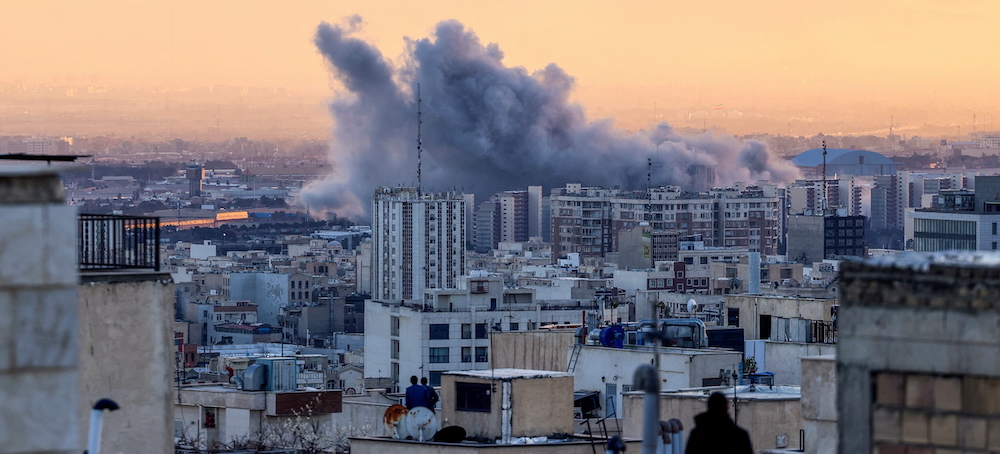 A plume of smoke rises after a strike on the Iranian capital Tehran. (photo: Atta Kenare/AFP/Getty Images)
 Full-Blown War Is No Longer an Effective Tool for Superpowers to Get What They Want
Jonah Shepp New York MagazineSo far, the war with Iran has not met any of President Donald Trump’s stated aims. It has not induced regime change, destroyed Iran’s nuclear and missile capabilities, shut down its regional network of proxy militias, or rendered it incapable of projecting power. With both the U.S. and Iran going into this weekend’s peace talks with maximalist negotiating positions, feeling like they have prevailed in the war and now have the upper hand, it’s unlikely the talks will deliver Trump’s goals, either.
These failures have come at tremendous cost. In five weeks, the U.S. has spent billions of dollars, stretched its armed forces thin, and exhausted an enormous amount of its munition stockpile. And those are just the direct costs: Economically, the war has disrupted global supply chains of critical resources, driving up the prices of essential consumer goods, including food and fuel both in the U.S. and around the world. The war has put further strain on our alliances in Europe, the Middle East, and Asia, while cementing the U.S.’s reputation as an erratic and unreliable actor on the world stage. And it has killed thousands of people, including 13 U.S. servicemembers, displaced millions of others, and wrought havoc and destruction in nearly a dozen countries.
For all this, the war has not only failed to achieve U.S. objectives, it has backfired, giving the Iranian regime power and leverage over the Strait of Hormuz and the global energy market that it did not have prior to this war. The tenuous cease-fire was supposed to “open” the strait, but Iran is retaining the right to search ships transiting through it and charge them a toll for safe passage. Far from hobbling Iran as a regional power, the war has instead made it a world power, since Iran has proved it is willing and able to singlehandedly shut down much of the global economy at a moment’s notice. Intelligence and military officials had warned Trump this war would not be easy, regime change was unlikely, and there was a real risk of Iran blocking the strait and attacking gulf targets, but he disregarded these warnings in favor of the hawkish optimism of Israeli prime minister Benjamin Netanyahu.
The Iran war is only the latest example of military misadventures that have gone sideways for the U.S. and other major powers recently. Take for example Russia’s invasion of Ukraine. What everyone assumed would be a cakewalk to Kyiv has turned, four years on, into an intractable bloodbath that has cost Russia hundreds of thousands of lives and perhaps trillions of dollars in direct expenses and lost economic growth, while permanently ruining its relations with Europe, increasing its dependence on China, and hastening its transformation into a global pariah.
Other recent U.S. interventions in the Middle East have had similar results: not just the costly long-term debacles in Iraq and Afghanistan but also our more limited interventions in places like Libya, Syria, and Yemen. In none of these places did American military superiority give the U.S. the ability to shape outcomes in its favor, even when U.S. forces or proxies performed well and achieved their military objectives on the ground. The initial invasions of Iraq and Afghanistan were relatively quick and easy victories, and the Iran war has been a showcase of the U.S. armed forces’ advanced tactical capabilities, but no amount of operational success automatically translates into strategic wins. You can fight the war perfectly, “win” the war on paper, and still have less than nothing to show for it in the aftermath.
Perhaps, paradoxically, war just isn’t that useful a tool for projecting power anymore.
Throughout the post–World War II era and especially since the fall of the Soviet Union, wars have shown diminishing returns for the U.S. and other world powers. The few military actions that have been relatively successful have been multilateral, clearly defined, and aimed at deterring aggressors and protecting civilians — such as the liberation of Kuwait in the first Gulf War, the NATO interventions in the Yugoslav Wars, and the war against ISIS (which addressed a crisis the Iraq War had helped create in the first place).
Under those circumstances, limited military interventions against nonstate actors or very weak states still have some value, but superpowers are finding full-on wars with smaller countries increasingly unaffordable, if not unwinnable. A key factor in this shift is technological: Drones, in particular, enable small and scrappy armies to face much more powerful adversaries cheaply and with less risk to lives. Cyberattacks, signal jamming, and other forms of electronic warfare work similarly to the advantage of smaller and poorer countries. Ukraine has used these asymmetric methods to great effect in defending against the Russian invasion, and drones and cyberattacks are key elements of Iran’s arsenal as well.
Rather than direct armed conflict against adversaries, it has often been more strategically valuable to take advantage of their own military misadventures by providing support to the smaller countries they target, thus helping those adversaries weaken themselves. This is what Russia and China have reportedly done in Iran, what Iran did in Iraq, and what the U.S. and a plethora of European countries have done in Ukraine. This was true in the Cold War as well, such as in the Chinese and Soviet assistance to North Korea and North Vietnam and the U.S. support for the Afghan mujahideen.
There’s even a counterexample to the self-harm the U.S. and Russia have done in getting themselves bogged down in ill-advised, unnecessary wars. China, instead of throwing its military weight around, has invested heavily in soft power, cultivating economic dependency in countries around the world, especially Asia and Africa. That’s not to say China isn’t aggressive: It has waged economic warfare through industrial and trade policy (as well as intellectual property theft). It has increased coordination with Russia, North Korea, and Iran to counteract U.S. strategic interests, and it has built up a menacing military presence in the South China Sea, as it maintains the ever-present threat to invade and recapture Taiwan. (And if its leaders are paying attention to how the wars in Ukraine and Iran have gone, they may realize invading Taiwan could be much harder than it seems.) At least up to now, China has avoided launching or getting dragged into wars, and in doing so, it has protected its resources and reputation. To many countries, China now looks like a more reliable partner than the U.S.
One of Trump’s fatal flaws is his blinkered view of power. Not only does he not appreciate the value of soft power, he doesn’t understand what makes a country powerful — especially not in a multipolar world where the U.S. is not the unrivaled sole superpower it was a few decades ago. Throughout his business career and his two presidencies, Trump has always been most fluent in the language of threats and aggression, and he is used to getting his way with that approach. In his zero-sum worldview, commanding the world’s most powerful military force should entitle him to dictate terms to the rest of the world.
But we are living in a world where neither the threat nor the act of war can compel other countries to do America’s bidding, and this worldview has led Trump to make a series of unforced errors that he thinks project strength but in fact weaken the U.S. Rushing to war with Iran was only the latest in a series of poor choices by a strategically nearsighted president whose infatuation with military might, obsession with self-glorification, and inability to reckon with risks he does not wish to see have turned the U.S. into the kind of rogue state we used to try to contain.
Shutting down USAID at the start of his second term was an incomprehensible self-inflicted wound, cutting off a vital and cost-effective conduit for American influence around the world. His constant denigration of NATO, his insistence that the U.S. is being “ripped off” by its allies, and his gutting of the American diplomatic corps have all diminished the U.S. presence on the world stage and created openings for our rivals to exploit. The consequences of his hollowing out of American soft power and diplomatic credibility will be long-lasting and difficult and may be impossible to fully reverse. Nevertheless, repairing this damage should be a day-one priority for whoever succeeds him as president, regardless of party or ideology.
Trump’s war with Iran was particularly careless and ill-conceived, and it was launched against an adversary that was well prepared and uniquely positioned to make it costly. However it ends, and hopefully it will soon, it won’t have been worth what it cost. But it has also provided another example (as if America needed one) of how dumb and pointless this kind of war now is by default.