
Fossil Fuel Companies Intensified Hundreds of Heatwaves Worldwide This Century: Study
Martina Igini Earth.org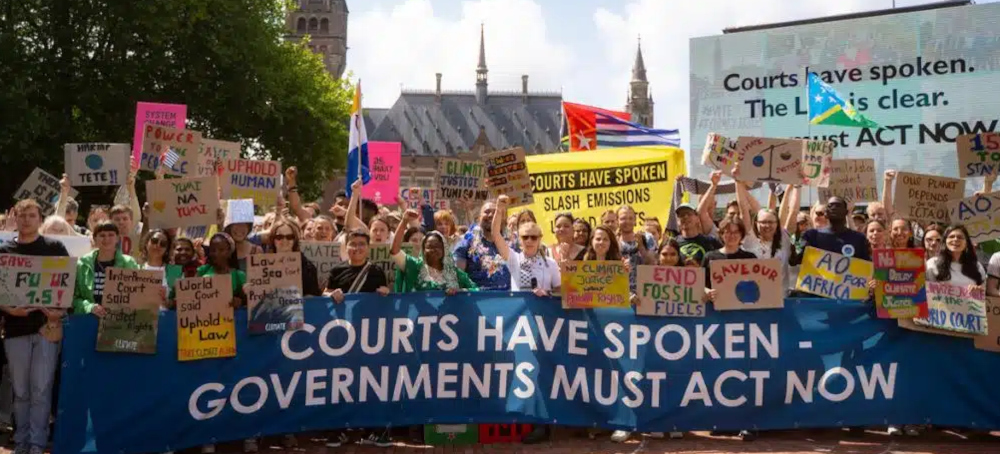 Demonstrations in front of the Peace Palace in The Hague ahead of the ICJ’s delivery of its advisory opinion on climate change on July 23, 2025. (photo: Greenpeace)
 Fossil Fuel Companies Intensified Hundreds of Heatwaves Worldwide This Century: Study
Martina Igini Earth.org
14 companies alone polluted enough to individually cause over 50 heatwaves, which scientists say would have been virtually impossible without climate change.
Researchers looked at 213 heatwaves that occurred between 2000 and 2023 across 63 countries. Using a well-established extreme event-based attribution framework, they first looked at how more intense and more likely these events were made by climate change. Then, they identified individual contributions from 180 major fossil fuel and cement companies—which they refer to as carbon majors— using these companies’ emissions data.
For the first time, individual companies were linked to specific, sometimes deadly heatwaves, such as the 2021 Pacific Northwest heat dome and the 2023 European heatwaves.
14 companies alone polluted enough to individually cause over 50 heatwaves, which scientists say would have been virtually impossible without climate change. These include Saudi Aramco, Gazprom, ExxonMobil, Chevron, BP, and Shell.
The Intergovernmental Panel on Climate Change (IPCC) has warned that human-caused climate change, which is primarily driven by greenhouse gases, has increased the frequency and intensity of heatwaves since the 1950s. Every heatwave in the world is now made stronger and more likely to happen because of human-caused climate change.
Heat is extremely dangerous for humans as it compromises physiological processes meant to keep the body cool, heightening the risk of heatstroke and other heat-related illnesses. It can be life-threatening if not promptly treated.
“We can now point to specific heat waves and say, ‘Saudi Aramco did this. ExxonMobil did this. Shell did this.’,” said Cassidy DiPaola, spokesperson for the Make Polluters Pay campaign. “When these companies’ emissions alone are triggering heatwaves that wouldn’t have happened otherwise, we’re talking about real people who died, real crops that failed, and real communities that suffered, all because of decisions made in corporate boardrooms.”
Global Warming Link
Half of global warming can be traced back to these 180 companies, according to the study, which was published Wednesday. The top 14 companies generated as many emissions as all the others combined. These include Former Soviet Union, China’s People Republic for coal, Saudi Aramco, Gazprom, ExxonMobil, Chevron, National Iranian Oil Company, BP, Shell, India for coal, Pemex, CHN Energy, China’s People Republic for cement and Petrobras.
This is not the first time that individual fossil fuel companies have been directly linked to climate change. In March, a study found that 36 major fossil fuel companies are responsible for over half of the world’s planet-warming carbon dioxide (CO2) emissions – among them Saudi Aramco, Coal India, ExxonMobil, Chevron and Shell.
CO2, a by-product of burning fossil fuels, biomass, land-use changes, and industrial processes such as cement production, is the principal anthropogenic greenhouse gas in the atmosphere, responsible for about three-quarters of planet-warming emissions. In spite of repeated appeals from the scientific community, global CO2 emissions from fossil fuels have increased by more than 60% since 1990, and atmospheric concentrations of CO2 are now 50% higher than before the onset of the Industrial Revolution.
Reparations
Lawsuits holding businesses, particularly fossil fuel companies, accountable for their role in climate change are on the rise globally and especially in the US. Claims range from damage contributions to greenwashing and insufficient climate risk management.
“Governments and companies are increasingly having to consider the legal ramifications of pushing ahead with oil or gas projects, as they risk being dragged through the courts,” said Catherine Higham, Senior Policy Fellow at the Grantham Research Institute on Climate Change.
In July, the International Court of Justice issued a “historic” advisory opinion on the responsiblity of countries in respect of climate change. The opinion also touches on companies’ responsibility, stating that fossil fuel production may be an internationally wrongful act that entitles victims to reparations.
For DiPaola, Wednesday’s report is “the evidence courts have been waiting for.”
“We can finally put a name and a number on who’s responsible for these disasters. The bill is coming due, and it’s time these polluters pay for the damage they’ve done,” she said.