
Forget the East Wing. The Real Demolition Has Only Just Begun.
Paul Goldberger The New York Times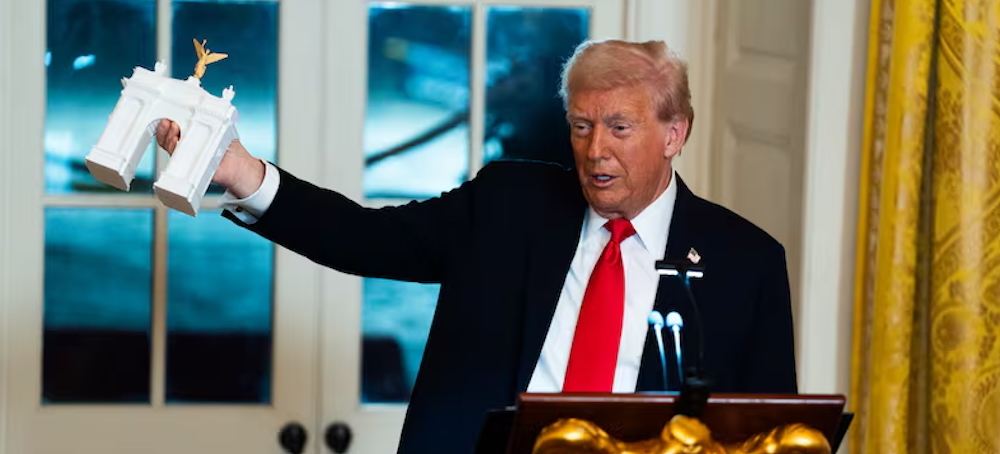 "The proposed 'Arc de Trump' in Washington is less a monument than a gaudy construction the height of a skyscraper." (photo: Getty Images)
 Forget the East Wing. The Real Demolition Has Only Just Begun.
Paul Goldberger The New York TimesChange is supposed to happen slowly and carefully in Washington, and there are systems in place to make that so. When the National Park Service said last week that the arch would not only block the vista between the Lincoln Memorial and Arlington National Cemetery but would also have an impact on 35 other Washington landmarks, it was a distressing preview of the administration’s attitude toward historic preservation. The Trump administration is in the process of making it much easier to demolish historic buildings and landscapes not just in Washington but nationwide.
The Park Service’s observations were made during a Section 106 review, which has been one of our most effective historic preservation tools for the past 60 years. The name is a reference to a clause in the National Historic Preservation Act of 1966. It requires that before approval is granted for any project that uses federal funds or could affect buildings or landscapes in the National Register of Historic Places, its impact on historic places must be evaluated and the public must be consulted. The Trump administration recently proposed changes that would render this type of review process impotent. If the changes go forward, the wanton destructiveness behind the arch and the East Wing ballroom will be just the beginning.
Section 106 has had a superb record of encouraging negotiation and compromise. It does not forbid change or even demolition, but it stipulates that efforts must be made to “avoid, minimize or mitigate” any harm to historic places. The very reasonableness of the law may be exactly what has led the Trump administration to be so determined to get rid of it. In the past few years in New York, Section 106 reviews have been a part of the process that has led to the saving of the T.W.A. terminal at Kennedy International Airport as well as the conversion of a portion of city’s main post office into the Moynihan Train Hall.
The proposed changes to Section 106 were issued by the Advisory Council on Historic Preservation. This is yet another of our government’s review organizations that has been filled with Trump appointees who have no sympathy for the subject on which they are expected to pass judgment. While the proposed changes do not technically eliminate Section 106, they eviscerate it.
If this new policy is enacted, it would extend the autocratic decision-making of Trump’s Washington fiascos to historic buildings and sites anywhere in the country. It is ironic indeed for the government to commemorate the nation’s 250th birthday by embarking on what Brent Leggs, the chief executive of the National Trust for Historic Preservation, has called “an unprecedented and deliberate attack on our civic and cultural inheritance.”