
For Exiled Uyghurs, UN Report Is Long-Awaited Vindication
Dake Kang Associated Press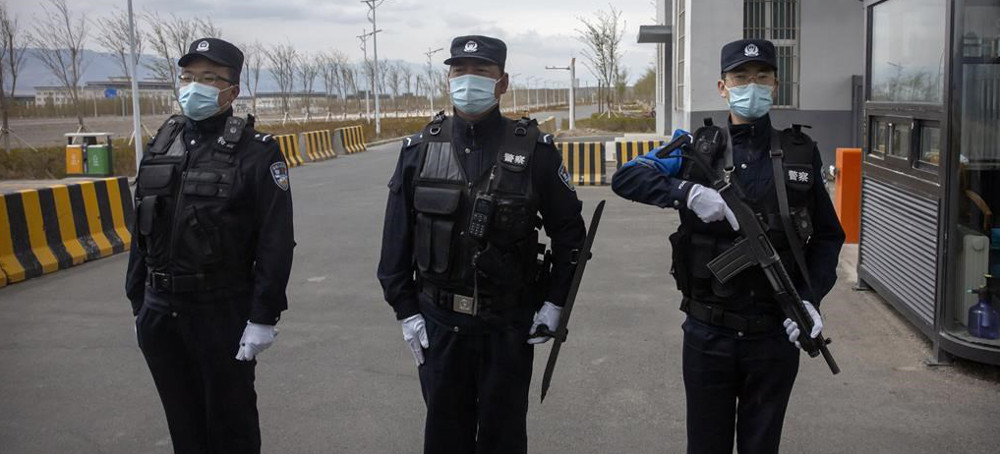 Police officers stand at the outer entrance of the Urumqi No. 3 Detention Center in Dabancheng in western China's Xinjiang Uyghur Autonomous Region, April 23, 2021. (photo: Mark Schiefelbein/AP)
For Exiled Uyghurs, UN Report Is Long-Awaited Vindication
Dake Kang Associated PressBeijing has spent years trying to control the narrative, vilifying people who have spoken against the crackdown while organizing tours and news conferences promoting its position. State media have interviewed Xinjiang residents who denounced accusations against the Chinese government as lies, though evidence shows that such statements are often scripted and coerced.
Many camp survivors faced years of threats by Chinese police in attempts to silence them, leaving them with a stark choice: speak out and face the consequences, or stay quiet to protect their loved ones.
Dawut made her choice on a fateful Friday in New York three years ago. That day, she was on her way to the United Nations to share her story for the first time when she got a call.
It was her brother, telling her that the police had come for their father and urging her not to speak. She froze with fear.
“But I thought of so many fathers and mothers in the camp, how I needed to speak up for them,” she said. “I thought, I will not change my mind. I will go.”
The consequences were immediate. Relatives in Xinjiang blocked her calls and texts. Two weeks later, an ex-neighbor called, saying her father had died while in police custody. The exact circumstances are unclear.
Now, Dawut said, it was all worth it.
“I felt like I did the right thing,” she said. “I am walking the path of truth.”
The U.N. report corroborated different aspects of the crackdown reported over the years, including forced labor, pervasivesurveillance, family separations and coercive birth control measures.
But the focus of the report was squarely on the mass detentions. The rights office said it could not confirm estimates that a million or more people were detained in the internment camps in Xinjiang, but that it was “reasonable to conclude that a pattern of large-scale arbitrary detention occurred” at least between 2017 and 2019.
Interviews and AP visits to the region show that China appears to have closed many of the camps, which it called vocational training and education centers. But hundreds of thousands of people continue to languish in prison on vague, secret charges, with leaked data showing one county in Xinjiang has the highest known imprisonment rate in the world.
Among those who fled Xinjiang, there was a palpable sense of relief, as they had worried that the U.N. report would be suppressed or watered down. U.N. High Commissioner for Human Rights Michelle Bachelet had said little after visiting Xinjiang on a government-organized tour in May, prompting criticism and concern from Uyghur groups.
Dina Nurdybay, an ethnic Kazakh who spent almost a year in detention, said she was worried when she heard Bachelet had visited Xinjiang at Beijing’s invitation. Nurdybay said she had been forced in the camps to sing and dance for journalists and officials, parrot propaganda and pretend life was great there. She worried that outside investigators would be tricked.
“It’s all lies,” she said. “You think it’s voluntary?”
Now, she said, she hopes the U.N. will help people like her escape harassment and live in peace. Every time she speaks to journalists, she said, Chinese police haul away her uncle and interrogate him for days at a time, telling him he should make her “shut up.”
Mihrigul Tursun, who testified about the camps before the U.S. Congress in November 2018, said the price she paid for speaking out was constant threats to her safety and a state-sponsored smear campaign. She’s been called a liar, followed by cars, photographed at restaurants by strangers. She is now under FBI watch, she said, after men dressed in hoodies broke her window and slipped a threatening letter under her door, forcing her to move seven times.
Before she went public, she spent sleepless nights sobbing, pondering whether to speak out. If she did, she knew she could never go back home, that she might never see her parents again.
But she remembered the women held in the cell with her. They had sworn an oath together: Whoever made it out would speak out about what they had witnessed inside, no matter the consequences.
“I feel like a dead person. They killed my dreams, they killed my hopes. I lost everything when I was in the camps,” Tursun said. “But today I feel a little better, because all that hard work has born some fruit.”
But, she added, the report is just the beginning. She won’t be satisfied, she said, until all the detention facilities are closed.
“We need results, we need action,” she said. “I need to know after the U.N. report, what can we do after that?”