
Florida Clears Groveland Four of 1949 Rape of White Woman
Terry Spencer Associated Press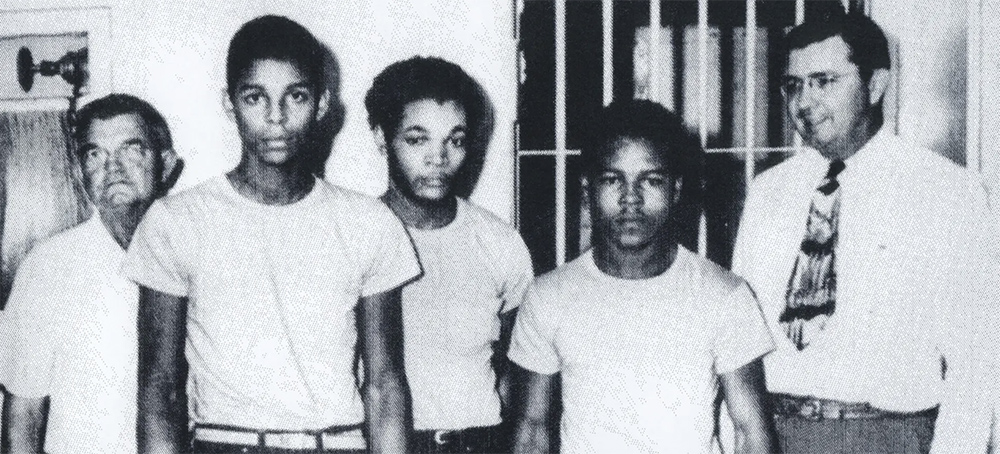 Reuben Hatcher, the jailer at left, stood with Charles Greenlee, Samuel Shepherd and Walter Irvin, three of the four men known as the Groveland Four, in August 1949. At right is Sheriff Willis McCall, who later shot Mr. Shepherd and Mr. Irvin. (photo: Gary Corsair)
Florida Clears Groveland Four of 1949 Rape of White Woman
Terry Spencer Associated PressKing said having the men exonerated in the same building where the trials were held was “of significant importance because upstairs there was a courtroom where 72 years ago (an) abomination of justice took place." He praised Gladson for pursuing justice.
“He could have easily kicked this case down the road and let someone else deal with it,” King said. “Even when it got frustrating and he felt there was no path toward this day, he dug in harder.”
Marshall Jr. said that, perhaps more than any other case, the Groveland Four “haunted” his father.
“But he believed better days were ahead,” Marshall Jr. said.
The Florida Legislature in 2017 formally apologized to the men's families. Gov. Ron DeSantis and the state’s three-member Cabinet granted posthumous pardons more than two years ago. In 2018, then-Florida Attorney General Pam Bondi directed the state Department of Law Enforcement to review the case. Earlier this year, the agency referred its findings to Gladson for his review.
Gladson and an investigator interviewed the grandson of Jesse Hunter, the now-deceased prosecutor of two of the Groveland Four defendants. According to the grandson, Broward Hunter, his grandfather and a judge in the case knew there was no rape.
The grandson also suggested to Gladson, based on letters he found in his grandfather’s office in 1971, that Willis may have shot Shepherd and Irvin because of the sheriff’s involvement in an illegal gambling operation. Shepherd was believed to be involved with the gambling operation too, and Willis might have seen a rape case as a “a way to get some people that were on his s— list,” Hunter told the prosecutor and investigator.
Gladson also said that James Yates, a deputy who served as a primary witness, likely fabricated evidence, including shoe casts.
The prosecutor also had Irvin’s pants sent to a crime lab in September to test for semen, something that was never done at Irvin’s trial, even though jurors were given the impression that the pants were stained. The results showed no evidence of semen, the motion said.
“The significance of this finding cannot be overstated,” Gladson said in his motion.