
Evan Gershkovich Is Finally Coming Home
Joshua Yaffa The New Yorker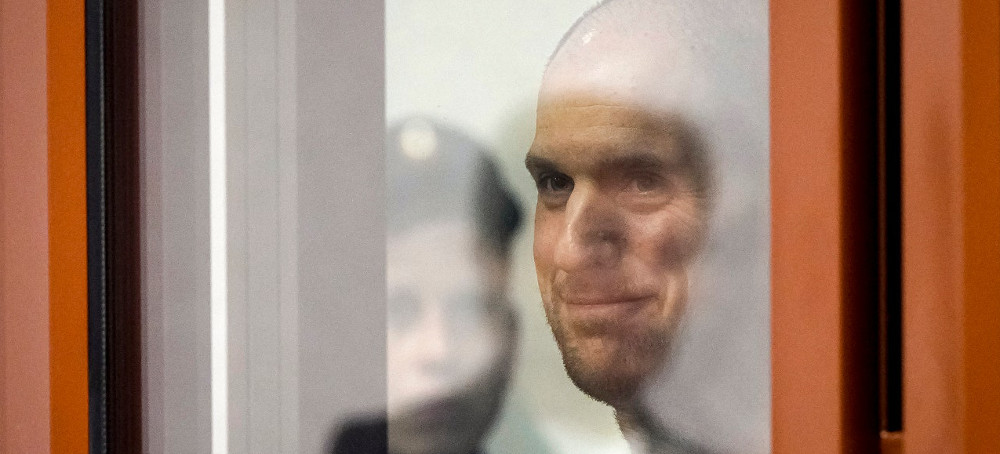 Wall Street Journal reporter Evan Gershkovich. (photo: Dmitri Lovetsky/AP)
 Evan Gershkovich Is Finally Coming Home
Joshua Yaffa The New Yorker
In a multinational prisoner exchange, the Wall Street Journal reporter was freed, after being detained for more than a year in Russian jail.
The events of Thursday were no less dramatic. Evan was flown on a Russian government plane to an airport in Ankara, Turkey, and then escorted across the tarmac and onto a flight to the U.S. Onboard another flight, headed to Germany, was Vladimir Kara-Murza, a longtime Russian-British activist and politician and a Washington Post contributor, who had spoken widely in the West about the need to confront the Kremlin and who was serving a twenty-five-year prison term; Oleg Orlov, one of the leaders of Memorial, Russia’s premier institution devoted to historical memory and the crimes of the Stalin era, which was dissolved by a Russian court in 2022; Ilya Yashin, among the last opposition politicians to stay in Russia after the invasion of Ukraine; and Sasha Skochilenko, an artist from St. Petersburg who, in the early days of the war, replaced supermarket price tags with stickers describing the horror of Russia’s war effort in Ukraine. (“The Russian army bombed an art school in Mariupol,” one read. “Around four hundred people were hiding inside.”) Three former coördinators for Alexei Navalny’s political movement were also freed, as was the youngest person ever convicted of treason in Russia: Kevin Lik, a teen-ager from a city in the North Caucasus, in southern Russia.
In exchange, the U.S and Germany, along with a number of other European countries, agreed to free a collection of Russian spies, fraudsters, and alleged smugglers. The most notorious among them is the convicted Russian assassin Vadim Krasikov, who, in 2019, shot a former Chechen separatist fighter in Berlin’s Tiergarten park. The open-source investigative outlet Bellingcat linked Krasikov to an élite unit inside the F.S.B., the Russian security service. In court, German prosecutors said that the Russian state was behind the assassination; Krasikov was issued a life sentence, after a court ruled that he was guilty of a “state-contracted killing.”
Freeing Krasikov had become something of an idée fixe for Putin ever since. In his interview with Tucker Carlson, this past February, Putin cited Krasikov in all but name when Carlson pushed him on freeing Evan. “Let me tell you a story about a person serving a sentence in an allied country of the U.S.,” Putin told Carlson. “That person, due to patriotic sentiments, eliminated a bandit in one of the European capitals.” He added, “We are ready to talk.” Putin’s offer was clear: Evan goes home when Krasikov does.
That was never going to be easy. After all, why should the German government agree to release a murderer convicted of one of the more shocking political killings in the country’s modern history in order to free an American journalist held in a Russian prison? In Putin’s world view, however, countries like Germany don’t have their own autonomous, sovereign geopolitical interests—European capitals are effectively vassals to an omnipotent Washington. Putin likely thought that President Joe Biden could readily convince, if not instruct, the German Chancellor, Olaf Scholz, to release Krasikov in exchange for Evan.
Things became even more complicated after the sudden death of Navalny, in February. Reporting quickly emerged that talks involving German, Russian, and U.S. officials had begun, about the contours of a possible trade, with the German side wanting any deal to include Navalny, who was then being held in a prison colony above the Arctic Circle. Not only was Navalny the signal political prisoner in Russia but, after he was poisoned by Russian agents, in 2020, he made his recovery while living with his wife and two children in Germany. He had become a recognizable and popular figure in the country.
Navalny’s allies claim that an impending trade had convinced Putin to eliminate Navalny. Maria Pevchikh, the head of Navalny’s political foundation, posited that Putin couldn’t tolerate the idea of Navalny’s freedom, and moved to “get rid of the bargaining chip.” Neither Pevchikh nor any of Navalny’s other allies presented evidence to confirm the specificity of this account. But, as the Financial Times reported back in February, “Germany’s appetite for a potential deal with the Kremlin to swap a Russian hitman in a prisoner exchange has cooled markedly.”
That is one reason why so many prisoners and countries were involved in the trade: besides the U.S. and Germany, alleged Russian intelligence operatives were returned from custody in Norway, Poland, and Slovenia. After the death of Navalny, such a large multiparty swap was the only way for all sides to feel that they had got something of sufficient value in the exchange.
The Biden Administration, for its part, wanted the release not only of Evan but also of Paul Whelan, a former U.S. marine and corporate-security manager in his mid-fifties who, in 2018, was arrested in an F.S.B. sting operation in a Moscow hotel room. The White House knew that, for all the fanfare around freeing Brittney Griner, the W.N.B.A. star imprisoned in Russia on drug charges, in a trade for the Russian arms dealer Viktor Bout, in 2022, they had left someone behind: Whelan. Bringing him and Evan, who was arrested in March of 2023, home was a matter of Biden’s legacy, a feel-good foreign-policy win in the final months of his Presidency.
Germany likely continued to push for a deal that would free not only American citizens but also high-profile Russian dissidents and political prisoners. According to The Insider, an investigative outlet, German officials insisted on a departure from the way in which Putin has historically conducted exchanges—of one for one—instead demanding multiple political prisoners at once for Krasikov. Now, if Scholz and his administration face questions about why they released a state-backed assassin like Krasikov, they can point to the international resonance of figures like Orlov and Kara-Murza, both of whom recently suffered deteriorating health in Russian penal colonies.
For Putin, gaining leverage was the whole point of arresting Evan in the first place: he doesn’t need him and Whelan indefinitely imprisoned; he sees them as bargaining chips (another word might be hostages). So, even when relations between the U.S. and Russia are at their worst, most antagonistic level in decades, Putin is always ready to use his “exchange fund,” as it’s known in Russian, especially when he sees the chance to bring back Russian assets, many of whom, given Putin’s own background in the security services, occupy a privileged position in his view.
In recent months, Donald Trump had boasted that he was singularly capable of freeing Evan. In May, Trump said that Evan would be released “almost immediately” if he were elected President in the fall. In a post on Truth Social, Trump wrote, “Vladimir Putin, President of Russia, will do that for me, but not for anyone else, and WE WILL BE PAYING NOTHING!” Trump repeated the claim during his debate with Biden in June.
In fact, Putin and the political establishment in Moscow are wary of Trump. He spent his first term talking up his solicitous attitude toward Russia and how he alone could fix the U.S.-Russia relationship—and then nothing much happened, as far as the Kremlin was concerned. The U.S. introduced more sanctions, expelled Russian diplomats and spies, and supplied Ukraine with antitank weapons after the Obama Administration had declined to do so.
One can imagine Putin thinking that the best window for concluding a complicated and sensitive diplomatic deal was not with Trump in office but, rather, with Biden about to leave it. And, for Putin, the notion of the U.S. “paying nothing” for Evan’s release was unthinkable, a non-starter. Better to do business with the devil you know—and, at the same time, send a signal to everyone in Washington and other Western capitals that you’re ready to negotiate if your interests are taken into account. Putin may wager that this message could somehow set the mood for negotiations over ending the war in Ukraine. (On that point, he may find himself disappointed: for the West, the idea of, say, releasing Krasikov is light-years away from the concept of cutting off support for Ukraine.)
It would be journalistically dishonest of me to pretend that anything in this prisoner story, however, concerned me as much as the fate of Evan. I met him shortly after he arrived in Moscow, in 2017, and immediately envied his easy sociability, his eye for the unusual but resonant story, and the way he made friends and contacts in so many disparate places and social circles. He was an energetic reporter, driven by a deep affection and curiosity for Russia—a country, as I wrote after his arrest, “that can surprise and disappoint you, even as it holds your attention.” His detention certainly did exactly that. Not only did it represent a sharp break from decades of precedent, in which foreign correspondents occupied a relatively protected status in Russia, but I was left with the knowledge that a person I cared about deeply woke up in a cell in Moscow’s Lefortovo Prison.
Lefortovo was designed around the principle of isolation and psychological pressure: you take your meals in your cell, go alone for an hour of exercise each day, and even have to turn and face the wall in the corridor if guards are escorting another prisoner. Despite all of that, Evan, from what I could tell in the letters we exchanged, kept up his spirits. He did pushups, meditated, read many books, and asked about the most picayune details and pieces of gossip from the outside. His case was classified as secret, so his friends and supporters never learned what precisely happened in court, but we saw pictures of him smiling and making a heart with his hands. To say I was impressed would be as much of an understatement as calling his prolonged imprisonment an injustice.
The past year and a half was marked by a certain unavoidable, maddening feeling of powerlessness. In March, on the one-year anniversary of Evan’s arrest, I joined a number of friends and colleagues in Berlin, in front of the Brandenburg Gate, and unfurled a large banner that read, in capital letters, “FREE EVAN.” It provided a moment of cathartic release, and an occasion for a small fraction of the many people who care about Evan to come together—but it was hard to convince ourselves that he was any closer to being released as a result. That feeling swelled last month, when Evan’s secret trial concluded with a guilty verdict and a sixteen-year sentence. He was a hostage who would be released only when his hostage-takers decided that his freedom was worth more to them than his continued imprisonment.
Yet it’s equally true that Evan’s ordeal should never have happened. Today, I’m simply glad that he is on his way home. He arrived in Russia with aspirations of becoming a foreign correspondent. He’s leaving as an example of dignity, bravery, and heroism. I look forward to telling him the same in person soon.