
EU Votes in Support of Nuremberg-Style Tribunal for Russia
Chris Powers Kyiv Independent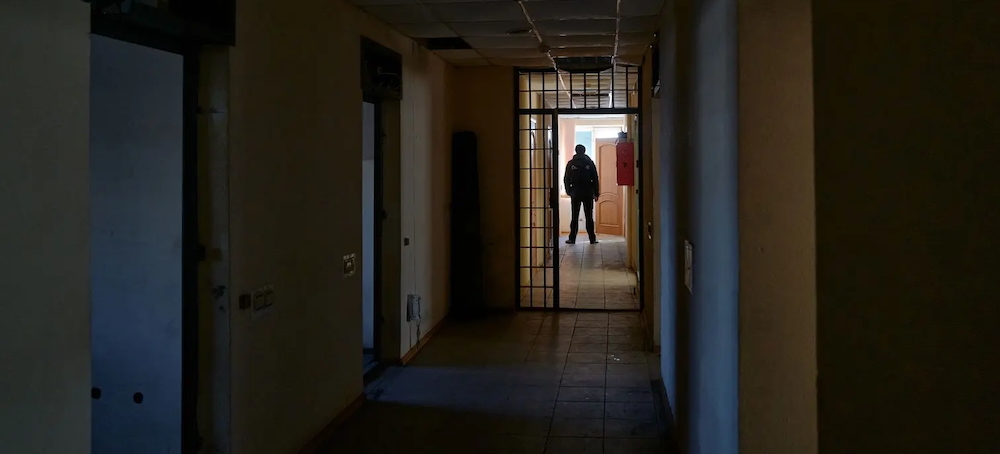 Officers of the War Crimes Prosecutor's Office and police officers investigate war crimes committed by the Russian occupying forces on the local civilian population in the basements and rooms of Ukrainian penitentiary buildings on Jan. 4, 2023, in Kherson, Ukraine. (photo: Pierre Crom/Getty Images)
 EU Votes in Support of Nuremberg-Style Tribunal for Russia
Chris Powers Kyiv Independent"This is a significant and long-anticipated step forward," Iryna Mudra, deputy head of the president's office, told the Kyiv Independent, adding that the EU's decision "marks the transition from conceptual design to the final phase of institutional establishment."
The Special Tribunal being set up will prosecute Russia for the same crime of aggression that Nazi German leaders were found guilty of in the Nuremberg trials at the end of World War II.
The Special Tribunal plays an important role because no other court has a legal mandate to prosecute the international crime of starting a war of aggression.
Legal scholar Philippe Sands already advocated in 2022 for a special tribunal to hold Russia accountable for the same crime, which was agreed on in principle by the Council of Europe in May 2025.
Following that, efforts to operationalize the special tribunal commenced. The Netherlands expressed its interest in hosting the court, and the EU provided funding to support evidence-gathering and other preparatory work ahead of the tribunal's full establishment.
"We are now moving from years of legal and diplomatic work into the stage where the operational architecture of the tribunal is being formally launched," Mudra said. She added that the goal is to ensure accountability is "not abstract, but legally enforceable."
Once up and running, key Russian leadership figures, including Russian President Vladimir Putin, will face charges. It is also possible that the court's remit could go beyond Russia and include other countries that have joined Moscow's war against Ukraine, such as Belarus and North Korea.
"It reflects a shared understanding among partners that the highest political and military leadership responsible for the decision to wage war must face justice under international law," Mudra said.
The tribunal already has significantly more than the 16 backers required to make it a reality, which means that the Council of Europe will be able to announce concrete progress when foreign ministers of the 46 member countries meet in the Moldovan capital of Chisinau on May 15.
"Justice is an indispensable element for lasting peace," Mudra said.
"At this stage, our focus is on maintaining momentum and translating political commitments into a functioning judicial mechanism," she added. "After years of work, the tribunal is becoming a reality."
The Ukrainian government expects that the special tribunal will be fully operational in 2027.