
Ending the Surge in Minnesota Isn’t Enough
Ben Burgis Jacobin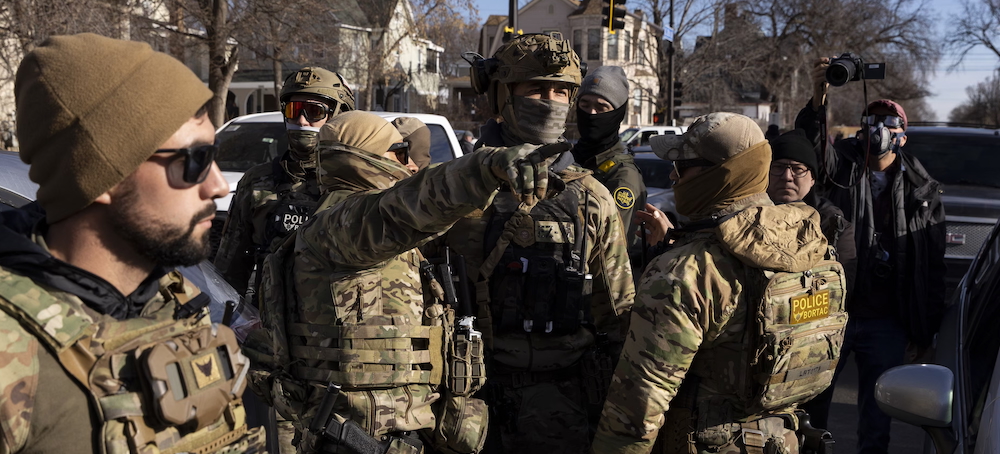 Federal agents clash with community members during the ongoing immigration raids in Minneapolis, Minnesota, on 12 January 2026. (photo: Anadolu/Getty Images)
 Ending the Surge in Minnesota Isn’t Enough
Ben Burgis Jacobin
It’s good that the federal occupation of Minnesota is ending. But the Trump administration shouldn’t be allowed to pretend it never happened. Justice would require a wave of impeachments, criminal charges, and restitution to the people of the Twin Cities.
Some Minnesotans are understandably cautious. The administration’s decisions about any given issue can and do change from day to day and even hour to hour. If Homan does turn out to be true to his word in this case, though, it’s good that the operation that has terrorized the Twin Cities for months is finally coming to an end. It’s just nowhere near good enough.
After everything that’s happened since “Operation Metro Surge” started on December 4, achieving even the bare minimum of justice would mean serious efforts to repair the damage and bring the people who inflicted it to account.
What Was Operation Metro Surge?
Minnesota is very far from the Mexican border. It was chosen for a theatrical performance of the Trump administration’s anti-migrant fervor in large part because of a welfare fraud scandal that was flatly irrelevant to the stated mission of either ICE or the Border Patrol, since almost everyone involved was a US citizen.
It’s likely that another contributing factor was Trump’s antipathy toward various Minnesota politicians like Governor Tim Walz and Rep. Ilhan Omar. Trump is so obsessed with Omar that he railed against the congresswoman in his speech at the World Economic Forum in Davos. And any doubt that this authoritarian show of force was motivated by considerations unrelated to immigration enforcement was removed by a January 24 letter to Walz from Attorney General Pam Bondi, where she held out the possibility of ending the operation in exchange for unrelated concessions like handing over the state’s voter rolls for federal examination.
Metro Surge involved thousands of agents being deployed to a place with very few unauthorized immigrants. With clear targets thin on the ground, they often resorted to asking random people for their papers. Sometimes, when papers were produced, agents didn’t seem to care.
Selamawit Mehari, for example, is a mother of three from Eritrea who was in the United States legally. Her twenty-one-year-old daughter, Yosan, tried to show the agents her mother’s paperwork, but they ignored her. Mehari was at a detention center in Texas by the time her legal status had been recognized, at which point she was released to find her own way back to Minnesota.
She’s far from alone. Agents seemed far more concerned with meeting daily arrest quotas than making sure they were targeting people who’d broken immigration laws. At times, ICE agents had so little to do within the limits imposed by normal procedures that they went around blatantly demanding that Minnesotans tell them the ethnicity of their neighbors.
This level of heavy-handed stupidity and cruelty predictably inspired widespread outrage, often from people who’d never been active in protest movements before. Residents of neighborhoods around the Twin Cities coordinated through Facebook groups and Signal group chats to track what agents were doing so they could meet up to protest them by shouting slogans or blowing whistles or monitor them with cell phone cameras to document possible abuses.
These activities are entirely and unambiguously legal. While various Trump administration officials have repeatedly insisted otherwise, citing concerns about “doxing” agents by filming them, it would probably take a constitutional amendment to take away these rights. Nevertheless, the last two months have seen a nonstop parade of incidents in which Minnesotans were physically attacked, arrested, had their cars vandalized by agents, or were threatened with having their names placed in a “database” of “domestic terrorists” for exercising their basic prerogatives as citizens of a democracy where the activities of the state are supposed to be transparent to the public.
And in two cases, American citizens were killed by federal agents. On January 7, Renée Good was shot and killed behind the wheel of an SUV as she tried to drive herself away from the scene of a confrontation. We have a number of videos of the confrontation, and frame-by-frame analyses by various news outlets quickly made nonsense of any possible self-defense claim. Good, whose glove box was overflowing with children’s toys, was clearly attempting to steer away from the killer, who had stepped in front of her vehicle and drawn his gun as other masked agents yanked at her car door.
Even without such analysis, common sense should tell us that killing a driver while standing directly in front of their vehicle does nothing to change that vehicle’s course, and that there’s no possible scenario where stepping aside while shooting — which is what the agent actually did — somehow makes the killer safer than stepping aside without shooting. The fatal bullet appears to have been fired through Good’s driver’s side window when the agent, Jonathan Ross, was indisputably in the clear.
The murder of Alex Pretti two and a half weeks later was, in some ways, even more clear-cut. Pretti, an Intensive Care Unit nurse at a veterans hospital, was actually shot in the back in a scene reminiscent of an execution carried out by a paramilitary squad in a Third World dictatorship. Desperate for something, anything, to justify the killing, the Trump administration and the right-wing media machine seized on the fact that Pretti had a gun.
He had a legal concealed-carry permit, he never took the gun out or brandished it in any way, and he’d been disarmed in any case before he was killed — but none of this stopped previously Second Amendment–loving American conservatives from doing a 180 and treating the presence of the gun as evidence that Pretti posed a threat that could only be neutralized by taking his life. Openly displayed guns have been a common feature of the Right’s own protests for a very long time, but this, too, was immediately forgotten.
In both cases, Homeland Security secretary Kristi Noem, whose department includes both ICE and the Border Patrol, smeared the victims as “domestic terrorists.” In Pretti’s case, she went as far as to claim, with no evidence of any kind, that he had been planning to carry out a “massacre.”
What Needs to Happen Now
ICE was created in 2003 as a more aggressive and militarized replacement for the old Immigration and Naturalization Service (INS). Under the second Trump administration, it’s turned into something qualitatively worse and more dangerous, a masked paramilitary force that openly recruits angry racists without vetting them.
ICE is such a recent addition to the American state that disbanding it outright would simply return us to the pre-2003 status quo. That’s exactly what should happen. And any remotely defensible version of the Border Patrol needs to confine its activities to actually patrolling the border.
Putting aside these larger issues, though, Trump, Noem, and Homan shouldn’t be allowed to simply draw down an operation that had proven to be a catastrophe for the administration’s public support and pretend that the whole thing never happened. At a bare minimum, Noem would be impeached, the killers of Pretti and Good would stand trial, and serious financial restitution would be paid out to all the Minnesotans who were brutalized, harassed, or arrested for exercising their constitutional rights.
This, at any rate, is what would happen in an even minimally functional democracy. Whatever we’ve currently got looks less like one of those with every passing day.