
Earth’s Greatest Underwater Migrations Are Disappearing
Johnny Sturgeon Inside Climate News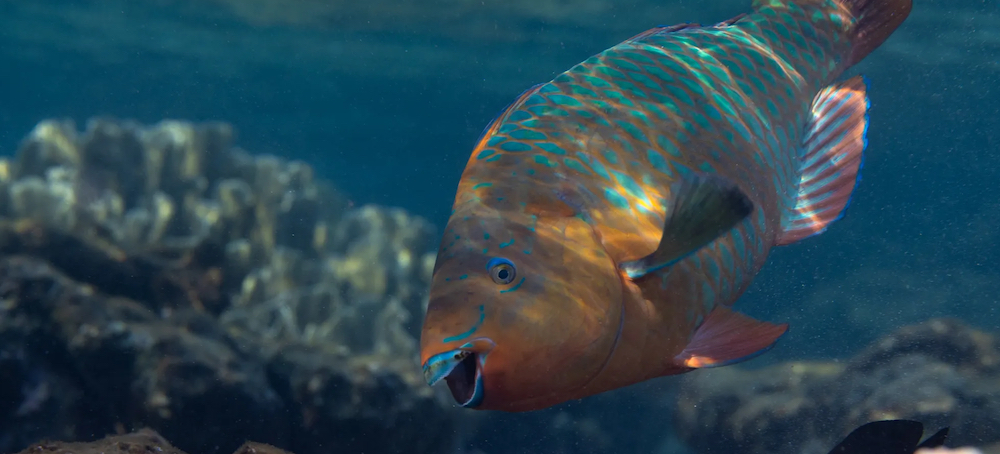 A parrotfish. (photo: Jenny Adler/Vox)
 Earth’s Greatest Underwater Migrations Are Disappearing
Johnny Sturgeon Inside Climate News
From the Amazon to the Mekong, migratory freshwater fish underpin food security for millions, but over 300 species need urgent conservation intervention, warns a new UN report.
Facing existential threats along their migratory paths, an ecological collapse is taking place largely out of sight.
Declining faster than many terrestrial populations, 325 migratory freshwater fish species have been identified as candidates for urgent conservation efforts by the United Nations’ Convention on the Conservation of Migratory Species of Wild Animals (CMS). These populations—critical for river health and economic output—have already declined by over 80 percent since 1970.
This week, ambitious international safeguarding efforts will be unveiled at CMS’ 15th annual meeting, or COP15, in Campo Grande, Brazil, marking a pivotal moment for a historically overlooked environmental crisis.
“Migratory freshwater fishes are among the most imperiled migratory animals on Earth,” CMS Executive Secretary Amy Fraenkel said in an email. “For some species, the declines have already been devastating.”
Underpinning some of the world’s largest inland fisheries, migratory freshwater fish sustain hundreds of millions of people both economically and as a primary source of protein. Despite being key to maintaining river health, their populations are collapsing from Europe’s Danube to South Asia’s Ganges–Brahmaputra–Meghna river basin.
Building on the original 2011 CMS review, the new report analyzed global datasets and stock assessments of nearly 15,000 species.
Facing accelerated decline from dam construction, overfishing, pollution, climate-driven flow changes and habitat fragmentation, many species are increasingly unable to make the journeys from spawning grounds, to feeding areas, to floodplain nurseries. With almost half of Earth’s rivers being shared by two or more nations, cross-border cooperation will be key to conservation success, notes the report.
“We have migrations that in terms of biomass rival the great migrations across the Serengeti,” said Zeb Hogan, lead author and research professor at the University of Nevada, Reno. “That same thing is happening underwater and you could stand on the bank of the river and not know that was occurring.”
Migratory freshwater fish, less visible than birds, land animals, or other large marine mammals, have historically received little attention despite their decline. “This crisis has escaped global attention partly because it is taking place underwater,” said Fraenkel. “In river systems that are not what comes to mind when one thinks about animal migrations.”
The report identifies priority river basins in South America, Europe, Africa and Asia, alongside eel corridors connecting small island states in Oceania. In Asia alone, a hotspot for at-risk fish, 205 species were identified as being in need of urgent conservation efforts.
Asia’s Mekong Basin, for example, spans six countries and over 2,700 miles from the Tibetan Plateau to the South China Sea. Producing 15 percent of the world’s inland catch, it is the largest inland fishery on the planet. However, the fishery’s annual economic value has reduced from $11 billion to around $8 billion in recent years as stocks plummet, said Hogan.
“It’s $3 billion, hundreds of thousands of tons of fish that would support millions of people. That’s the kind of loss we’re talking about,” he said, highlighting the critically endangered status of the Mekong giant catfish as an example of the collapse.
Meanwhile, along the Amazon, 20 migratory freshwater fish meet the criteria for CMS Appendix II listing—a formal acknowledgement that species would benefit from international cooperation before it is too late. Collectively, these species account for 93 percent of landings and underpin a fishery valued at $436 million.
Among the Amazonian species being added to the CMS listing is the dorado catfish, which has the longest life cycle migration of any freshwater fish. The bottom-dweller, known for its sleek gold-silver body reaching more than six feet in length, journeys over 6,800 miles from the Andean headwaters to coastal nurseries—a distance increasingly disrupted by manmade infrastructure.
At CMS COP 15 this week, Brazil and other regional governments are expected to propose the “Multi-species Action Plan for Amazonian Migratory Catfish.” The plan recognizes “the exceptional ecological, cultural and economic importance of migratory catfish in the Amazon Basin,” and seeks international collaboration between fisheries, energy infrastructure officials and water authorities.
“Cooperation between countries that share rivers is both urgently needed and genuinely possible,” said Fraenkel. With COP15 hosted in Brazil—home to both the Amazon and the Pantanal, the world’s largest tropical wetland—Fraenkel believes momentum is building for migratory freshwater fish.
Hogan, who readily admits he is used to working against a backdrop of decline as a conservation biologist, hopes to avoid “shifting baselines” and policy makers simply accepting a degraded environment as the new norm.
“We shouldn’t be self-limiting in the way that we think about this,” he said. “We should be open-minded about the possibilities and keep everything on the table.”