
Donald Trump’s Lose-Lose Negotiations with Iran
Isaac Chotiner The New Yorker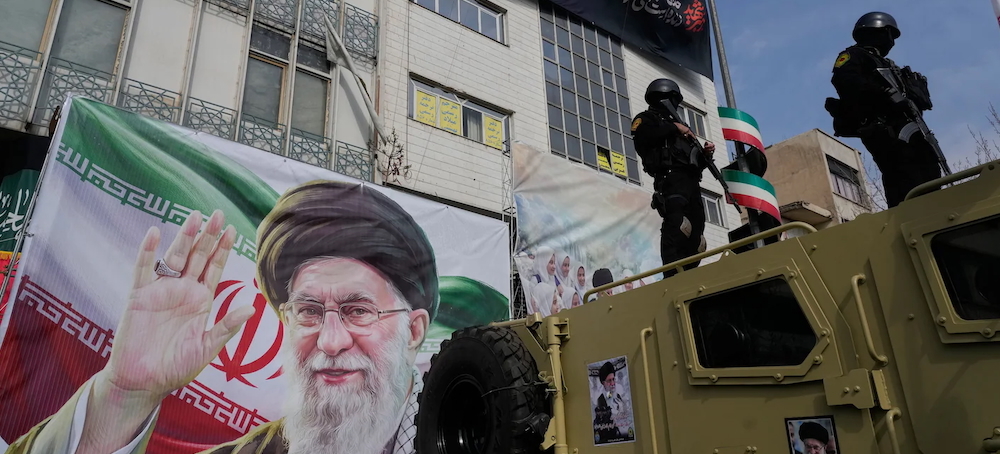 Policemen watch over a rally for Ayatollah Mojtaba Khamenei as participants hold banners depicting his father, the late Ayatollah Ali Khamenei, in Tehran. (photo: Vahid Salemi/AP)
 Donald Trump’s Lose-Lose Negotiations with Iran
Isaac Chotiner The New Yorker
How the President’s insistence on Tehran’s unconditional surrender made it impossible to make a deal.
I recently spoke by phone with Ali Vaez, the director of the Iran Project at the International Crisis Group. During our conversation, which has been edited for length and clarity, we discussed what’s really keeping the two sides from reaching a deal, how the leadership of the Iranian regime has changed since the killing of Ayatollah Ali Khamenei, and why this war is likely to continue being a lose-lose situation for both sides.
As time ticks on without a formal end to the war, and we continue with some version of a ceasefire, how do you see the situation changing? With each day that passes, what is actually changing for either side, if anything?
I think the ceasefire is inherently unstable because both sides are constantly testing each other’s limits and, in a way, escalating the conflict. The double blockade actually creates a pretty tenuous situation because every interdiction, every warning shot, every seizure of vessels, could become a trigger for a wider relapse into conflict. And the reality is that this is a high-stakes game of chicken, in which both sides are hoping that the economic pressure will force the other side to blink first.
On the Iranian side, they are facing challenges in terms of limited storage capacity for their oil production. And the problem Iran has, which is quite peculiar in a way, is that, because there hasn’t been a lot of investment in Iranian energy infrastructure over the years, if they are forced to shut down their production they might not be able to revive it. But they had boosted sales of their oil to China in anticipation of a potential blockade. So economically, they have enough cushion for two to three months to be able to withstand the blockade.
The New York Times said three to six months was their estimate for how long Iran could survive easily enough. You think it’s potentially less than that?
Yeah, I think two to three months, because there are other challenges as well. They have storage of basic staples, et cetera, but all of that is quite limited, and some of that capacity was actually damaged or impacted during the war. So I think the timeline is shorter, but the issue is that the Iranians believe that the American timeline is even shorter than that. In other words, if the timeline is measured in two to three months for the Iranians, they believe that it is measured in two to three weeks for President Trump. And that’s not just because he’s not a patient man but because continued disruption of the energy markets will start showing its effects in the coming days and weeks. For instance, you see that a lot of airline companies are basically cancelling flights because they only have limited jet fuel, and they’re starting to run out.
And the dwindling supply of oil applies to a lot of other petrochemical companies in Asia, and so on. So the pain on the international economy, which obviously is interlinked to the political cost that President Trump is paying at home, would increase exponentially in the coming days. And that’s why the Iranians believe that they have a better chance of withstanding the pressure than the U.S. does.
Do you agree with their analysis?
I think the problem with this kind of analysis, in general, is the expectation of what the end result could be for both sides. If the expectation is that the Iranians would, after two to three months, capitulate to the U.S.’s terms, I think that’s never going to happen, regardless of the status of Iran’s economy or how much pain they have absorbed by that point. And by the same token if, per Iran’s expectation, the U.S. is to blink first, it is still not going to give Iran a lot of the things that Iran expects the U.S. to concede on. So, at the end of the day, neither side is likely to fold on the economic pressure anytime soon. And that’s why both sides would have to return to the table, show flexibility, and accept a compromise, which is why this game of chicken is so futile. In addition to being dangerous, it’s just so futile because there is no way other than America accepting a degree of uranium enrichment in Iran, and the Iranians accepting that the U.S. is not going to give them a lot of the things that they want, including control over the strait.
Although in a way, they already have that.
I mean making it official; that’s what they want. And my understanding is that, in Islamabad, what the U.S. position has been is that either there’s freedom of navigation for all, or there is a tolling system that the U.S. is involved in, mirroring what the President had said publicly. So it is not inconceivable that there might be some kind of compromise that would see a consortium running the strait and charging tolls for a period of time, and those funds could be used for recovery from this war for countries on both sides of the Gulf.
To return to Iran: Even if things do get really dire in Iran, is that really going to matter to the regime, which doesn’t care about the Iranian people? They were shown several months ago that if they rise up they’re going to be massacred en masse.
I think that’s absolutely right. This is why I’m saying it’s futile, because there’s no situation under which the regime would either capitulate or collapse as a result of economic pressure. So this triangulation is just not going to work. But the reverse also applies. President Trump wants to visit President Xi in mid-May and would like this issue to be resolved by that time. And then there’s the World Cup in the U.S., and, if there’s no jet fuel, it’s going to undermine the U.S.’s ability to host the tournament. There are all of those considerations, but at the end of the day, again, the U.S. is also not going to completely capitulate to the Iranians. They both have to compromise. So this is why it’s just a ridiculous standoff.
And it seems like the only thing that’s going to potentially cause them to compromise is if both sides feel a certain amount of pain, which is a terrible thing to say, because you don’t want anyone to feel pain. And the thing we’re not even talking about is the effect this has had on the global economy and what that means for people all across the world.
Absolutely. We already saw this with the Russia-Ukraine war. So now imagine, with the fertilizer disruption, what kind of effect this is going to have on the price of food in the Global South. Nobody is paying attention to that right now, but this standoff is going to cost so many lives, even though, at the end of the day, as we discussed, it is not really going to fundamentally change either side’s positions.
But something that I would say is different, not just in terms of analyzing how this standoff is going to play out but to convey to you the view from Tehran in terms of what they believe is the U.S. strategy behind the blockade, is that they don’t believe that the objective is to strangulate their economy. They believe the objective is to deliver a third strike that would include another surprise attack, another high-level assassination of senior officials, and basically would be on par with what they have seen in June of 2025 and February of 2026. They believe that this whole strategy is to buy time until the U.S. can get more troops to the region and prepare for another shock-and-awe operation that the U.S. hopes would bring down the Iranian regime. So they don’t believe that this whole thing is just a game of chicken. They believe that it is most likely a cover for another kinetic action against them.
Why didn’t Iran shut down the strait after the attack by the U.S. and Israel last June, if they had the power to do so?
The Twelve-Day War completely changed Iran’s defensive doctrine. Prior to that war, they always believed that the best strategy was to tiptoe around a direct confrontation with the United States, which would be very costly for Iran. But when the U.S. joined the Twelve-Day War, even if they did it briefly, it really changed Iran’s calculus, and they came to the conclusion that their deterrence was no longer being taken seriously by the U.S. Therefore, they decided that they would have to respond to the next round of conflict in a way that would create a new equilibrium and restore that deterrence. And in order to do that they would have to demonstrate that Iran is not the predictable cautious actor that Trump had experienced ever since he killed Qassem Soleimani in 2020, and that Iran would not hesitate to go all out and act as if it has nothing to lose.
The planning for this war started on June 24, 2025, not in February of this year. Right after the Twelve-Day War, they started planning, and Khamenei was involved in this planning. So I can’t say that his absence resulted in Iran becoming bolder. However, I do believe that in its implementation his absence has helped the regime, or the new class of Revolutionary Guard leaders who are currently in charge, to act with more maneuvering space and with less restraint because Khamenei was such a cautious man.
The reporting, at least that I’ve read, suggests that the Revolutionary Guard generals are really in charge of the country now, much more than Khamenei’s son. Is that your understanding, too?
One hundred per cent. First of all, he is grievously injured, so he’s not able to be involved in the day-to-day decision-making at the tactical level. He’s in a completely different position than his father was. In any case, the new Supreme Leader would have to take time to consolidate power. A Supreme Leader who is injured and incommunicado for security reasons would face very serious limitations, in addition to the fact that he owes his power to the Revolutionary Guard. He owes the survival of the regime to the Revolutionary Guard. So there is a change in the balance of power, in that he is now subservient to them rather than the other way around, as it was under his father’s rule. And, again, I think the strategy of going all out, attacking all neighbors, closing the strait, was designed under his father, but the Guard now has a much freer hand than would’ve been the case if the father were still around.
There is a tendency to see war as a zero-sum game, with one side winning and one side losing. But regarding the question of whether more time without a deal helps Iran or helps the United States it seems like you don’t view it as zero sum. You don’t think, well, one week from now, Iran’s position will clearly be better, or the United States’ will be better. It seems like you’re saying that everyone’s going to suffer.
That’s absolutely right. I do believe that this has become a lose-lose dynamic, that with more time, both sides are actually suffering, and it’s all unnecessary. And in a way it is because President Trump, from his first term in office, has always acted as a hammer, and doesn’t know what a handshake is. He’s always believed that pressure would eventually bring Iran to its knees, first with a level of economic coercion that no other President had done before. I mean, people forget, in 2019, he did manage to bring down Iran’s oil exports to one hundred thousand barrels a day, down from 2.5 million barrels. And Iran survived that. They survived, in fact, eight years of maximum pressure and sanctions.
Trump, in the second term, has doubled down. And he has always believed that there is one additional pressure tool, just around the corner, that would magically conjure victory. Whereas the reality is that none of these tools work. Meanwhile, the Iranians, in their resistance, have absorbed the kind of damage to the country that is extremely difficult to recover from. And, of course, the highest price is paid by the Iranian people. And, again, all of that is for nothing because, O.K., you proved that you can’t be bullied or dictated to, but so what? At the end of the day, you still need a deal, you still need sanctions relief, you still need economic recovery. I am hearing that the Iranian regime thinks that the damage to the country in this conflict is already more extensive than the eight-year war with Iraq. And at the end of that war, in 1989, Iran was able to recover because basically it was unshackled. It had the ability to export oil. It was under no sanctions. But how are they going to recover from this with so much damage to their infrastructure unless they have serious sanctions relief? And so they need a deal, too. This is why, again, this is absolutely lose-lose.
Sometimes I think Donald Trump does not actually care whether Iran builds a bomb in five years or ten years or fifteen years. And so what we’re actually arguing about here is not the facts on the ground of Iran but ways for the United States to save face. Do you agree? And, if you do agree with me, does that suggest that what we should be looking to get out of this is not so much a solution to the question of Iran’s role in the region, or the United States’ role in the region, or Iran developing nukes or Iran not developing nukes, but, in fact, a way for both sides to save face?
I couldn’t agree more. It’s absolutely accurate, but the problem in saving face is that the President’s style also doesn’t allow for the other side to save face. He is the biggest obstacle to getting a deal with Iran because he constantly insults them and signals that the only kind of solution that he’s willing to accept is one in which he can humiliate the Iranians into surrendering to his terms. His language is not the language of win-win deals. His language is the language of unconditional surrender, as he said in the early days of the war.
If he could be disciplined enough to not humiliate the Iranians and allow them to save face, he could’ve had a deal in his first term that was even better than Obama’s, but he just can’t help himself. This is the problem. I think the Iranians are willing to give him a face-saving way out of this. It’s Trump who’s not willing or able to do so, and that’s where the obstacle is. Just look at what’s been happening in the past few days. The Iranians are going to Islamabad, trying to figure out a way forward with the Pakistanis. They’re going to Muscat, and talking to the Omanis. Then they’re going to Moscow, talking to the Russians about a solution for the stockpile of enriched uranium. Have you seen the U.S. negotiators going around the world trying to find solutions? They’re just sitting there and waiting for the Iranians. On February 26th in Geneva, I was shocked by the way that Witkoff and Kushner approached these negotiations, which was to say, “We don’t need experts. We don’t need details. We just need you to accept our terms.” And this is just not how it works with the Iranians. In fact, I don’t think it’s the way it works with anybody. If you don’t give them a face-saving way out of this, you’re just not going to have a deal, regardless of its merits.