
Donald Trump Meet Mohammad Mosaddegh
Marc Ash Reader Supported News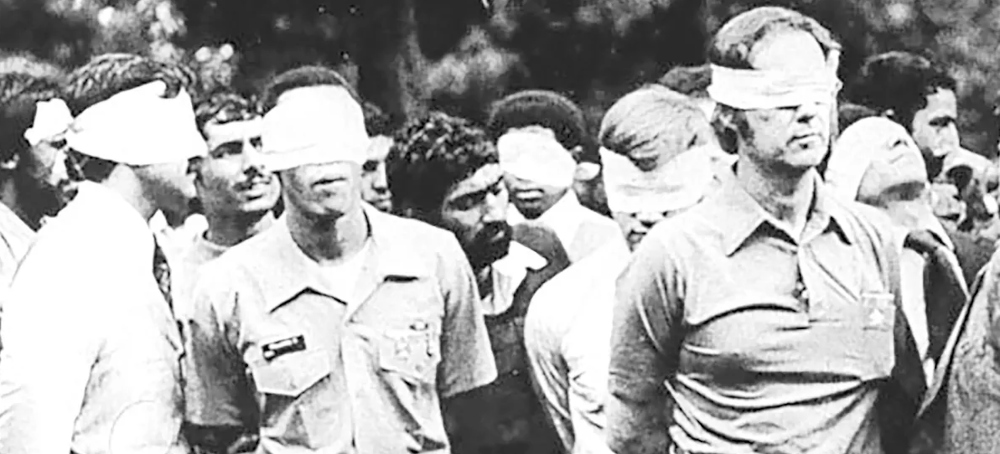 Blindfolded U.S. hostages and their Iranian captors outside the U.S. embassy in Tehran, Iran, 1979. (Photo: Reuters)
 Donald Trump Meet Mohammad Mosaddegh
Marc Ash Reader Supported NewsCommercially refined crude oil has had a relatively short but meteoric life. In less than fifty years it went from a promising energy concept to an indispensable global security commodity. Petroleum based fuels mobilized both the first and second world wars, the most horrific conflicts in human history. Mechanized mobilization meant an exponential expansion in the scope of destruction. Genghis Khan and the Mongol armies by comparison were certainly apocalyptic in their intent but their logistic innovations were the horse and the elephant.
By the end of World War II Iran’s vast oil reserves were highly coveted by the world’s imperial powers. The British had the inside track. The Anglo- Persian Oil Company had purchased nearly total control of Iran’s oil production at the beginning of the twentieth century. In the post World War II-Cold War security environment the British and their American partners had no intention of relinquishing control.
Dr. Mohammad Mosaddegh was a firebrand and a Persian nationalist. But he was also an institutionalist, someone who believed in parliamentary process. Popular support drove his political rise and parliamentary process lifted him to become Prime Minister of Iran. Mosaddegh believed that Iran (Persia) must be for Iranians and that included its oil reserves. Moreover he believed in Iran’s inherent right to sovereignty. That is where Mosaddegh like Fidel Castro, Hugo Chávez and Nicolás Maduro who followed him and many like minded leaders ran afoul of imperial global powers. Specifically Western imperial powers.
The response from the U.S. and UK was the 1953 Iranian coup d’état. Orchestrated by the CIA and the British MI6. By today’s standards the overthrow of Mosaddegh was relatively quick and the bloodshed limited. The Western friendly monarchist Shah, Mohammad Reza Pahlavi, who Mosaddegh had outmaneuvered politically was restored to power and the goals of the American and British were seemingly achieved. Mosaddegh’s grip on parliamentary power was easily derailed. He himself was placed under long-term detention and died in relative obscurity from cancer in 1967. However his dream of home-rule remained in the hearts and minds of Iranians.
By Western standards Shah Mohammad Reza Pahlavi was forward thinking and progressive. He marginalized — some might say repressed — Iran’s religious hard liners. Vanquished Shia cleric and political agitator Ruhollah Mostafavi Musavi Khomeini, instituted peasant class friendly land reforms, empowered labor and merchant groups and promoted rights, including the right to vote for Iranian women. Social freedoms flourished and Iran seemed poised to become an international partner. But the Shah carried with him the curse of foreign interference in Persian affairs.
Trevor Hunnicutt writing recently for Reuters said, “When the explorer Marco Polo traveled what’s now the Iranian side of the Strait of Hormuz in 13th century Persia, he marveled at the trade-rich waterway but warned about the region’s tricky politics.”
What the American and British operatives planning the overthrow of Mohammad Mosaddegh appear not to have grasped or wanted to grasp was the ambient volatility of the Iranian political environment. It was as fractious as it was factional. Nationalists (Mohammad Mosaddegh), secular progressives (Reza Pahlavi), theocratic fundamentalists (Ruhollah Khomeini) and many other sub groups all exerting pressure.
The American and the British saw what they could achieve in the moment but there is no indication that they gave serious consideration to the long term consequences. With Reza Pahlavi in power, Mohammad Mosaddegh under confinement and Ruhollah Khomeini in exile the short term objectives of the American and British were served.
Ultimately the 1979 overthrow of Shah Mohammad Reza Pahlavi was probably due more to the his own onset of cancer in 1973 than the strength or determination of his political opposition. Unfortunately the care Pahlavi received was sub-par, even for the day and a disease he might otherwise have survived proved fatal. Weakened to the extent that he could no longer appear in public Pahlavi withdrew and fled Iran in a last ditch effort to obtain life saving treatment. It was in his absence, in early 1979 that the Islamic Revolution led by a recently repatriated Khomeini (the first Ayatollah) erupted.
When images of Iranian students storming the U.S. Embassy in Tehran and parading diplomatic staff in front of news cameras unfolded in the American media people saw something that was shocking but without context impossible to comprehend. Why did this happen? Who were these people? Why do they hate us so much?
The problem is that our government had attempted to wade into and tinker with cultures and dynamics that they had no real understanding of with hubris rather than skill. What followed was not only a hostage crisis, but a long term global security threat that has taken the lives of countless U.S. service members and allied fighters, from that day — to this day. The U.S. military was comparatively as superior to Iran’s then as it is now. It didn’t matter then and it won’t matter now.
What is needed in this moment Mr. President is diplomatic skill, a thing for which you have no use.